Thermochromic Inks & Dyes
Fabric Definitions — dye and colour definitions from Apparel Search
Search Apparel Search
At a Glance
Definition: Thermochromic inks and dyes are temperature-sensitive compounds, developed in the 1970s, that temporarily change colour with exposure to heat, in two forms: liquid crystals and leuco dyes.
Category: Fabric Definitions
Thermochromic inks and dyes are temperature-sensitive compounds, developed in the 1970s, that temporarily change colour with exposure to heat. They come in two forms, liquid crystals and leuco dyes; the leuco dyes are easier to work with and allow a greater range of applications, including flat thermometers, battery testers, clothing, and the indicator on bottles of maple syrup that changes colour when the syrup is warm. The property behind them is thermochromism — the ability of a substance to change colour due to a change in temperature — and the most well-known line of clothing to use thermochromics was Hypercolor.
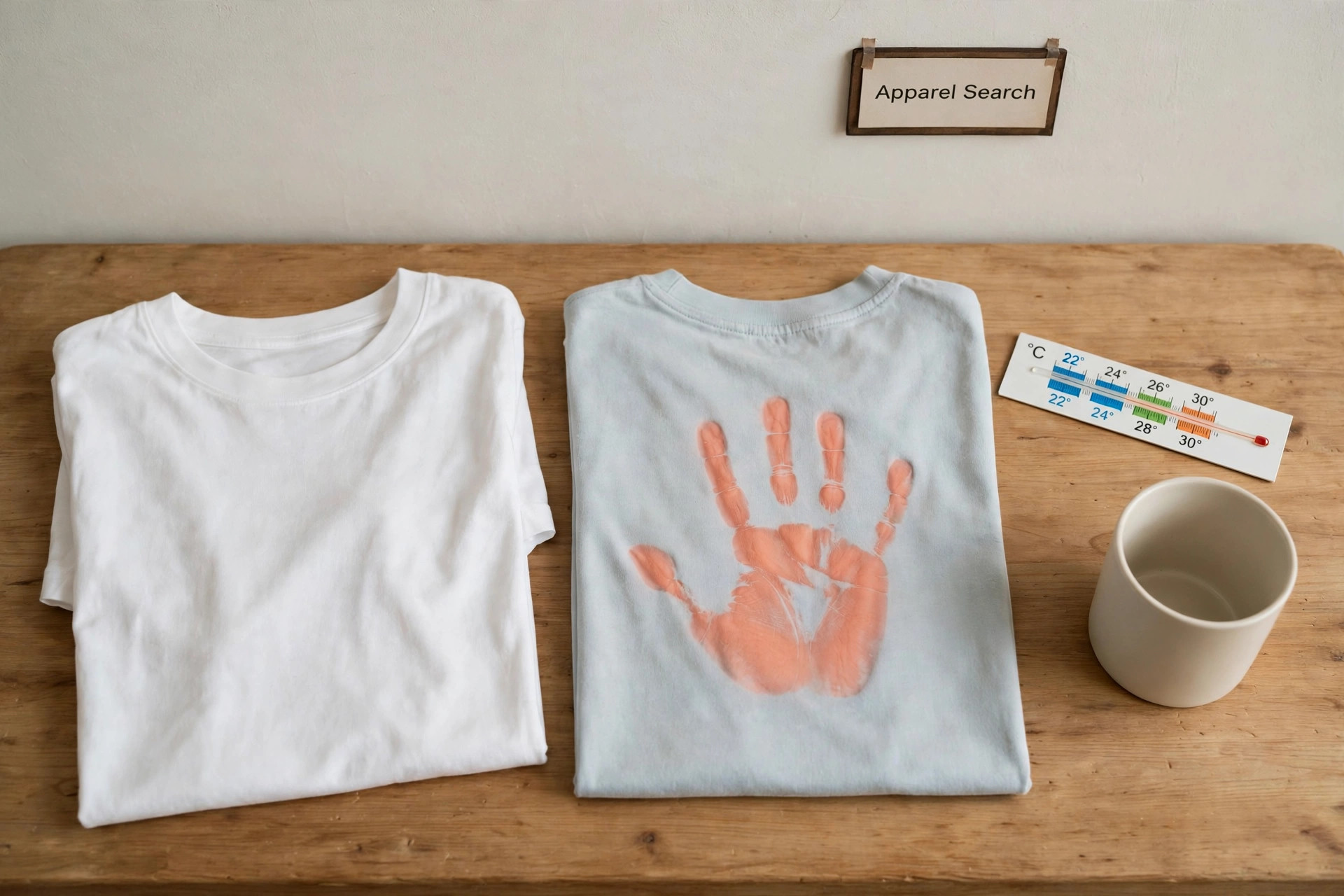
How the Two Systems Change Colour
The two basic approaches rest on different physics. Liquid crystals work by structure: as temperature changes, the spacing of the crystal layers changes, and with it the wavelength of light they reflect, sweeping through a spectrum in sequence. Liquid crystals are therefore used in precision applications, as their responses can be engineered to accurate temperatures — the thermometers used on the exterior of aquariums, or to take a body temperature via the forehead — but their colour range is limited by their principle of operation. Leuco dyes work by chemistry: a dye held in a microcapsule with a solvent is coloured while the solvent is solid and loses its colour when the solvent melts at the design temperature, or the reverse. Leuco dyes allow a wider range of colours to be used, but their response temperatures are more difficult to set with accuracy. Encapsulation lets leuco dyes be printed like ordinary inks onto shirts, mugs, labels and cans — one transition temperature, one colour flip, engineered anywhere from freezer cold to hot-drink heat.
Thermochromics in Clothing
Hypercolor shirts of the late 1980s and early 1990s made the effect a fashion event: body heat from a hand or an armpit visibly changed the garment's colour. The same sensitivity set the limits — the microcapsules degraded with harsh washing, heat and ultraviolet light, so the change weakened over the garment's life. A mood ring is the everyday example of the same principle outside clothing, and the effect also appears in baby bottles that change to a different colour when cool enough to drink, in kettles, and in drinks cans whose thermochromic ink changes from white to blue to indicate the can is cold. Modern clothing applications are more targeted: safety and promotional garments, children's products that signal bath or drink temperature, and novelty prints where a hidden design appears in warmth. In specification terms a thermochromic print must name its activation temperature, its two colour states and its wash limits, because unlike a normal pigment print it is a working mechanism printed onto cloth, not just a colour — compare the ordinary dye classes, whose job is to stay exactly the colour they were applied.
Chromism and the Dye Family
Thermochromism is one of several types of chromism — reversible colour change in response to a stimulus — and thermochromic colorants sit inside the wider dye family as its deliberate exception: every other dye in this section, from indigo to the disperse dyes of sublimation printing, is valued for fastness, for not changing. A thermochromic dye is engineered to change, temporarily and reversibly, and then to change back. That is why its applications divide so cleanly between measurement, where the change must mean an exact temperature, and novelty and signalling, where the change itself is the message. For the production context in which such inks are applied, see dyeing and finishing and the textile dyes guide.
Common Questions
What are the two forms of thermochromic colour?
Liquid crystals and leuco dyes. Liquid crystals are used in precision applications, because their responses can be engineered to react at accurate temperatures. Leuco dyes are easier to work with and allow a greater range of applications, though their response temperatures are more difficult to set with accuracy.
What is thermochromism?
Thermochromism is the ability of a substance to change colour due to a change in temperature, and it is one of several types of chromism. A mood ring is an excellent example, and the effect is also used in baby bottles that change colour when cool enough to drink, and in kettles.
Which clothing made thermochromics famous?
Hypercolor, the line of clothing that changed colour with body heat, was the most well-known clothing application of thermochromic dyes. The same principle is used in reverse on drinks cans whose ink changes from white to blue to show the can is cold.