Quaker Tapestry
Embroidery Definitions — embroidery and needlework definitions from Apparel Search
Search Apparel Search
At a Glance
Definition: The Quaker Tapestry is a work of 77 embroidered panels illustrating the history of Quakerism from the 17th century to the present day, worked in crewel embroidery between 1981 and 1989 and housed at the Friends Meeting House in Kendal, Cumbria.
Category: Embroidery Definitions
The Quaker tapestry tells the history of Quakerism across 77 panels, running from the 17th century to the present day. It was the idea of the Quaker Anne Wynn-Wilson, who designed it, and its permanent home is the Friends Meeting House at Kendal in Cumbria, England. Between 1981 and 1989 some 2,000 men, women and children in 8 countries stitched the panels, working in crewel embroidery. Like the much older cloth that inspired it, the Bayeux tapestry, it is embroidery rather than woven tapestry — a community's history carried in needlework.
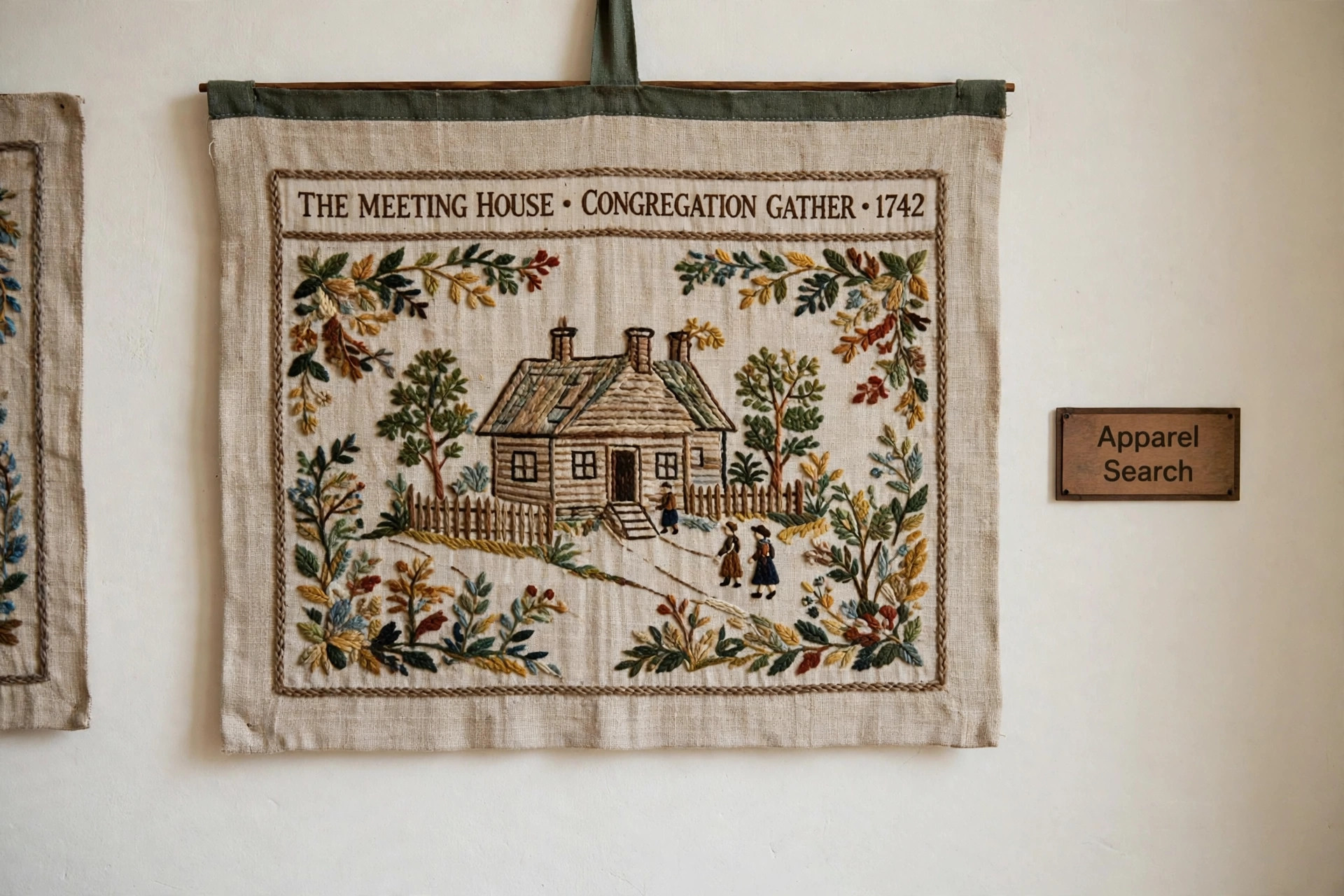
Design: The Bayeux Model
Wynn-Wilson's design leans heavily on the Bayeux cloth, and deliberately so. The panels adopt the same structural choices: each is divided horizontally into three bands; faces and hands are reduced to embroidered outlines; and clothing is filled in solidly, worked in the laid technique used at Bayeux. The grammar scales well — hundreds of historical figures stay readable at a glance — and it lets a visitor follow a long documented history in sequence, image supported by text, much as the Norman cloth does. Each panel measures 25 inches wide by 21 inches tall, a book-page proportion suited to a work administered, in effect, like a book in production.
Stitches, Including One Invented for the Job
The stitching rests on four historic stitches — split stitch, stem stitch, chain stitch and Peking knot — worked in crewel wool. Lettering posed a problem the old vocabulary could not solve: tight curves. Wynn-Wilson answered it by inventing a new corded stitch, the Quaker stitch, designed to turn the small radii that captions and inscriptions demand. The invention is emblematic of the whole project: a practical solution devised by the designer, then adopted by every one of the 2,000 stitchers, so that a new stitch entered the embroidery vocabulary because a community's story needed its words to be legible.
A Community Stitches Its Own History
Most monumental embroideries are commissioned from professionals; this one was deliberately the opposite. Its thousands of makers, spread across 8 countries, were stitching episodes of a history their own meetings and families belonged to — relief work, conscientious objection, the Underground Railway, schools and meeting houses. What held the multitude together was the shared technique: one stitch vocabulary, one design hand, one panel format, so that panels made on different continents read as a single work. The subjects alternate between biography, place and testimony — George Fox's convincement and his travels to Sedbergh, Lichfield and Pendle Hill; Margaret Fell, called the Mother of Quakerism; John Woolman; Elizabeth Fry and her patchwork quilts; the Friends Ambulance Unit; Quaker merchants, botanists, doctors and scientists; the Great Hunger; the World Conference of 1991 — closing with a final panel of the world family of Friends.
Panels Listed Like Chapters
The panel list itself reflects the method of making. The panels run in lettered and numbered sequences — A1 onwards through F22 and beyond, framed by a title panel, The Prism, and the final World Family and Friends panel — because a work of 77 panels by 2,000 hands had to be assigned, stitched and checked like chapters. The arrangement lets the tapestry be read at two speeds: a visitor can follow the whole story in an hour, or spend that hour on a single panel. Its setting completes the argument — a working Friends Meeting House at Kendal rather than museum glass — keeping the cloth in the community it was made by and for. For the wider family, see embroidery, the embroidery stitch definitions, counted-thread embroidery and drawn thread work.
Common Questions
How was the Quaker tapestry designed?
Its design was heavily influenced by the Bayeux tapestry, with similar choices: three horizontal divisions within panels, embroidered outlines for faces and hands, and solid infilling of clothing worked in the Bayeux technique. Each panel measures 25 inches wide by 21 inches tall.
What is Quaker stitch?
Quaker stitch is a new corded stitch invented by Anne Wynn-Wilson for this tapestry, to allow for tight curves on the lettering. The tapestry otherwise uses four historic stitches: split stitch, stem stitch, chain stitch and Peking knot.
What do the 77 panels depict?
The history of Quakerism from the 17th century to the present: George Fox's convincement and travels, Margaret Fell, meeting houses and Quaker schools, conscientious objection, Elizabeth Fry and criminal justice, relief work and the Friends Ambulance Unit, Quaker merchants, scientists and botanists, and the World Conference of 1991, closing with a World Family and Friends final panel.