Bayeux Tapestry
Embroidery Definitions — embroidery and needlework definitions from Apparel Search
Search Apparel Search
At a Glance
Definition: The Bayeux Tapestry is an embroidered cloth about 50 cm high and 70 m long that depicts the events leading to the Norman Conquest and the Battle of Hastings in 1066, captioned in Latin.
Also known as: Tapisserie de Bayeux (French); in France it is occasionally called La Tapisserie de la Reine Mathilde — the Tapestry of Queen Matilda
Pronunciation: BY-yer
Category: Embroidery Definitions
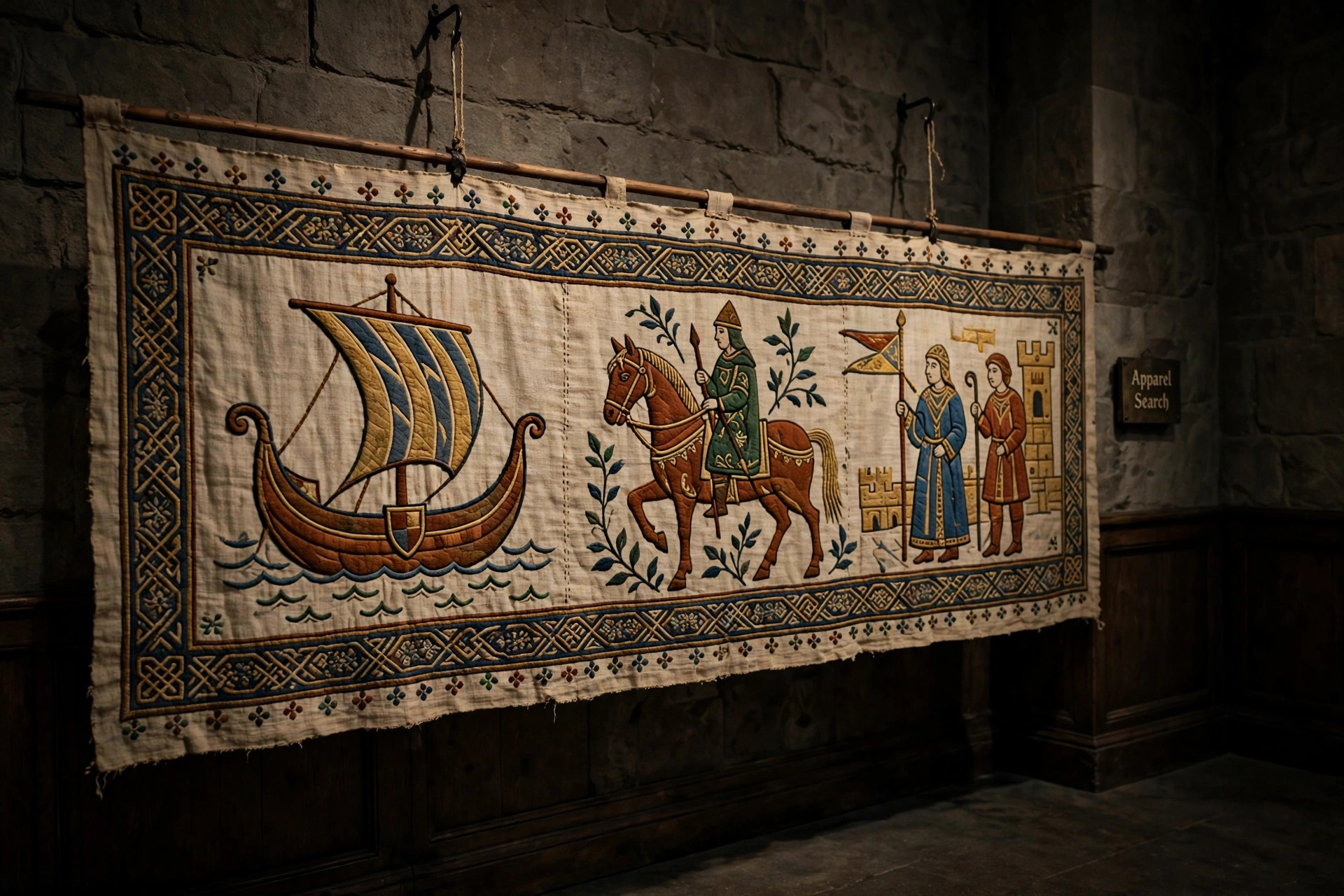
The Bayeux tapestry is a band of embroidered cloth roughly 50 cm (20 in) deep and 70 m (230 ft) long, worked with scenes of the Norman Conquest of England and the Battle of Hastings in 1066 and captioned throughout in Latin. Despite its name it is not a tapestry in the technical sense — nothing in it is woven to form the picture; the images are stitched in wool onto a linen ground. It is now displayed in a dedicated museum at Bayeux in Normandy, France, and the earliest written reference to it is an inventory of Bayeux Cathedral drawn up in 1476. Who ordered it, and where it was made, have been argued over ever since.
On This Page
Who Commissioned It — Matilda or Odo?
French tradition long held that the cloth was commissioned and made by Queen Matilda, wife of William the Conqueror, together with her ladies — hence its occasional French name, the Tapestry of Queen Matilda. Scholarly analysis during the 20th century shifted the weight of opinion to William's half-brother, Bishop Odo. Three of Odo's followers who are named in Domesday Book appear in the embroidery; the cloth was kept at Bayeux Cathedral, a building Odo himself raised; and it may have been ordered alongside the cathedral's construction in the 1070s, finished by 1077 in time for the dedication. A further candidate has been put forward more recently by the art historian Carola Hicks: Edith of Wessex. The work remains a French national treasure, and its probable English workmanship keeps the argument alive.
Made in England
If Odo was the patron, the design and making most likely happened in England at Anglo-Saxon hands. Odo's power was centred on Kent; the Latin of the captions carries hints of Anglo-Saxon usage; other embroideries of the period come from England; and the vegetable dyes used can be matched to cloth traditionally produced there. The stitching itself would have fallen to skilled needleworkers — the period did not require them to be women, and the later opus Anglicanum from the same region was made by men and women alike — with the monks of St Augustine's Abbey at Canterbury a plausible workshop. The technique is economical: outlines and details in stem stitch, with the broad areas of colour laid down and couched in the laid work now called the Bayeux technique — the same combination the Quaker tapestry would borrow nine centuries later.
The Story the Cloth Tells
The embroidery opens with King Edward of England, who has no heir, sending Harold Godwinson — the most powerful earl in the country — to his cousin William of Normandy with word that William is chosen as the next king. Crossing the Channel, Harold is storm-driven off course and taken prisoner by Guy, Count of Ponthieu; William demands his release and receives him as a guest. Harold campaigns at William's side, at one point dragging two Norman soldiers out of quicksand near Mont St Michel, and the two men celebrate their victory together before Harold swears on the bones of saints — on holy relics — to support William's claim to the English throne. He then sails home, and in due course is himself crowned.
Some months later a hairy star appears — Halley's Comet, first seen on 24 April, nearly four months after Harold's coronation — and to medieval eyes a comet warned of doom. Across the Channel, William hears that he has been betrayed and resolves to take England by force. A fleet is built, held back for a time by contrary winds, and then crosses in what amounts to a D-Day in reverse: an invasion force of roughly 7,000 men landing unopposed. While Harold is in the north defeating the Norwegian king Harald Hardraada — the last Viking invasion of England, whose defeat still left the English weakened — the Normans build a castle, pillage the countryside and burn homesteads to draw him south.
The battle is joined on 14 October 1066, about 105 km (65 mi) from London, Harold's men having marched from Stamford Bridge in three days and arriving exhausted. The armies are evenly matched. Archers open at about a hundred yards to little effect against the English shield wall; knights charge; a Norman retreat draws some of Harold's men out of position against his orders. When William's horse is killed and a rumour runs that he himself is dead, he pushes back his helmet and shows his face, declaring that he still lives and will yet be the victor. As the day wears on the English weaken, Norman knights kill Harold, and leaderless, the English flee. Throughout, the two sides are told apart by the customs of the day: the Normans wear the backs of their heads shaved, the Anglo-Saxons wear moustaches. William was crowned king of England on Christmas Day by Archbishop Ealdred of York, and Matilda was crowned 17 months later; the embroidery itself does not show these events.
Survival, Seizures and Display
For centuries the cloth was brought out once a year at Bayeux for the Feast of the Relics. It resurfaced to scholarly attention in the late 17th century, and engravings of it were published by Bernard de Montfaucon in the 1730s. During the Revolution, men from Bayeux fighting for the Republic wanted to use it as a cover for an ammunition wagon; a lawyer who understood what it was saved it by substituting another cloth. Napoleon seized it in 1803 and carried it to Paris as inspiration for his own planned invasion of England; when that plan was abandoned the cloth went back to Bayeux, where the townspeople kept it wound up like a scroll. Seized again by the Ahnenerbe, it spent much of the Second World War in the basement of the Louvre. Today it is protected in a darkened room, under special lighting and behind sealed glass, to limit damage from light and air.
Mysteries and Reliability
The work is incomplete and partly unexplained. At least two panels are missing — perhaps another 6.4 m (7 yards) — and the lost ending would probably have shown William's coronation; the modern artist Jan Messent has attempted a reconstruction. One scene shows what appears to be a clergyman striking a woman, under an inscription nobody can now interpret; historians guess it records a scandal of the day so well known that it needed no explanation. The death of Harold is disputed: the figure traditionally identified as Harold is struck in the eye by an arrow, and the words Harold Rex stand above his head — but the arrow is absent from Montfaucon's 1729 engravings and may be a later repair, while the following scene, labelled with words meaning "he is killed", shows a figure cut down by a sword. Medieval symbolism expected a perjurer to die by a weapon through the eye, which suits the cloth's argument that Harold broke his oath. Read as history, the tapestry is advocacy as much as record — yet as a visual document of medieval arms, apparel and everyday objects it has no surviving rival, even allowing for oddities such as warriors shown fighting bare-handed where other sources indicate the general use of gloves in battle and the hunt.
Copies, Parodies and Screen Life
The cloth has been imitated for as long as it has been famous. Later embroideries on invasion themes — the Overlord embroidery at Portsmouth among them — consciously parody and honour it, and a full-size replica, finished in 1886, is exhibited at the Museum of Reading in Reading, Berkshire. Sections of the tapestry supplied the opening credits of Robin Hood: Prince of Thieves and appear in Disney's Bedknobs and Broomsticks, and in the internet era its style has become a widely copied visual language, its images re-captioned in imitation Middle English as homage to other stories. For the stitches it uses, see the embroidery stitch definitions, and for the counted and drawn techniques catalogued alongside it, counted-thread embroidery and drawn thread work.
Common Questions
Who commissioned the Bayeux tapestry?
French tradition assumed it was commissioned and created by Queen Matilda, William the Conqueror's wife, and her ladies, and in France it is occasionally called the tapestry of Queen Matilda. Scholarly analysis in the 20th century points instead to William's half brother Bishop Odo: three of Odo's followers named in Domesday Book appear on the tapestry, it was found in Bayeux Cathedral, which Odo built, and it may have been made for the cathedral's dedication in 1077.
Where was the Bayeux tapestry actually made?
If Odo commissioned it, it was probably designed and constructed in England by Anglo-Saxon artists: Odo's power base was in Kent, the Latin text contains hints of Anglo-Saxon, other embroideries originate from England at this time, and the vegetable dyes match cloth traditionally woven there. The stitching was most likely done by skilled workers, possibly at St Augustine's Abbey, Canterbury.
Is the Bayeux tapestry really a tapestry?
No. The Bayeux tapestry is not tapestry as such: it is embroidered cloth, while a tapestry is woven. Its wool designs are stitched onto a linen ground — in laid work and stem stitch — rather than formed by the warp and weft of a loom.