Thimble
Sewing Definitions — stitches, seams, quilting and sewing terms from Apparel Search
A thimble is a protective shield worn on the finger or thumb. Originally thimbles were used solely for pushing a needle through fabric or leather as it was being sewn, and for that job the thimble's dimpled surface grips the end of the needle while its hard cap takes the pressure, letting the sewer drive the needle through resistant material without injury. The earliest thimble was Roman and found at Pompeii, made of bronze and dated to the first century AD. Thimbles are most usually made from metal, leather, rubber, wood, glass or china, and early thimbles were sometimes made from bone, horn or ivory.
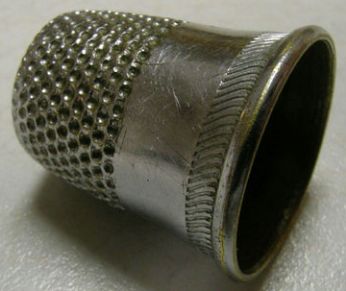 The earliest
thimble was Roman and found
at Pompeii. Made of bronze,
it has been dated to the
first century AD. A Roman
thimble was also found at
Verulamium, present day
St Albans, in the UK and
can be seen in the museum
there. Thimbles are most
usually made from metal,
leather,
rubber, wood, glass or
china.
Early thimbles were sometimes
made from bone, horn or
ivory.
Originally thimbles were used solely for pushing a needle through fabric or leather as it was being sewn. However they have since gained many other uses. In the 1800s they were used to measure spirits (hence the phrase "just a thimbleful"). Women of the night used them in the practice of thimble-knocking where they would tap on a window to announce their presence. Thimble-knocking also refers to the practice of Victorian schoolmistresses who would tap on the heads of unruly pupils with dames thimbles.
Before the 18th century the small dimples on the outside of a thimble were made by hand punching but in the middle of that century, a machine was invented to do the job. If you find a thimble with an irregular pattern of dimples, it was probably made before the 1850s. Another consequence of the mechanisation of thimble production is that the shape and the thickness of the metal changed. Early thimbles tend to be quite thick and to have a pronounced dome on the top. The metal on later ones is thinner and the top is flatter.
Collecting thimbles became popular in the UK when many companies made special thimbles to commemorate the Great Exhibition held in the Crystal Palace in Hyde Park, London.
In the 19th century many thimbles were made from silver. Because this is a soft metal, it is easily pierced by a steel needle. Charles Horner solved the problem by using a steel core covered inside and out by silver. The result was still as pretty as a traditional silver thimble but more practical and durable. He called his thimble the Dorcas and these are now popular with collectors.
During the First World War silver thimbles were collected from "those who had nothing to give" by the British government and melted down to buy hospital equipment. In the 1930s and 40s red-topped thimbles were used for advertising. Leaving a sandalwood thimble in a fabric stores helps to keep moths away. Thimbles have also been used as love-tokens and to commemorate important events. A miniature thimble is one of the tokens in the game of Monopoly.
People who collect thimbles are known as digitabulists.
The English Patient makes
profound use of the thimble
from both literal and symbolic
perspectives.
| Clothing & Fashion Industry Definitions |
| fabric & Textile Industry Definitions |
| Sewing Terms & Sewing Definitions |
| yarns & yarn Industry Definitions |
| The above article is licensed under the GNU Free Documentation License. From Wikipedia, the free encyclopedia (https://en.wikipedia.org/wiki/thimble). 9/6/06 |
| Clothing Industry |
| Fashion Models Fashion Newspaper |
A Small Shield With a Two-Thousand-Year HistoryHand sewing asks the middle finger to do something unreasonable: push the blunt end of a needle, thousands of times a day, through cloth that resists it. The thimble is the armour for that fingertip, a cap of hard material whose dimples catch the needle's end and keep it from slipping sideways into the finger. The Roman thimble from Pompeii, bronze and dated to the first century AD, shows the design was already settled in antiquity: a domed cap with a pitted surface. A Roman thimble was also found at Verulamium, modern St Albans, and can be seen in the museum there. Sailmakers, tailors and quilters developed their own forms, including the open-ended tailor's thimble and the palm thimble or sailmaker's palm that pushes heavy needles through canvas and leather, the work described under the stitching awl's companion trades. Manufacture left evidence collectors still read. Before the 18th century the small dimples on the outside of a thimble were made by hand punching; in the middle of that century a machine was invented to do the job, so a thimble with an irregular dimple pattern was probably made before the 1850s. Mechanisation also changed shape and thickness: early thimbles tend to be quite thick with a pronounced dome, while the metal on later ones is thinner and the top flatter. Silver thimbles, common in the 19th century, had a practical flaw, since silver is soft and easily pierced by a steel needle; Charles Horner solved the problem with a steel core covered inside and out by silver, producing the Dorcas thimble, pretty as a silver thimble but durable, and now popular with collectors. Measures, Tokens and CollectorsA tool carried by everyone gathers extra meanings. In the 1800s thimbles were used to measure spirits, hence the phrase just a thimbleful. Victorian schoolmistresses practised thimble-knocking, tapping unruly pupils on the head with dame's thimbles, and the same word names a quite different tapping on windows. Thimbles have been used as love-tokens and to commemorate important events; collecting became popular in the UK when many companies made special thimbles to commemorate the Great Exhibition at the Crystal Palace. During the First World War, silver thimbles were collected from those who had nothing to give by the British government and melted down to buy hospital equipment, and in the 1930s and 40s red-topped thimbles carried advertising. A sandalwood thimble left in fabric stores is said to help keep moths away, and a miniature thimble is one of the tokens in the game of Monopoly. Modern sewers choose among metal, leather, rubber and silicone thimbles, including soft leather palm guards for quilting and adhesive dot thimbles for a single fingertip, but the working principle is unchanged since Pompeii. Of all the tools in this section of sewing definitions, the thimble is the only one worn rather than held, and the only one whose purpose is to protect the worker rather than act on the work, a reminder that sewing has always been skilled manual labour performed by hands worth protecting. Common QuestionsWhat is a thimble used for?A thimble is a protective shield worn on the finger or thumb, used for pushing a needle through fabric or leather as it is being sewn. Its dimpled surface steadies the needle's end while the hard cap takes the pressure. How old are thimbles?The earliest thimble was Roman, found at Pompeii, made of bronze and dated to the first century AD. Another Roman thimble was found at Verulamium, present-day St Albans in the UK. What are people who collect thimbles called?People who collect thimbles are known as digitabulists. Collecting became popular in the UK when companies made special thimbles to commemorate the Great Exhibition at the Crystal Palace in Hyde Park, London. More to ExploreMore from Apparel Search: Sewing Definitions | Clothing Industry Glossary | Fashion Terms | Apparel Search Home
|