Denim Fabric Guide
Denim Washes & Finishes
Stone, enzyme, acid, bleach, sanding, resin and laser — the factory processes that turn dark loom-state cloth into finished jeans
Almost no jeans are sold in the state they leave the loom. Between weaving and the store shelf, most denim passes through an industrial laundry where a battery of washing and finishing processes decides its color, softness and surface character. This page of the Denim Fabric Guide covers those treatments strictly as processes — what each one does to the fabric and why a laundry chooses it. For the garment-side view of the finished styles, the shopping companions are the Men's Denim Washes & Finishes Guide and the Women's Denim Washes & Finishes Guide.
Wash and finish: in denim production, a "wash" is any wet treatment applied to the sewn garment (or fabric) after manufacture, and a "finish" is any process — wet or dry — that changes its final hand feel, color or surface. Desizing, stone washing and enzyme washing are washes; hand sanding, resin setting and laser etching are dry finishes. Most commercial jeans receive several in sequence.
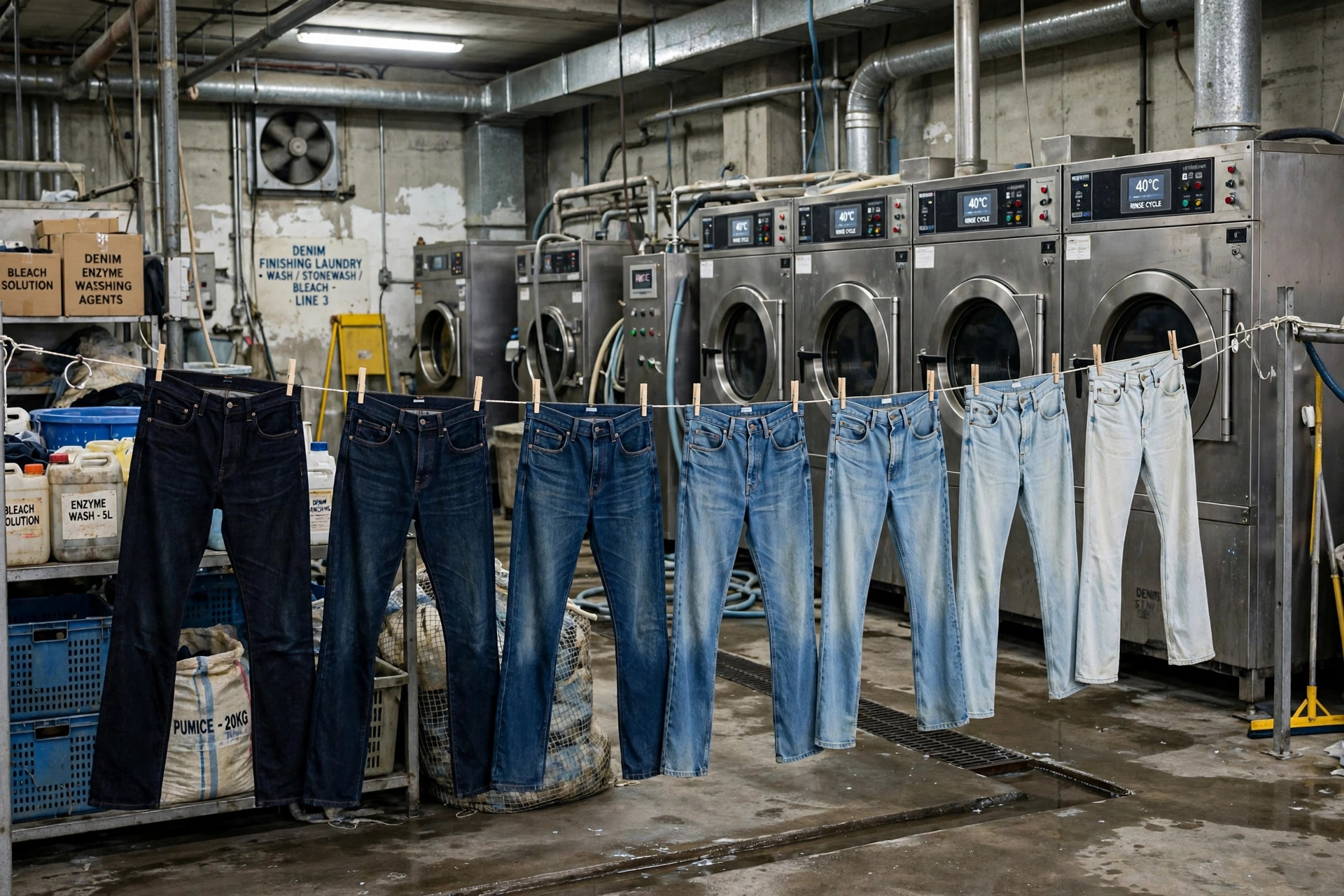
Desizing and the Rinse Wash
Every wet process starts with desizing: the starch and sizing applied to warp yarns for weaving must come out before dye can leave the fabric evenly. The simplest complete treatment is the rinse wash — one desize and rinse cycle that removes starch, takes out a little loose indigo, and shrinks the garment to size. A rinse-washed jean stays dark and crisp-looking but feels wearable, and it is the closest factory equivalent to buying raw denim and washing it once at home.
Stone Washing and Enzyme Washing
Stone washing tumbles garments with pumice stones in industrial machines. The abrasive stones knock indigo off the raised parts of the twill, producing the familiar faded blue and a softened hand — at a cost. Pumice wears machines, generates sludge, damages garments unevenly and must literally be shaken out of every pocket. Enzyme washing, developed as the cleaner alternative, uses cellulase enzymes that digest surface cotton fiber and free the indigo attached to it. Enzymes deliver a comparable faded effect with less fabric damage and no stones, and the two are often combined: a short stone cycle plus enzymes, tuned to the target shade. Either way, the process is controlled by time, temperature and load — a few minutes separate a light stonewash from a heavily abraded one.
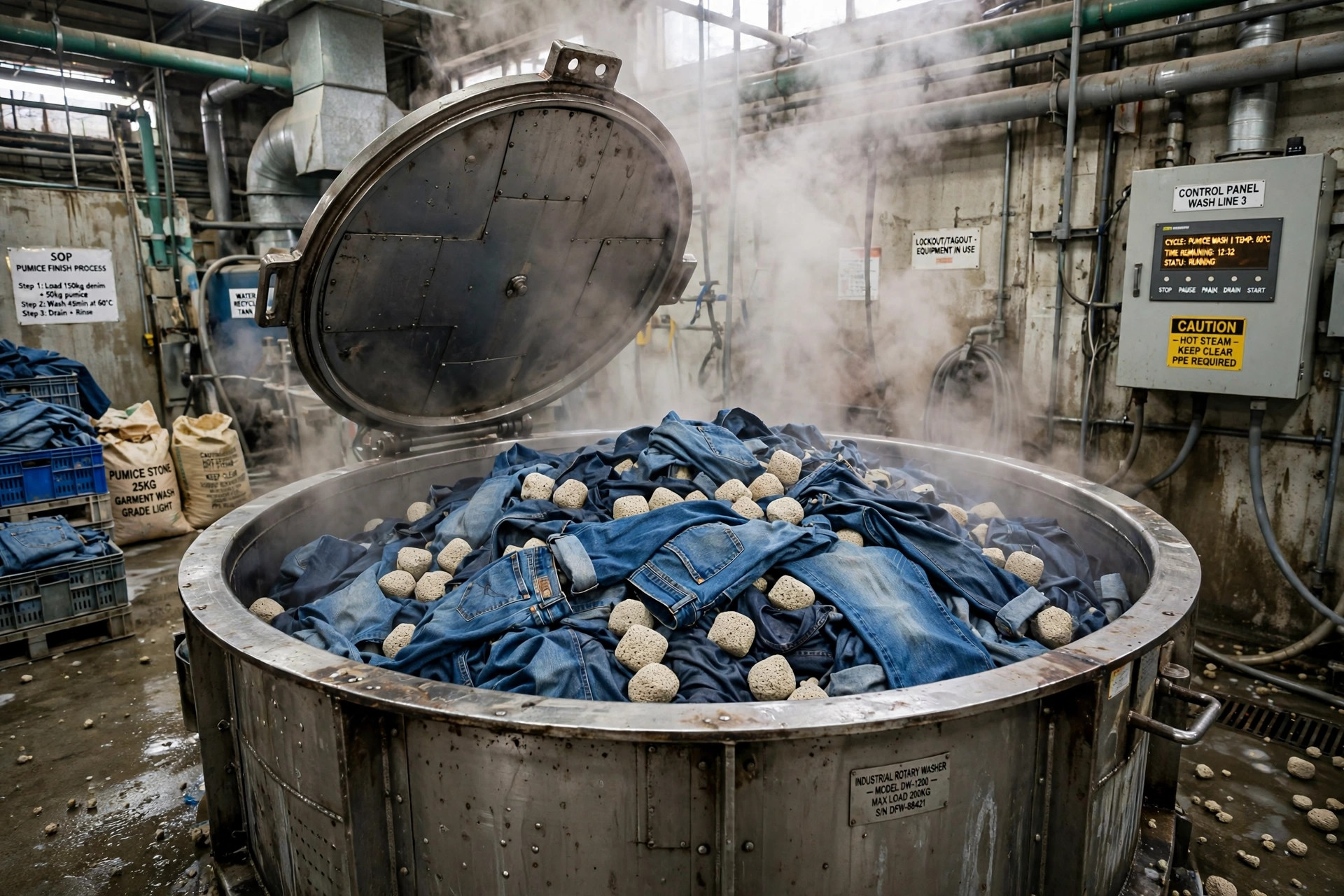
Acid Wash, Bleach and Color Removal
Acid wash is a stonewash variant in which the pumice is soaked in a bleach solution (historically potassium permanganate or sodium hypochlorite) before tumbling; the stones discharge color in random patches, leaving the marbled, high-contrast snow-wash pattern of the 1980s. Full bleach washes immerse the garment to push the shade toward pale blue or near-white, and must be carefully neutralized to stop the chemical attack on the cotton. Potassium permanganate spray, applied by hand gun to thighs and seat, lightens selected areas and is then neutralized — a step increasingly replaced by laser for both precision and worker safety.
Dry Finishes: Sanding, Whiskers and Resin
Before or between washes, laundries add localized wear by hand. Workers sand the fronts of thighs and seats with abrasive tools, scrape creases at the hips to suggest whiskers, and abrade hems and pocket edges. Three-dimensional whiskers and creases are set by applying resin to the arranged folds and curing the garment with heat, so the pattern survives washing. Traditional sandblasting — spraying garments with abrasive sand — produced strong effects but caused silicosis in workers and has been banned or abandoned by most of the industry; its look is now achieved with hand sanding and laser.
Laser and Ozone: The Modern Laundry
Laser finishing draws fade patterns with a computer-guided beam that vaporizes surface indigo: whiskers, honeycombs and all-over fading are designed on screen and reproduced identically on every garment, in under a minute each, with almost no water. Ozone finishing fades garments with ozone gas in a sealed chamber, achieving bleach-type lightening without liquid chemicals. Together with water-recycling and enzyme processes, these technologies define the modern low-impact laundry — and they change the fabric less brutally than the pumice-and-bleach era did. At home, the gentler end of this spectrum is what sensible washing preserves; see Denim Care & Shrinkage for how domestic washing continues — or undoes — the factory's work.
Process order matters: a typical fashion jean might be desized, hand-sanded, sprayed, stone-and-enzyme washed, tinted, resin-set and softened in sequence. Each step is a cost line in production, which is why heavily finished jeans can cost more to make than better cloth left plain.
More in the Denim Fabric Guide
Common Questions
What is enzyme washing in denim?
Enzyme washing uses cellulase enzymes to digest a fine layer of cotton fiber on the fabric surface, releasing indigo and softening the cloth. It achieves much of the faded, softened effect of stone washing with less damage to the fabric, less sludge in the water, and no pumice to wash out of pockets and machines.
Do washes and finishes weaken denim?
Aggressive ones do. Stone washing, bleaching and sanding all remove fiber or attack the cotton, so a heavily processed jean starts life measurably weaker than the same cloth left raw. Gentler processes — a plain rinse wash or a light enzyme treatment — have little effect on strength. The more destroyed the look, the shorter the garment's remaining life tends to be.
What is laser-finished denim?
A computer-guided laser burns away the indigo surface of the fabric to draw whiskers, fading and worn patterns designed on screen. It replaces hand sanding and much chemical processing, uses almost no water, and produces identical results from garment to garment — which is why large brands have adopted it for both quality control and sustainability reasons.
Back to the Denim Fabric Guide
Finishing is the last step of making denim. Return to the hub for the whole process — weights, weave, raw and selvedge cloth, and care.
Back to the Denim Fabric Guide