Apparel Search · Fabric Construction Guide
Double Cloth: Two Complete Fabrics Woven as One
Two warps and two wefts on one loom weave two complete cloths at the same time, one above the other, stitched together as they form — the structure behind reversible coats, heavy blankets and double-faced cloth.
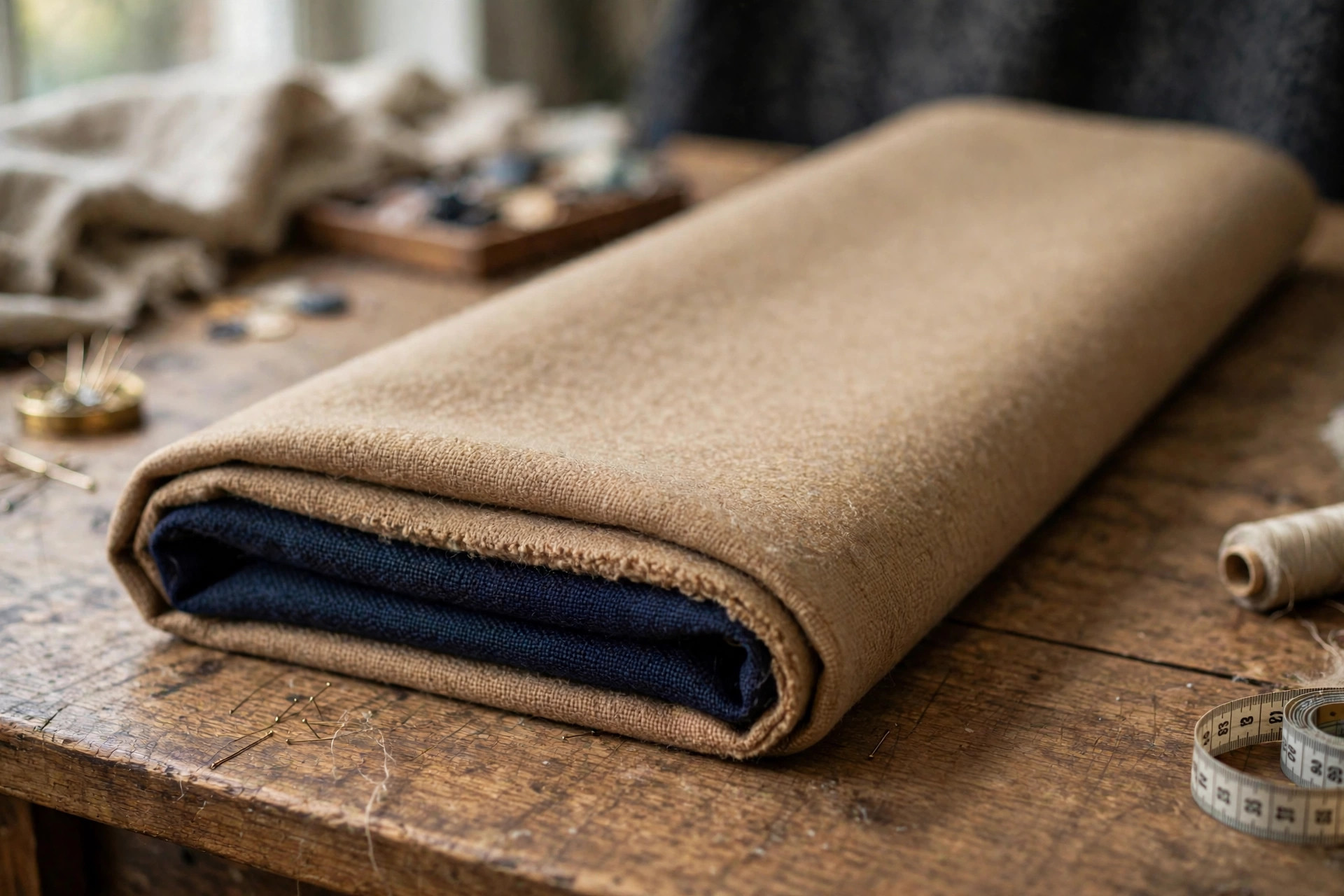
Most woven fabrics are a single layer of interlaced yarn. Double cloth refuses that economy. On the loom, two complete fabrics form at the same moment, one floating above the other, each with its own warp threads and its own weft picks — and at planned points the two layers trade yarns and stitch themselves together, so what comes off the loom is a single, thick, genuinely two-faced cloth. A coat cut from it can be camel on the outside and navy inside, finished on both faces, with no lining anywhere. This page of the Weaving & Woven Fabric Construction guide explains how the trick is worked; if the single-layer structures are new to you, start with Basic Weave Structures, because each layer is usually one of those familiar weaves — plain weave or a simple twill — woven twice over.
The structure is old and entirely practical. Before central heating, a blanket that was effectively two blankets joined in the weaving was a serious household asset, and a reversible coat gave its owner two garments for one cutting. Some cloths, too, need a hard-wearing face and a soft back, and weaving the two together bonds them more honestly than any later gluing or sewing can. Everything distinctive about double cloth — its weight, warmth, price and two finished faces — follows from that one decision to weave two fabrics instead of one.
Double Cloth, Defined
Double cloth (also called double weave) is a fabric woven on one loom from two warp systems and two weft systems, forming two complete cloths simultaneously, one above the other. The layers are joined during weaving — by their own yarns exchanging places at stitching points, or by an extra binder yarn — so the result is one fabric with two fully finished, often different, faces.
How the Interlacing Works: Two Cloths, One Loom
A double-cloth loom carries two warp systems, normally on two separate warp beams so each can be tensioned and delivered at its own rate, and it inserts two weft systems pick by pick. The harness motion keeps the systems apart. When a face pick is inserted, the face ends lift and interlace in their own pattern while every back end is held down below the shuttle path. When a back pick follows, the back ends form their own shed above the lowered face ends and weave their own cloth in the lower layer. Pick by pick, layer by layer, two fabrics grow in the same few millimetres of space — most commonly plain weave in both layers, or a twill in one or both where drape or a diagonal face is wanted.
Nothing in either layer, taken alone, is exotic. The skill lies in the separation: ends or picks that stray into the wrong layer show instantly as defects, so the shedding plan must park each system cleanly while the other weaves. And because the loom makes two fabrics in the time of one, weaving is slower and the cloth consumes roughly twice the yarn of a single fabric — the first reasons double cloth has always been a premium construction.
Read the cross-section from the side and the structure becomes plain. The upper wavy line is the face warp undulating over and under its own weft; the lower line is the back warp doing the same in its own layer. Between stitching points the two cloths are independent, with a real gap between them. Only where the gold dashes cross are the fabrics actually connected — which is why the joining method, covered next, decides so much of the finished cloth's character.
How the Two Cloths Are Joined
The simplest stitching method uses the cloths' own yarns. At a planned point, a face warp end dives down and interlaces once with the back cloth, or a back end rises into the face, and the exchange ties the layers together before each yarn returns to its own fabric. Done with warp ends in one area and weft picks in another, the exchanges distribute so evenly that neither face shows more than a pin-point mark. Designers can even make the stitching part of the design: points where the layers swap outline checks and spots, because an end that changes layers also changes which colour shows on the face.
The second method adds a dedicated binder yarn — a finer extra warp that weaves into the face cloth for a few picks, crosses the gap, weaves into the back cloth, and repeats. A binder gives a firm, regular join that does not disturb the pattern of either face, at the cost of a fifth yarn system to feed. Whichever method is chosen, stitch spacing is a balance: too far apart and the layers bag and shift in wear; too close and the fabric stiffens, the faces dimple at every stitch, and the point of two independent cloths is lost.
Joining can also be rationed to the edges, or withheld in patches, and then double weaving becomes a shaping tool. Stitch only along two selvedges and the loom produces a seamless woven tube. Stitch around a rectangle and leave the middle free and the cloth contains a pocket — the principle behind pockets formed in the cloth itself, double-width fabrics woven folded and opened flat, and some industrial filter constructions. The same family produces the most famous double-woven fabric of all: velvet, woven as two ground cloths face to face with pile yarns travelling between them, then sliced apart so one loom run yields two velvets. Its cut-pile relative is covered in the corduroy fabric guide.
Structure and Properties
Thickness is the first property anyone notices. Two complete cloths plus the air gap between them make double cloth substantially thicker and heavier than any single fabric of comparable yarn, and that trapped still air is a genuine insulator, so the cloth is warm out of proportion even to its weight. The two faces are fully finished in the weaving, not raw undersides: each can carry its own colour, weave and pattern, which is why a double-cloth garment needs no lining — the inside is already a presentable fabric, chosen by the weaver rather than exposed by accident. Reversibility follows naturally: turn the garment and the second face becomes the outside.
The structure is stable and hard-wearing for the same reason it is expensive: yarns are locked in two interlaced layers, the stitching stops the layers shearing against each other, and there is a great deal of material to wear through. Against that stand the costs — roughly double the yarn, slower weaving on a more complex set-up, and a weight not every garment wants. Double cloth is chosen deliberately, where its bundle of properties — warmth, body, two finished faces — is exactly what the end use requires.
Fabrics and End Uses
The signature product is the reversible coat or jacket: wool double cloth with one colour outside and a contrast inside, its edges finished so both faces can show at collar, cuff and vent. Blankets and throws are the second classic use, woven with a pattern on one face and its colour-reversed twin on the other. Double-faced suiting uses a finer version, giving cloth with a clean inside that can be left unlined. Upholstery exploits the body and abrasion resistance, and industry uses heavy double constructions in belting and felts, where layers stitched in the loom outlast a single thick weave and cannot delaminate, because there is no adhesive to fail. The pattern is constant: double cloth is specified where one cloth would need a partner — a lining, a backing, a second blanket — and the structure supplies that partner itself.
How to Recognize Double Cloth
Start with the two faces. A true double cloth shows two genuinely different, fully woven surfaces — different colours, often different patterns — and real thickness between them. At a cut or frayed corner, tease the layers gently with a pin: in a double cloth they separate and open like the covers of a book everywhere except at the stitching points, where yarns visibly cross and hold them. That test separates double cloth from its look-alikes. A bonded or laminated fabric also has two faces, but its layers are glued; teased apart they peel with a film or foam residue, and the join is a coating, not yarns. A double-faced twill, despite the confusingly similar name, is a single cloth whose two sides differ only because of the twill's geometry — there is no second layer to tease open at all.
| Fabric | How it is made | Can the layers separate? | The two faces |
|---|---|---|---|
| Double cloth | Two complete fabrics woven at once on one loom and stitched together by their own yarns or a binder | Yes — the layers tease apart everywhere except at the woven stitching points | Two fully finished woven faces; colours and patterns can differ completely |
| Bonded / laminated fabric | Two ready-made fabrics (or fabric and foam or film) glued together after weaving | Only by peeling the adhesive, which leaves film or foam residue | Whatever the two glued components show; the join is a coating, not weaving |
| Double-faced twill | One single cloth woven in a twill whose face and back present differently | No — there is only one layer of cloth | Two looks from one fabric; no second cloth exists inside |
Weight confirms the verdict: double cloth carries roughly twice the material of a single cloth of similar yarn, and feels it. Combined with the teasing test and the two finished faces, that heft makes this one of the easier advanced weaves to identify with confidence.
More Weave Structures
Common Questions
How are the two layers held together?
At planned stitching points the two cloths exchange yarns as they weave: a face end dips to bind into the back cloth, a back end rises into the face, or an extra binder yarn travels between them tying them together. The stitches are woven in, not sewn or glued afterwards, so the fabric behaves as one cloth and the layers separate only where the stitching pattern leaves them free.
Is double cloth the same as double-faced fabric?
No. Double cloth is two complete fabrics woven at once and stitched together, so its two layers can be teased apart at a cut edge, except at the stitching points. A double-faced fabric is a single cloth, often a twill, whose two sides look different — there is no second layer inside it.
Why is double cloth so warm?
Warmth comes from still air, and double cloth traps a layer of it between its two woven faces. Two complete cloths also put roughly twice the material into the fabric, so a double-cloth coat or blanket blocks wind and holds heat far better than a single cloth of similar yarn.
Is velvet a double cloth?
Velvet is woven by a close relative of the double-cloth method. Two ground cloths are woven face to face on one loom with pile yarns travelling between them, and a knife slices the pile yarns apart to produce two velvet fabrics. It is double weaving put to work making pile, rather than a two-layer cloth.
Back to the Weaving & Woven Fabrics Guide
The Weaving & Woven Fabrics hub maps the whole construction story — the loom cycle, loom types, patterned weaving and the named fabrics each structure produces.
Search Apparel Search