Apparel Search · Fabric Construction Guide
Leno Weave: Crossing Warps That Lock an Open Cloth
Two warp ends work as a pair — one running straight, one crossing around it at every pick — so the weft is gripped, not just crossed, and an open mesh becomes one of the most stable structures in weaving.
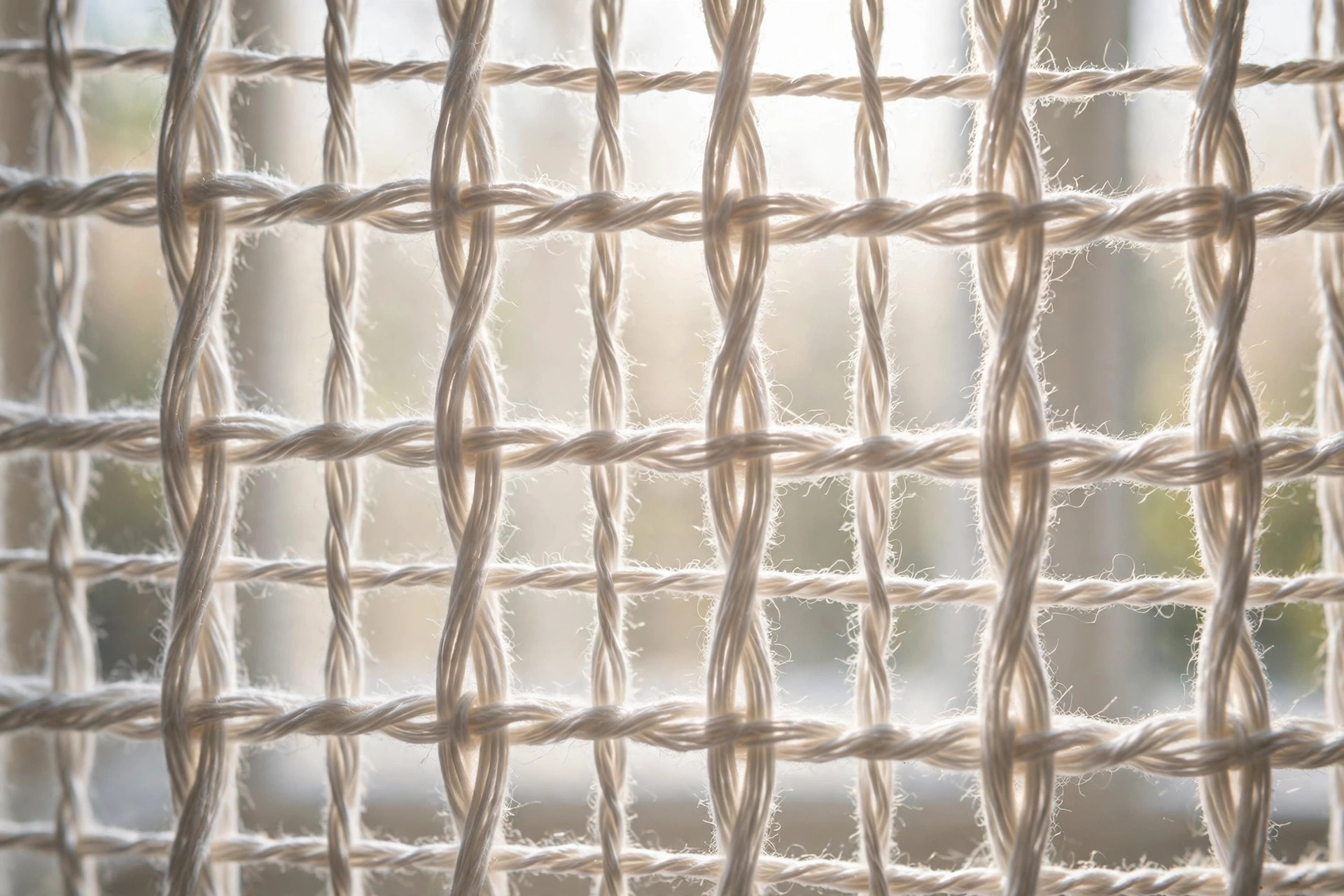
Every other weave structure holds its yarns in place the same way: a thread is trapped because another thread crosses it, and friction does the rest. Leno weave does something no plain, twill or satin interlacing attempts. Its warp ends travel in pairs, and one end of each pair physically crosses around the other, wrapping every weft pick in a closed loop of warp yarn. The result looks like the frailest fabric in weaving — a sheer mesh you can see straight through — yet its openings stay square and it refuses to skew. This page is one spoke of the Weaving & Woven Fabrics guide; if the foundations are new to you, the basic weave structures page covers plain, twill and satin first, and leno makes most sense read against plain weave, whose open grid it borrows and then improves on.
Leno is also the structure behind a more familiar word. The gauze on a first-aid dressing, the net curtain at a window, the mesh bag holding onions at a market stall — all are leno cloth, because an open mesh that keeps its shape is exactly what leno provides. Plain weave can be woven just as openly, but its mesh is a truce rather than a lock: pull it on the diagonal and the threads slide until the grid collapses into diamonds and bunched yarns. Leno removes the possibility of sliding altogether — and everything distinctive about the fabric follows from that.
Leno Weave, Defined
Leno weave (also called gauze weave) is a woven structure in which the warp ends are arranged in pairs: a standard end that runs straight, and a doup end that crosses from one side of the standard end to the other between picks, passing beneath it. Each weft pick is therefore encircled by the twisted pair and locked in position. Woven openly, leno produces gauze — a light, sheer mesh whose openings cannot slip or skew, unlike an open plain weave.
How the Interlacing Works: The Doup and Its Partner
Start with the pair. Across a leno warp the ends alternate in fixed couples. The standard end (or ground end) behaves like any warp thread: it rises and falls to form the shed and otherwise runs straight down the cloth, never leaving its lane. Its partner, the doup end (or crossing end), leads a double life. It helps form the shed like a normal end, but between one pick and the next it also steps sideways, ducking underneath the standard end and emerging on the opposite side. Pick by pick the doup end spirals around its straight partner, and each pick is laid into the shed while the pair stands crossed.
The sideways step is what ordinary looms cannot do, and it is why leno needs one piece of special equipment: the doup heddle. A standard heddle can only raise or lower its end. A doup heddle — a half-heddle on its own doup frame — can also pull its end laterally, drawing it across and under the standard end before the shed opens. The sequence repeats thousands of times: the doup crosses, the shed forms with the pair twisted, the pick is laid and beaten home, and the doup crosses again for the next pick. Each pick ends up caught inside the twist, pinched between the standard end on one face and the doup end on the other.
In its commonest form, plain leno, the doup crosses at every pick and the whole cloth is one continuous locked mesh. In patterned leno the doup crosses only at intervals, letting the pair run parallel for stretches before twisting again, producing figured effects and checks within the mesh. Leno also combines with other structures — stripes of leno set into a plain-weave ground give the openwork bands of leno-stripe shirtings and curtain fabrics, alternating a sheer locked stripe with a firmer plain one. The same trick works in miniature at the edge of almost any fabric: as the how weaving works page notes, many cloths are finished with a leno-bound selvedge, where a crossing pair locks the outermost picks so the selvedge cannot unravel.
Why an Open Cloth Can Be So Stable
Leno's stability is clearest if you first watch an open plain weave fail: each yarn there is held only by friction where it crosses its neighbours. Woven closely, friction is plentiful and the cloth is firm. Spaced widely apart — as gauze must be — each crossing becomes an isolated hinge with nothing to stop one thread sliding along another. A diagonal pull, the bias direction in which woven cloth is always weakest, lets warp and weft scissor past each other: square openings shear into diamonds, yarns bunch into cords, and the fabric skews.
Leno replaces friction with geometry. A weft pick does not rest between two parallel warp ends; it passes through a loop. The doup end crosses below the standard end on one side of the pick and crosses back on the other, so the pick is threaded through a closed eye of warp yarn. For the pick to slide, the loop would have to travel with it, and the loop is anchored to the standard end, itself locked to the picks above and below. Every element is held mechanically, not by surface grip. Pull it on the bias and the pairs flex slightly, but the mesh keeps its square geometry and springs back when released. The cloth can be mostly air and still hold its dimensions through washing and hard use, which no other simple weave can promise at that openness.
The locked structure shapes the rest of leno's character: very light, completely sheer, passing air and light freely. For its weight it is strong, because loads are shared by the twisted pairs rather than concentrated on single sliding threads. The costs are real: the doup mechanism slows the loom, the crossing ends suffer more abrasion in weaving, and leno's hand is slightly wiry and crisp rather than soft and drapey. Leno is a specialist, chosen when an open fabric must stay put.
| Point of comparison | Leno weave | Plain-weave gauze |
|---|---|---|
| Warp behaviour | Ends work in pairs that cross and lock — one runs straight, one twists around it | All ends run parallel and never cross |
| Weft security | Every pick is encircled by the twisted pair and gripped | Picks are held only by friction at each crossing |
| Mesh stability under diagonal pull | Openings stay square; the cloth resists skewing | Threads slide; openings shear into diamonds and yarns bunch |
| Loom requirement | A doup heddle and doup frame to cross the ends | Any loom; two shafts suffice |
| Typical cloth | Medical gauze, net curtains, mesh bags, scrim | Cheesecloth and other loose, shifting open cloths |
Fabrics and End Uses
Leno's oldest famous product is its most familiar: medical gauze. A dressing must be open enough to let a wound breathe, soft enough in fine cotton to sit against skin, and above all stable — a bandage whose mesh slid and bunched would be useless. Leno gauze meets all three requirements, and its absorbent, steady mesh has made “gauze” a household word. The same virtues serve the home: net curtains and drapery hang in even, square-meshed panels that filter light without sagging out of true, and leno mosquito netting keeps a regular mesh fine enough to bar insects while air moves freely.
Industry takes the structure further. Produce bags and laundry bags are leno mesh, strong for their weight and open enough to wash, drain or display their contents. Carpet backing uses leno's locked grid to hold tufts and coatings in register. Glass-fibre scrim — the reinforcing mesh embedded in plaster, roofing and composite panels — is leno woven in fibreglass yarn, its crossing pairs keeping the grid square while resins flow through the openings. Agriculture weaves leno into shade cloth and crop-protection netting that must survive seasons outdoors without distorting. In dress fabrics it appears more delicately: sheer shirtings, blouse fabrics and leno-striped summer cloths that will not skew in the wash.
How to Recognize Leno Weave
Hold the fabric up to the light. The open mesh is obvious, but look at the lengthwise threads: they do not run in straight, evenly spaced lines. They travel in visible pairs, and within each pair the two threads twist around each other, crossing between every weft pick like a tiny two-ply cord. Between the pairs sit the regular square openings of the mesh. Under a magnifier the twist is unmistakable — the crossing pairs are the signature of the structure.
Then pull the fabric gently on the diagonal, the direction that destroys a plain-weave gauze. A leno mesh resists: the openings stay essentially square, the cloth feels surprisingly firm for something so sheer, and it springs back when released. If the warp threads twist in pairs around each pick and the mesh refuses to skew, the cloth in your hands is leno, its mesh locked by the same crossing that locked it on the loom.
More Weave Structures
Common Questions
Is leno weave the same as gauze?
Yes: leno is the structure, and gauze is the open cloth it produces. The word gauze is also used loosely for any sheer, open fabric, including plain-weave versions whose threads can slip, but in weaving terminology a true gauze weave is a leno weave, its warp ends working in crossing pairs that grip every pick.
Why doesn't leno fabric unravel or skew?
Because every weft pick is physically encircled by a pair of warp ends. The doup end crosses around its standard partner between picks, so each pick sits inside a closed loop of warp yarn instead of resting between parallel threads. The yarns cannot slide, the square openings cannot collapse into diamonds under a diagonal pull, and the mesh holds its shape.
What is a doup?
A doup is the special heddle that makes leno weaving possible, and by extension the warp end it controls. Mounted on its own doup frame, it lifts its end and draws it sideways beneath the standard end, so the end passes from one side of its partner to the other between picks. That sideways crossing, repeated at every pick, is the whole mechanism of the leno weave.
How does leno differ from mock leno?
In true leno the warp ends genuinely cross: each pair twists around every pick and locks it in place. Mock leno only imitates the look. Its warp ends run straight in groups on an ordinary loom, and the open effect comes from the grouping and the interlacing alone, so its mesh can slip and skew in wear. It is cheaper and faster to weave, but cannot match the locked stability of true leno.
Back to the Weaving & Woven Fabrics Guide
The Weaving & Woven Fabrics hub maps the whole construction story — the loom cycle, loom types, patterned weaving and the named fabrics each structure produces.
Search Apparel Search