Apparel Search · Fabric Construction Guide
Piqué & Bedford Cord: Cords Raised by a Hidden Warp
A fine plain-weave face stretched over a straight, hidden stuffer warp stands up in rounded cords — the woven piqué of marcella shirting and its hard-wearing relative, Bedford cord.
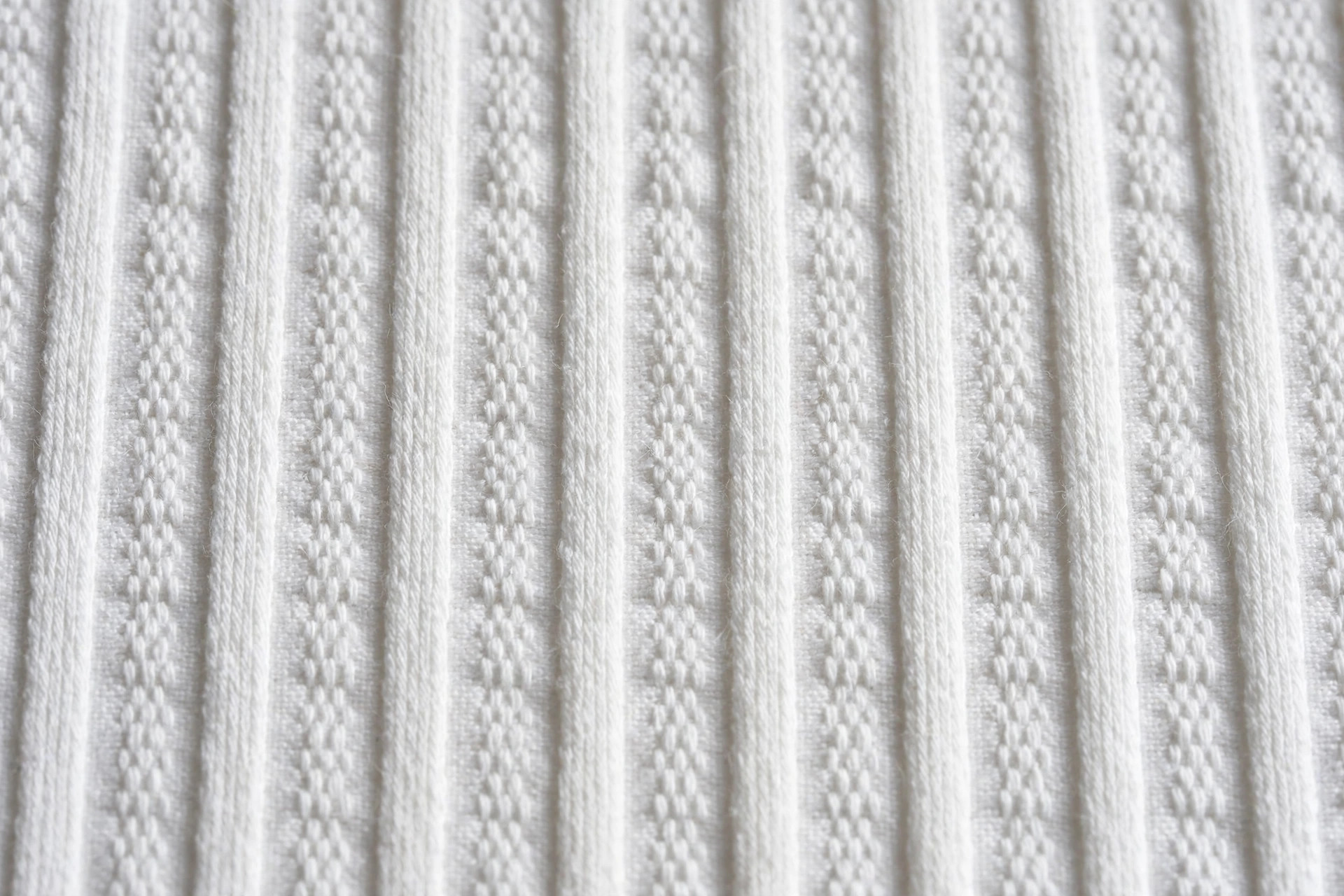
The word piqué is most shoppers' name for the textured knit of a polo shirt, and that fabric is real — but it is not this one. Woven piqué is the older structure, a loom-woven cloth whose surface stands up in fine, rounded cords running along the warp, built not from loops but from two warp systems working against each other. The woven versus knit comparison shows why they behave so differently despite sharing a name: the knit stretches and drapes softly, while the woven cloth is firm, crisp and stable.
This page belongs to the Weaving & Woven Fabric Construction guide and sits alongside the basic weave structures, because woven piqué is best understood as a plain weave with a secret. Under its fine plain-woven face runs a second, hidden warp that never interlaces into the surface at all. That hidden warp is the engine of the structure: it stays straight and flat while the face cloth, bound down at intervals, arches over it cord by cord. Its closest relative, Bedford cord, uses the same trick with coarser yarns and deeper lines to make a far more durable corded cloth.
Piqué Weave, Defined
Woven piqué is a corded fabric in which a fine plain-weave face cloth, woven slightly longer than the cloth beneath it, is bound down at regular stitching lines so that between those lines it arches up into rounded cords running along the warp. Beneath each cord lies a straight stuffer warp that gives the cord its core. Bedford cord is the heavier, harder-wearing member of the same family.
How the Interlacing Works: A Face Over a Core
Woven piqué is woven with two warp systems. The first is the face warp: fine ends, usually cotton, interlacing with the weft in plain weave, one over and one under, to form the visible skin of the cloth. The second is the stuffer warp — also called the backing or core warp — made of coarser ends that run behind the face under firm tension and lie essentially straight. The stuffer ends do the quiet work. Because they are held tight and never weave up into the face, they fix the true length of the cloth, while the face ends are delivered slightly more generously, so the face cloth is a little longer than the core it covers.
The two systems are married by stitching. At regular intervals across the width, the face cloth is bound down hard — by an extra stitching warp working at points, or by the pattern of the weft itself — creating a sunken line where face and core are pulled tightly together. Between one stitching line and the next, the face is free. Its extra length has nowhere to go except outward, so it bulges up and away from the straight stuffer beneath it, forming a plump, rounded cord that runs continuously along the warp. Repeat that across the width and the whole cloth becomes a series of parallel lengthwise cords separated by fine sunken valleys, every cord a small arch of plain weave standing over a straight core.
A weaver who wants still plumper cords has one more lever: wadding. A soft, thick wadding weft can be laid inside each cord as it forms, floating within the arch instead of interlacing through the face, and it fattens the cord the way padding fattens a quilt. Whether or not wadding is used, the principle never changes — a long face over a short, straight core, pinned down at lines, must rise between them. That is the whole of piqué; every other member of the family varies only where the stitching lines fall and how coarse the yarns are.
Marcella and Figured Piqué
The finest and most famous woven piqué is marcella, the cotton cloth of formal dress shirts, dress-shirt fronts and the waistcoats worn with white tie. Its cords are very fine, its face yarns are combed cotton, and its surface is usually white or nearly so, because in evening dress texture, not colour, does the decorating. Its name comes from Marseilles, the French port whose stitched and corded cloths — the famous Marseille quilting tradition — gave raised, stitched fabrics their reputation.
Plain parallel cords are only the beginning. If the stitching lines are rearranged so that the face is bound down not in straight warp-way lines but in a pattern, the cords break up into figures: small diamonds, squares and the tiny all-over texture called bird's-eye are the classic figured piqués. Each figure is simply a map of where the face was pinned and where it was allowed to rise, woven into the cloth, not printed or embroidered on, so the pattern survives years of washing that would fade a surface print. Marcella dress fronts exploit exactly this durability — the pattern is structure, and structure does not wash out.
Bedford Cord: The Hard-Wearing Relative
Bedford cord takes the same two-warp construction and builds it for work. Named for Bedford in England, it is a firm, heavy corded cloth in which each cord is separated from its neighbours by two fine sunken lines, finer and sharper than the single valley of a dress piqué. Within each cord, the face ends weave plain over a straight stuffer core exactly as in piqué; at the lines between cords the ends bind down at their tightest, and those paired lines give Bedford cord its crisp, almost engraved rib. In cotton, wool or blends, it became a standard cloth for trousers, breeches and riding dress, uniforms, waistcoats and hard-use upholstery.
The difference between the two cloths is therefore one of degree, not of kind. Piqué aims at fineness: small cords, smooth yarns, a surface meant to catch candlelight on a dress shirt. Bedford cord aims at endurance: bolder cords, stronger yarns, sunken lines that protect the raised face by taking the first contact with chairs, saddles and straps. A tailor choosing between them is really choosing how the same hidden-warp trick should be tuned — toward elegance or toward wear.
Structure and Properties
Because the cords run along the warp and the core beneath them never bends, piqué and Bedford cord are firm, stable cloths with a pronounced lengthwise rib and very little give in either direction. The raised cords create channels of air along the surface, so cotton piqué feels cooler and drier against the skin than a flat cloth of the same weight, one reason it suited dress shirts worn under formal layers. The structure holds a crease well, presses crisply and resists bagging at elbows and knees. Its weaknesses are the honest ones of any raised surface: the crowns of the cords take the abrasion first, so cords flatten slowly with long wear and hard laundering, and the sunken lines can hold soil that a flat cloth would release, which is why white marcella rewards careful washing.
| Fabric | Cord formed by | Surface feel | Typical cloth |
|---|---|---|---|
| Woven piqué | Plain-weave face arched over a straight stuffer warp, bound at stitching lines | Fine, firm, rounded lengthwise cords | Marcella dress shirts and waistcoats, figured dress fabrics |
| Bedford cord | The same arched face and stuffer core, with two fine sunken lines between cords | Hard, crisp, boldly ribbed | Trousers, uniforms, riding dress, upholstery |
| Corduroy | Extra weft floats cut after weaving to form pile | Soft, plush, velvet-like ridges | Casual trousers, jackets, children's wear |
Fabrics and End Uses
The family's uses follow its two tunings. Fine piqué and marcella serve formal and summer dress: dress shirts and detachable dress fronts, evening waistcoats, and lighter figured piqués for blouses, dresses and children's good clothes, where the small all-over figure gives interest without print. Bedford cord serves the working wardrobe and the house: trousers and breeches, uniform jackets and waistcoats, riding habits, cushion covers and upholstery that must take daily friction without going shiny or thin. Both share one virtue that keeps them in production: the texture is the construction, so there is nothing applied to peel, crack or wash away. As long as the cloth lasts, the cords last with it.
How to Recognize Piqué and Bedford Cord
Run a fingertip across the cloth, against the direction of the ribs. True woven piqué and Bedford cord show fine, even, parallel ribs running along the length of the fabric, firm and smooth-crowned, with narrow sunken lines between them; Bedford cord's lines come in close pairs and its cords feel harder and bolder than marcella's. Turn the cloth over and the back is comparatively flat, because the stuffer warp that forms the core lies straight behind the face. The decisive test is a cut edge: in cross-section the face appears as a thin skin arching over a straight core yarn, a tiny woven tunnel repeated cord after cord. And it is not corduroy — corduroy's ribs, covered in the corduroy fabric guide, are cut pile that feels soft and plush and can be brushed in one direction, while piqué's cords are solid woven cloth, smooth in every direction and impossible to brush.
More Weave Structures
Common Questions
Is piqué a weave or a knit?
Both. Woven piqué is the older structure described on this page, with a plain-weave face arched over a straight stuffer warp to form solid cords. The piqué of most polo shirts today is knitted, made on a knitting machine with tuck stitches that create a textured, dimpled surface. The two fabrics share a name and a textured hand, but their construction, stretch and manufacture are entirely different.
What is marcella?
Marcella is a fine cotton woven piqué used for formal dress shirts, dress-shirt fronts and white-tie waistcoats. Its cords are much finer than those of Bedford cord, often worked in a small diamond or bird's-eye figure, and its name comes from Marseilles, the city long associated with this type of stitched and corded cloth. It is crisp, breathable and holds its texture through careful laundering and pressing.
How is Bedford cord different from corduroy?
Bedford cord's ribs are solid woven cords formed by a face cloth arched over a straight stuffer core, so the surface is hard and smooth with fine sunken lines between cords. Corduroy's ribs are cut pile: loops of extra weft are cut after weaving to stand up as soft velvet-like ridges. Bedford cord feels firm and wears flat, while corduroy feels plush and its pile can crush.
Why are the cords raised?
Because the face cloth is woven slightly longer than the straight stuffer warp beneath it. The stuffer ends are held tight and lie flat, while the face ends are held looser and bound down only at the stitching lines. Between those lines the extra length of face cloth has nowhere to go except outward, so it arches up into a rounded cord, sometimes fattened further by a wadding weft laid inside it.
Back to the Weaving & Woven Fabrics Guide
The Weaving & Woven Fabrics hub maps the whole construction story — the loom cycle, loom types, patterned weaving and the named fabrics each structure produces.
Search Apparel Search