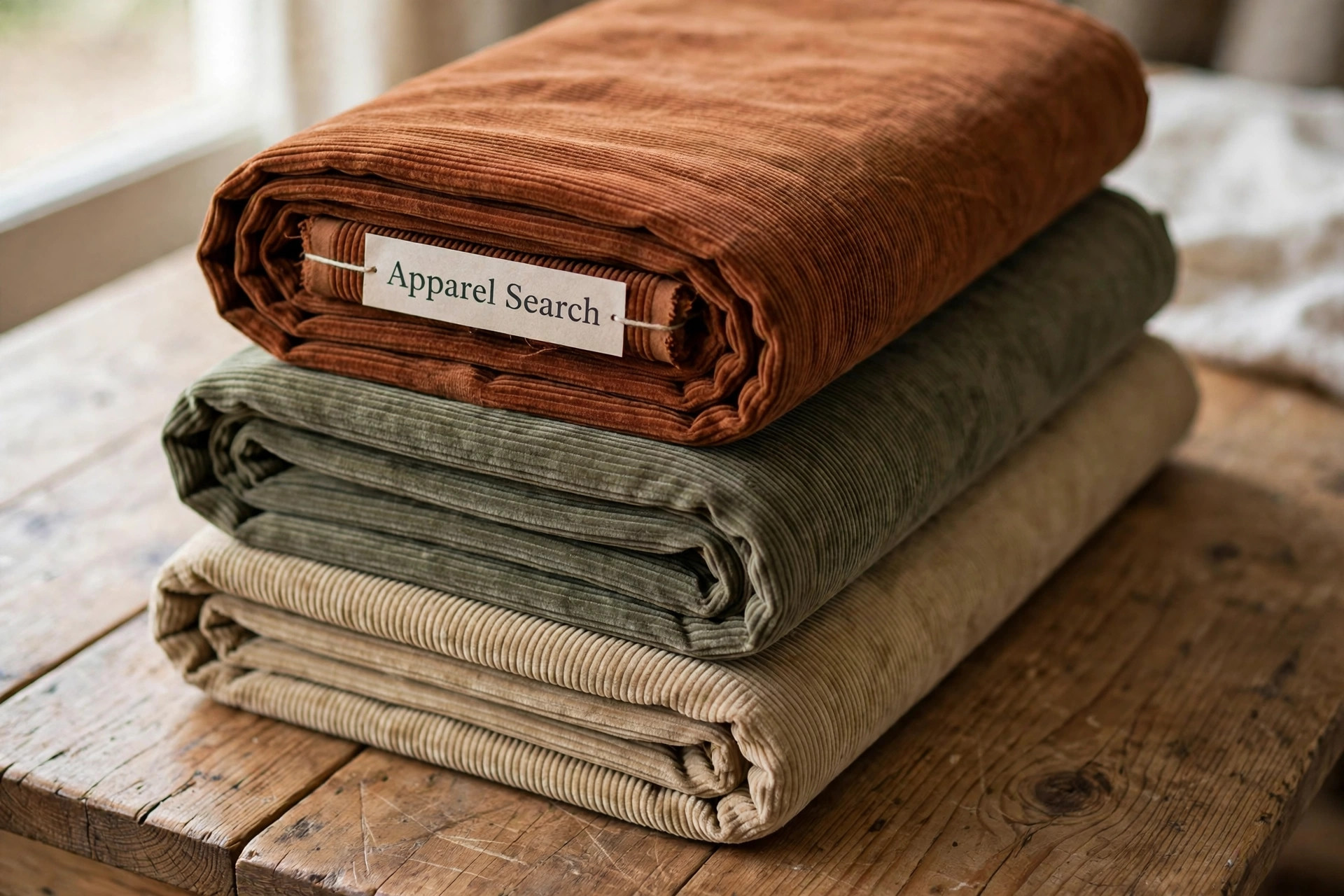
Corduroy is the ribbed, velvety cloth of autumn trousers, jackets and caps - a fabric you can recognize across a room and identify blindfolded by running a thumb across its ridges. Those ridges are called wales, and almost everything about a corduroy - how formal it looks, how it drapes, how warm it feels - follows from how many wales it packs into an inch and how its pile is cut. This guide explains how corduroy is built, where it comes from, the wale types you will meet on labels, what it does well and where it needs care, and how to choose and look after it.
01 / The fabric
What Corduroy Is
Corduroy is a woven pile fabric, most often made from cotton, sometimes with a small share of polyester or elastane blended in. It starts as an ordinary woven ground cloth, but extra weft yarns are woven in so that they float over groups of warp threads in neat lengthwise rows. After weaving, those floats are cut down their centers, and the cut ends are brushed upright - and that row of tiny cut tufts is a wale. Run your hand along the cloth and the pile leans and catches the light; run it across and you feel the ribs. The pile is also why corduroy shades differently in different directions, a quality tailors call the nap.
Corduroy belongs to the fustian family - the sturdy cotton pile cloths that include velveteen - and its modern form took shape in the cotton mills around Manchester, England, where ribbed fustians became the hard-wearing cloth of working wardrobes; in parts of continental Europe the fabric is still called "Manchester" after the city. You will often hear that the name comes from the French corde du roi, "cloth of the king." It is a good story, but treat it as folklore: there is no etymological evidence for it, and historians regard it as a folk etymology - a marketing tale rather than a derivation. The likelier origin is plain English: "cord," for the ribs, joined to "duroy," an old name for a coarse woolen cloth.
Unlike the fabrics in most of these guides, corduroy is defined by its surface rather than its fiber. The ground weave underneath is frequently a twill, which gives the cloth its backbone, but it is the cut pile on top that makes corduroy corduroy - the same family of construction, at a much shorter pile, as velvet.
02 / Performance
How Corduroy Feels and Performs
The pile makes corduroy warm, soft and quietly insulating: the upright tufts trap air and break the wind, which is why a corduroy jacket or pair of trousers feels a full season warmer than the same weight of plain cotton. The ground cloth gives it substance and abrasion resistance - corduroy earned its working reputation honestly - and the cotton pile takes dye deeply, so cords come in rich, saturated autumn colors that suit the fabric's character. Corduroy also muffles sound and feels substantial in the hand, part of its long association with country clothing, teaching wardrobes and 1970s tailoring alike.
The same pile is the source of its weaknesses. Pile crushes where it is sat on, belted or creased, and crushed areas can stay shiny or flat; the tufts pick up lint and dust more readily than a smooth cloth; and corduroy has a definite nap, so garments must be cut with every piece running the same way or panels will shade differently. It is a characterful fabric, not a carefree one.
Strengths
- Warm and wind-resistant for its weight
- Soft, velvety hand with real substance
- Hard-wearing ground cloth; resists abrasion
- Takes deep, saturated dye colors beautifully
- Comfortable, forgiving drape in finer wales
Trade-offs
- Pile crushes at seats, knees and creases
- Attracts lint, dust and pet hair
- Nap shades differently by direction and light
- Can develop shiny worn patches over time
- Heavier wales feel bulky in tailored garments
03 / Varieties
Corduroy by Wale Count
- Needlecord / pinwale - the finest corduroy, at roughly 16 to 21 wales per inch. The ribs are so fine the cloth reads almost like velvet at a distance. It drapes softly and is the dressiest cord: shirts, dresses, children's clothing, slim trousers and soft jackets.
- Standard (mid) wale - the classic corduroy, around 11 wales per inch (roughly 8 to 13 depending on the mill). The rib is clearly visible but not loud. This is the versatile middle ground for everyday trousers, skirts, overshirts and casual jackets.
- Wide wale - bold, chunky ribs at roughly 3 to 8 wales per inch. Unmistakably casual and a little retro, wide wale suits statement trousers, jackets, overshirts and light upholstery, where the texture is the point.
- Stretch corduroy - any of the wale counts above woven with a small percentage of elastane. The ribs and look are unchanged; the give makes slim trousers and fitted jackets noticeably more comfortable.
- Printed and pigment-dyed corduroy - corduroy colored or printed with pigment dyes, often for casual and children's wear; the print sits on the pile tips, so it softens in character as the pile moves.
04 / Construction
How Corduroy Is Made and Used
Making corduroy is weaving plus surgery. The cloth leaves the loom with its extra weft floats uncut; rotating blades or guided knives then slice each float row precisely down the middle, the fabric is brushed to raise and separate the cut fibers, singed to clear stray fuzz, and washed or finished to soften the hand. Every step shows in the finished cloth: clean cutting gives even, plush wales, while poor brushing leaves the pile flat and patchy.
In the wardrobe, wale count assigns the jobs. Needlecord goes where a smooth, quiet cloth is wanted - shirts, dresses, children's clothes. Standard wale is the trouser-and-jacket workhorse of autumn dressing. Wide wale is outerwear and statement territory, and the heaviest cords appear in caps, bags and light upholstery. Whatever the wale, look for the nap rule in well-made garments: all pieces cut in the same direction, so the color reads evenly from head to hem.
05 / Buying
How to Choose Corduroy
Choose the wale first, because it decides both the look and the job: fine needlecord where you want corduroy's warmth without its bulk, standard wale for the classic trouser, wide wale when the texture itself is the style. Then run a hand over the pile - good corduroy feels dense and even, springs back when pressed, and shows no thin or bald lines along the wales. Hold the cloth to the light and tilt it: some shading shift is the nap and is normal, but blotchy patches suggest uneven finishing.
Read the fiber label next. Pure cotton corduroy is the traditional, breathable choice and the one that ages with the most character; a little polyester adds abrasion resistance, and a touch of elastane transforms the comfort of close-fitting trousers. For trousers and jackets, also check that the garment's panels share one nap direction - mixed directions are a manufacturing shortcut you will see every time you wear the piece.
06 / Care
Caring for Corduroy
Turn corduroy inside out before washing - this protects the pile from rubbing against other garments - and wash it in cool or warm water on a gentle cycle, with similar colors, since the pile sheds a little lint and dye in early washes. Avoid hard creasing in the wash and dryer: fold lines pressed into pile can be stubborn. Dry on low heat or line dry, and store garments folded or hung without crushing the pile under heavier clothes. See the fabric care guide for the full routines by fabric.
Pressing is where corduroy is most often ruined. Never press a hot iron flat onto the pile - it crushes the tufts and leaves a permanent shine. Instead, turn the garment inside out and press the back, or use steam held just above the surface and let the pile lift itself; a clothes brush run gently along the wales restores crushed areas and lifts lint. Between wears, a lint roller or brush is corduroy's best friend - the pile that makes it warm is the pile that collects everything it touches.
Corduroy at a Glance
Common Questions
What does wale mean in corduroy?
A wale is one raised rib of the cut pile, running the length of the cloth. Corduroy is graded by wale count - how many ribs fit in one inch. The higher the count, the finer the rib: needlecord has roughly 16 to 21 wales per inch, standard corduroy sits around 11, and wide wale drops to roughly 3 to 8 bold ribs.
Does corduroy shrink?
Cotton corduroy can shrink a little, most noticeably at its first wash, especially in hot water or a hot dryer. Wash it inside out in cool or warm water, dry on low heat or line dry, and choose pre-shrunk garments where the fit matters. Blends with polyester shrink less than pure cotton.
Why does corduroy change color in different light?
That is the nap. The cut pile leans in one direction and reflects light differently depending on the angle you view it from, so the same cloth can look richer or paler as it moves. It is a natural property of pile fabrics, and well-made garments are cut with every panel's nap running the same way so the shading stays even.
How do you press corduroy without crushing it?
Never press a hot iron directly onto the pile - it flattens the tufts and can leave a permanent shiny mark. Turn the garment inside out and press the back, or hold a steam iron just above the surface and let the steam lift the pile, then brush the wales gently back into line.
More to Explore
Explore more: Fabric Directory | Fabric Industry Guide
Definitions and Comparisons
Directories and Further Reading
Search Apparel Search
Fabric Guides
- Fabric Guides Hub
- Cotton Fabric Guide
- Denim Fabric Guide
- Silk Fabric Guide
- Linen Fabric Guide
- Wool Fabric Guide
- Polyester Fabric Guide
- Cashmere Fabric Guide
- Nylon Fabric Guide
- Rayon Fabric Guide
- Spandex Fabric Guide
- Corduroy Fabric Guide
- Satin Fabric Guide
- Chiffon Fabric Guide
- Twill Fabric Guide
- Velvet Fabric Guide
- Jersey Fabric Guide
- Fleece Fabric Guide
- Lace Fabric Guide
- Tulle Fabric Guide
- Poplin Fabric Guide
- Fabric Care Guide