Corduroy
Fabric Definitions — fabric and textile definitions from Apparel Search
Search Apparel Search
At a Glance
Definition: Corduroy is a durable woven cloth whose face is built from parallel raised cords of cut, tufted fibre, with the width of each cord — the wale — deciding which garments the fabric suits best.
Category: Fabric Definitions
Word Origin
The name rests on "cord": twisted fibres which, once woven, lie parallel to one another and form the ridged pattern. The word names the cloth after the cords that cover its face.
Corduroy starts from cord: fibres twisted together and woven so that they lie side by side in parallel lines, in a construction related to twill, and those parallel lines become the pattern of the cloth. In its modern form the fabric is usually made of tufted cords, and between one row of tufts and the next there may be a narrow channel where the base fabric shows through bare. The word itself works as a noun, a transitive verb and an adjective. As a cloth, corduroy has a reputation for durability; the clothes cut from it are casual in character and are reached for most often in cold climates and cold seasons.
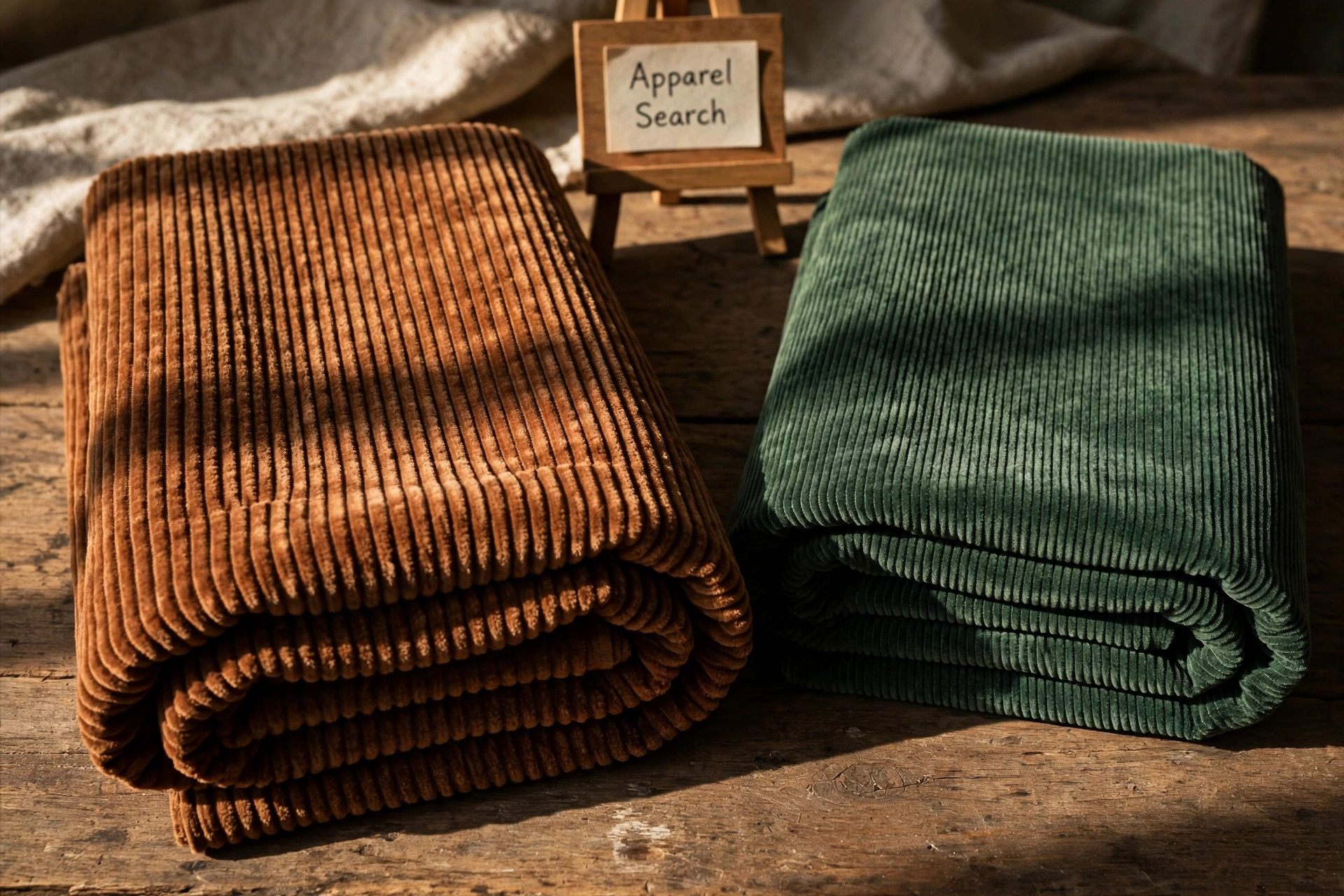
How the Cords Are Formed
The cords are not woven as solid ribs. Extra weft threads are first woven in as floats over the ground cloth, and the floats are then cut through, so that each cut end springs up as a short tuft. Row upon row of those tufts, all running parallel, gives corduroy its ribbed pile face — a surface that is raised and soft where the tufts stand, and flat in the channels that can be left bare to the base fabric between them. That cut-pile construction separates corduroy from a merely ribbed flat weave: the ribs here are made of thousands of tiny cut fibre ends, which is also why the cloth feels warm and why it shades as the pile is brushed one way or the other.
Wale: The Measure of the Cord
Corduroy is specified by its wale — the width of the cord, counted in cords to the inch. A wide-wale trousering may run at roughly four to eight wales per inch; a standard trouser corduroy sits near eleven; and at the fine end, pinwale and needlecord run from about sixteen to twenty-one. The count predicts the garment before it is ever seen. Low counts give bold, rustic ribs and the most casual effect of all. High counts bring the surface closer to velveteen, smooth enough for shirts and for children's wear. In practice the trade sorts itself by waistline: wide wale is found most commonly on pants and trousers, while medium, narrow and fine wales are usually found in garments worn above the waist.
Fibre follows the same practical logic. Cotton corduroy is the standard for trousers and jackets, and cotton blends add resilience. Cutting matters as much as choosing: because the pile shades differently according to whether it runs up or down, every piece of a garment is cut with the pile running the same way, exactly as a tailor handles velvet.
Where Corduroy Is Worn
Trousers are corduroy's home ground — the construction of pants is where the material is most commonly found — but the same cloth is also used for sport jackets and for shirts. Its social register is settled: corduroy clothing is considered casual, and its warmth suits it to colder climates and to the seasonal, cold-weather part of the wardrobe rather than to formal dress. Durability underwrites that whole career; this is a cloth bought to be worn hard and kept for years.
Caring for a Cut-Pile Surface
The tufts that make corduroy are both its strength and the part that needs looking after. Sustained pressure crushes the pile, and the channels between the cords collect lint, so the cloth is brushed with the pile, washed inside out, and stored hanging rather than folded under weight. A steamer lifts crushed pile far better than a hard press, which can flatten the cords for good. Where corduroy does wear out, it thins first where the tufts take the abrasion — the seat, the knees, the elbows — while the ground weave underneath stays sound, so an old pair of cords fades in pattern instead of tearing. None of that makes the fabric delicate; it simply asks that its raised surface, the very feature that makes it corduroy, be treated as a surface and not as flat cloth.
The Other Corduroy: A Road of Logs
One further meaning of the word has nothing to do with clothing, and the original page kept it on record. A corduroy road is built by laying logs side by side, at right angles to the direction of travel, across a low or swampy stretch of ground. It turns impassable mud into a passable track, but the ride over it is bumpy even in the best conditions, and loose logs that roll or shift are a hazard to horses. A plank road, which uses hewn boards instead of round logs, gives the smoother and safer surface. In slang, a corduroy road is any road in poor repair — full of holes, ruts and surface swellings — where the journey is unpleasant and the vehicle itself is at risk.
Common Questions
What is wale in corduroy?
Wale is the width of one of corduroy's raised cords, usually counted as cords per inch. Broad, widely spaced wales are the trousering weights, while medium, narrow and fine wales — down to needlecord, with its many slim ribs — are more often used in garments worn above the waist.
How is corduroy's pile made?
Extra weft threads are woven so that they float over the ground cloth, and those floats are then cut. The cut ends stand upright as short tufts arranged in parallel rows, and those rows are the cords; a channel left bare to the base fabric may separate one row of tufts from the next.
Is corduroy a formal fabric?
No. Garments made from corduroy sit on the casual side of the wardrobe, and the cloth is chosen most often for colder climates and the colder parts of the year. Trousers are its commonest use, with sport jackets and shirts after them.