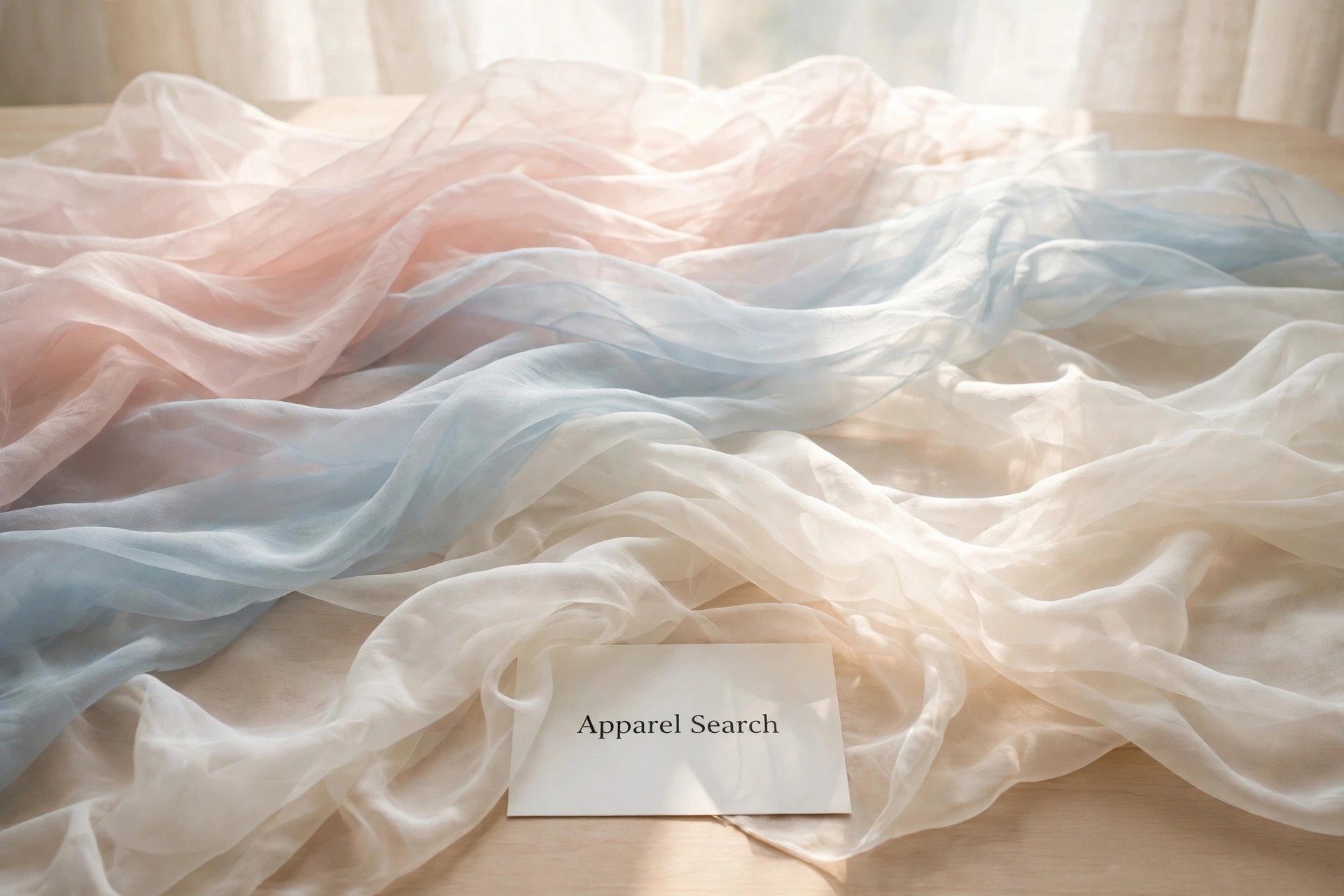
Chiffon is the sheer, floating cloth of evening overlays, bridal veils, scarves and soft blouses - a fabric that seems to move a half-second after the wearer does. It is built from the simplest weave there is, plain weave, and everything special about it comes from its yarns: fine threads twisted so tightly that they kink, pucker and give the cloth its faintly grainy texture and gentle spring. Chiffon began as a silk luxury and is now woven mostly from polyester, which has made it affordable without changing its essential character. This guide explains how chiffon is made, how it differs from its sheer cousins georgette and organza, what it does well, why it is famously difficult to sew, and how to choose and care for it.
01 / The fabric
What Chiffon Is
Chiffon is a lightweight, sheer plain weave - one thread over, one under - woven from high-twist crepe yarns. The twist is the whole story. In classic chiffon the yarns alternate between S-twist (twisted in one direction) and Z-twist (twisted in the other) in both warp and weft. Yarns twisted that hard want to untwist, and their struggle against the weave gives chiffon its slightly puckered, fine-grained surface, its soft matte glow instead of a shine, and a small amount of mechanical give - the cloth stretches a little and recovers, even though it contains no elastic fiber at all.
The name is a small irony: chiffon comes from the French word for a rag or cloth - from chiffe, meaning rag. The fabric itself was originally woven in silk, and silk chiffon remains the luxury standard: featherlight, fluid and softly luminous. Today most chiffon is polyester, which is tougher, cheaper and easier to wash, though a little stiffer and less breathable than silk; nylon and rayon chiffons also exist. As with satin, the fiber changes the care and the price - the construction, fine high-twist yarns in a plain weave, is what makes it chiffon. Our crepe vs chiffon comparison looks at how chiffon sits within the wider crepe family.
Chiffon's sheerness is part of the design. A single layer is translucent, so garments use it in gathered, draped or layered forms - over a lining, over an opaque underdress, or in multiple floating layers that build color and coverage together. Where a design needs a sheer fabric with real body instead, its cousins take over, as the varieties section explains.
02 / Performance
How Chiffon Feels and Performs
Chiffon feels like tinted air. It is among the lightest woven fabrics in ordinary use, it drapes in soft, collapsing folds, and it moves beautifully - skirts and sleeves of chiffon trail, billow and settle slowly, which is why dancers, brides and evening dresses rely on it. The high-twist yarns give the surface a fine, dry grain rather than a slippery shine, so chiffon clings less than satin and photographs softly, without glare. Layered, it builds depth of color no opaque cloth can imitate.
Its weaknesses are the price of that delicacy. The fine yarns and open plain weave fray readily at cut edges, snag on rough surfaces, and slip and shift under a sewing needle - chiffon is widely considered one of the hardest common fabrics to sew. It offers no warmth and no structure: a chiffon garment gets its shape entirely from the body, the lining or the cut. Silk chiffon also asks for careful washing, though polyester chiffon is considerably more forgiving.
Strengths
- Extremely light and airy; barely felt on the body
- Fluid, romantic drape that moves beautifully
- Soft matte surface with a fine, grainy texture
- Layers build color and coverage without weight
- Slight natural give from the high-twist yarns
Trade-offs
- Sheer - needs lining or layering for coverage
- Frays readily at cut edges
- Slips and shifts - difficult to cut and sew
- Snags on rough surfaces and jewelry
- No warmth or structure of its own
03 / Varieties
Chiffon and Its Sheer Cousins
- Silk chiffon - the original: the softest, most fluid and most luminous chiffon, and the most expensive and delicate. The choice for fine scarves, luxury blouses and couture evening wear.
- Polyester chiffon - the everyday standard. Nearly as sheer and floaty as silk, far cheaper and tougher, and machine washable on gentle cycles; slightly stiffer in drape and less breathable in heat.
- Georgette - chiffon's sturdier sibling: also a plain weave of high-twist crepe yarns, but heavier, more crinkled and more opaque, with a springier hand. Georgette holds up better in garments that are worn hard rather than draped, and its grainier surface makes it a little easier to sew.
- Organza - the opposite temperament: a sheer plain weave of low-twist yarns with a crisp, glassy stiffness. Organza stands away from the body and builds volume in ball gowns and structured overlays, where chiffon would collapse. Compare tulle as well - a net, not a weave, and stiffer still.
- Pearl, satin-faced and jacquard chiffons - variations with a subtle sheen, a satin stripe or woven pattern worked into the sheer ground, used when plain chiffon needs a touch more presence for evening wear.
04 / Construction
How Chiffon Is Used - and Sewn
Chiffon earns its place wherever a garment should suggest more than it covers: evening gowns and their floating overskirts, bridal veils and overlays, soft blouses, scarves, saris and dupattas, dance costumes, and the layered skirts and sleeves that turn a simple dress romantic. It is also a team player - gathered into ruffles, pleated into skirts, or draped over a satin underdress so the two cloths give each other what they lack: the satin provides coverage and shine, the chiffon provides air and movement.
Sewing chiffon is a core skill, and an honest guide must say plainly: it is difficult. The cloth slides on the table, shifts under the presser foot, and frays while you watch. Experienced sewers cut it with a rotary cutter on a mat, sometimes over tissue paper, use fine pins and a fresh fine needle, and finish seams as French seams or narrow rolled hems that enclose the fraying edges. Seams are kept simple - chiffon rewards draped, gathered and flowing designs and punishes fussy construction. If you are buying rather than sewing, those same details are your quality checklist: neat enclosed seams and clean rolled hems are the marks of a maker who respected the fabric.
05 / Buying
How to Choose Chiffon
Start with the fiber, because it sets both the experience and the upkeep. Silk chiffon is the choice when the garment is an investment - a scarf, a fine blouse, an heirloom dress - and its fluidity is genuinely unmatched. Polyester chiffon is the sensible default for most dresses, blouses and occasion wear: it keeps the look, survives gentle machine washing, and costs a fraction as much. Whichever you choose, hold a layer over your hand: the weave should be even, without pulled threads, snags or thin patches, and the color should stay consistent when the cloth is layered, since that is how it will be worn.
Then think about coverage and construction. Plan the lining or underlayer as part of the purchase - an unlined chiffon dress is a beach cover-up, whatever the hanger suggested. Check the seams and hems for the enclosed finishes described above, and give the cloth a gentle tug at a seam: fine yarns in an open weave should not grin or slip at the stitching. Finally, match the fabric to the silhouette - chiffon wants to flow, gather and float, so choose designs that let it, rather than tailored shapes it cannot hold.
06 / Care
Caring for Chiffon
Silk chiffon is hand-washed in cool water with a gentle detergent, never wrung or twisted - roll it in a clean towel to lift the water out, then dry it away from direct sunlight and heat. Polyester chiffon is hardier: a gentle machine cycle in a mesh bag, in cool water, suits most garments, followed by air drying; it needs little or no ironing, and a cool iron or light steam handles the creases it does pick up. In both cases the fabric care guide gives the routines by fiber, and the garment's own label outranks any general advice.
Handle chiffon like the fine net it nearly is. Keep it away from rough surfaces, hook-and-loop fasteners and unfiled nails, all of which pull its fine threads; store it rolled or loosely folded with tissue rather than crushed in a drawer, and hang garments on padded hangers so the shoulders are not cut into by the cloth's own slight weight. Treat snags early by easing the pulled thread back with a pin rather than cutting it, and your chiffon will keep floating for years.
Chiffon at a Glance
Common Questions
What is chiffon made of?
Chiffon is defined by its construction, not its fiber: a sheer plain weave of fine, high-twist crepe yarns. It was originally woven in silk, and silk chiffon is still the luxury version. Most chiffon today is polyester, which is cheaper, tougher and easier to wash, and nylon and rayon chiffons are also made.
What is the difference between chiffon and georgette?
Both are plain weaves of high-twist crepe yarns, but georgette is heavier, more crinkled and less sheer, with a springier, grainier hand. Chiffon is the lighter, softer and more fluid of the two, chosen for maximum drape and float; georgette gives more coverage and holds up better in garments that are worn rather than draped.
Is chiffon hard to sew?
Yes - it is one of the most difficult common fabrics to sew. It slips and shifts while being cut and stitched, and its fine yarns fray quickly at cut edges. Sewers manage it with a rotary cutter, fine pins and needles, tissue support, and enclosed finishes such as French seams and narrow rolled hems.
How do you wash chiffon?
Silk chiffon should be hand-washed in cool water with gentle detergent, never wrung, and dried away from sun and heat. Polyester chiffon can usually be machine washed on a gentle cycle in a mesh bag in cool water and air dried. In both cases, follow the garment label, and see the fabric care guide for fiber-by-fiber routines.
More to Explore
Explore more: Fabric Directory | Fabric Industry Guide
Definitions and Comparisons
Directories and Further Reading
Search Apparel Search
Fabric Guides
- Fabric Guides Hub
- Cotton Fabric Guide
- Denim Fabric Guide
- Silk Fabric Guide
- Linen Fabric Guide
- Wool Fabric Guide
- Polyester Fabric Guide
- Cashmere Fabric Guide
- Nylon Fabric Guide
- Rayon Fabric Guide
- Spandex Fabric Guide
- Corduroy Fabric Guide
- Satin Fabric Guide
- Chiffon Fabric Guide
- Twill Fabric Guide
- Velvet Fabric Guide
- Jersey Fabric Guide
- Fleece Fabric Guide
- Lace Fabric Guide
- Tulle Fabric Guide
- Poplin Fabric Guide
- Fabric Care Guide