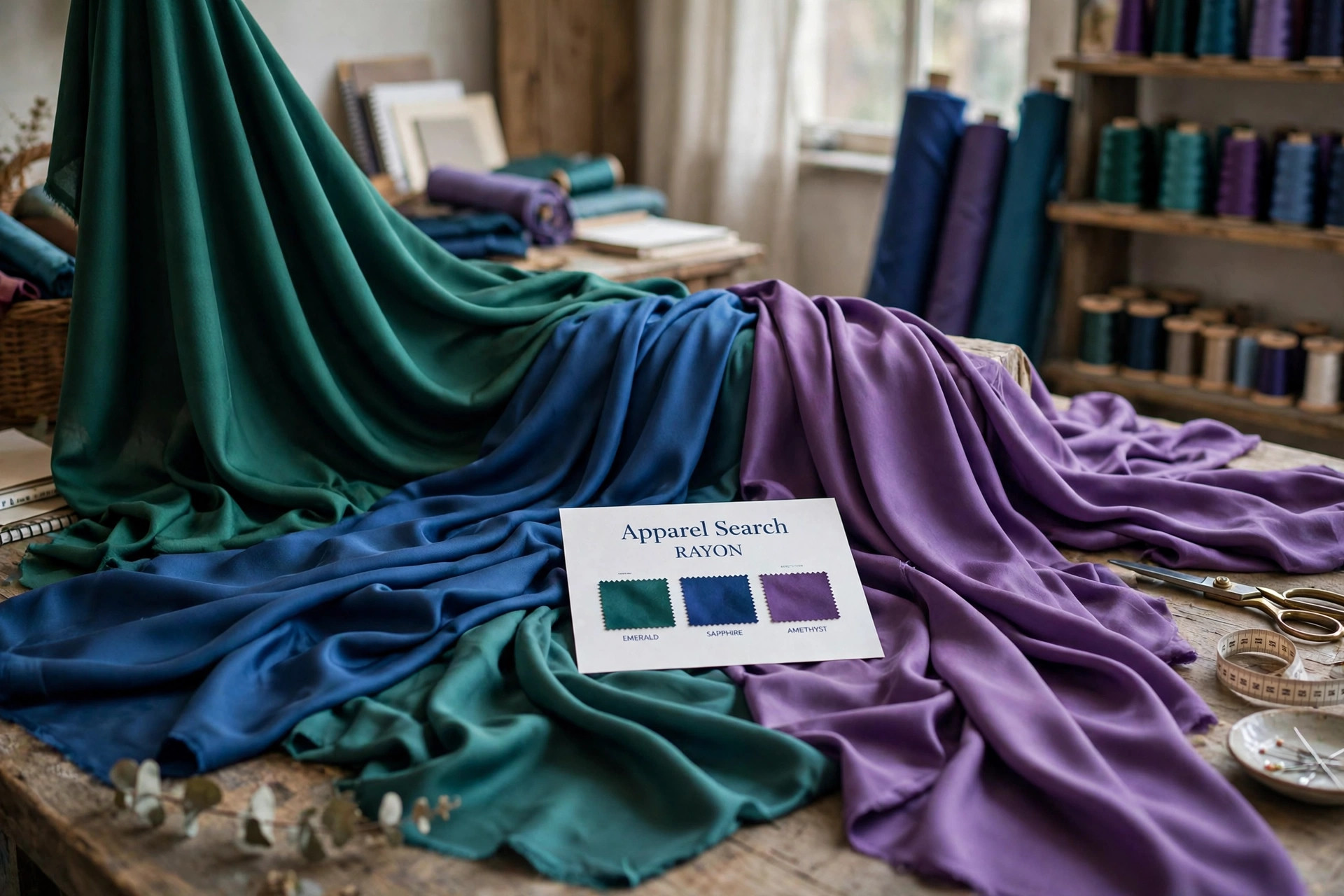
Rayon is the in-between fiber: made by people, but made from plants. It drapes like silk, absorbs like cotton, takes dye in deep, glowing colors - and then, in the wash, it can shrink, wrinkle and weaken in ways that surprise anyone who treats it like cotton. This guide explains what rayon is, how the first manufactured fiber came to be, how viscose, modal and lyocell differ inside the rayon family, and how to choose and care for rayon so its famous drape survives the laundry.
01 / The fiber
What Rayon Is
Rayon is a regenerated cellulose fiber. Cellulose from wood pulp or cotton linters is dissolved into a thick liquid, extruded through the tiny holes of a spinneret, and solidified back into cellulose in filament form - the same plant polymer it started as, rearranged into a fiber. That is why rayon is called semi-synthetic: its raw material is natural, its making is industrial, and its behavior borrows from both sides. Like cotton and linen it is cellulose, so it absorbs water, breathes and burns rather than melts; unlike them, its filaments are smooth, even and made to a chosen fineness, which is where its silk-like luster and fluid drape come from.
Rayon was the first manufactured fiber. The French chemist Hilaire de Chardonnet patented a process for making filaments from nitrocellulose - an early "artificial silk" - in the 1880s, and manufacture of his Chardonnet silk began in 1891; the material worked, but nitrocellulose was dangerously flammable. The process that made rayon practical was viscose, patented in 1892 by the British chemists Charles Frederick Cross, Edward John Bevan and Clayton Beadle: cellulose treated with caustic soda and carbon disulfide becomes a honey-like liquid - viscose - that can be spun into fiber. The British firm Courtaulds put viscose rayon into commercial production in 1905, and it became the standard rayon of the twentieth century. The fiber went by names like artificial silk until 1924, when the name rayon was adopted in the United States.
Later fibers in the family improved on viscose, as the varieties section explains. For the formal definition, see the rayon fiber definition.
02 / Performance
How Rayon Feels and Performs
Rayon's signature is drape. Its smooth filaments and relatively low stiffness let the cloth fall in soft, liquid folds, which is why rayon is the default fiber of flowing dresses, blouses, skirts and scarves, and why it is used for linings that must slide. It is highly absorbent - in the same family as cotton for taking up moisture - so it feels cool and comfortable in heat, and it takes dye exceptionally well, giving the deep, saturated colors and sharp prints rayon is known for. It does not build up static the way synthetics do.
The weakness is water. Ordinary viscose rayon swells when wet and loses a large share of its strength - commonly cited at roughly 30 to 50 percent - so a wet rayon garment is fragile exactly when the washing machine is working on it. It also wrinkles readily, can shrink when washed warm or agitated, and recovers poorly from creasing compared with wool or synthetics. None of this makes rayon a bad fiber; it makes it a fiber whose care label is a real instruction, not a suggestion - and whose newer relatives, modal and lyocell, were developed specifically to fix the wet-strength problem.
Strengths
- Fluid, silk-like drape for dresses, blouses and linings
- Highly absorbent and cool-feeling in hot weather
- Takes dye in deep, vivid colors and sharp prints
- Soft and smooth against the skin
- Little static build-up
Trade-offs
- Loses much of its strength when wet - fragile in the wash
- Wrinkles easily and recovers slowly from creasing
- Can shrink with warm water and agitation
- Many rayon garments are dry-clean only
- Less abrasion-resistant than cotton or synthetics
03 / Varieties
The Rayon Family: Viscose, Modal and Lyocell
- Viscose rayon - the original and still the most common rayon, made by the viscose process described above. In Europe, "viscose" is the name on the label for the same fiber the United States calls rayon. It has the family's best drape and lowest price - and its weakest wet strength.
- Modal - a high-wet-modulus rayon, developed as an improved viscose: its fibers are made to keep much more of their strength when wet, resist shrinking, and stay soft and smooth through repeated washing. Modal is the rayon of underwear, t-shirts, pajamas and bedding blends, often mixed with cotton or a little spandex. See the related viscose definition for how the base process works.
- Lyocell - rayon-family fiber made by a different route: cellulose is dissolved directly in a solvent (an amine oxide) rather than chemically converted, and the solvent is recovered and reused in a closed loop. Lyocell is stronger wet and dry than viscose, manages moisture well, and has a smooth, soft hand; it is sold under brand names as well as its generic name. See the lyocell definition.
- Cuprammonium rayon (cupro) - an older, fine-filament rayon made by dissolving cellulose in a copper-ammonia solution. It is silky, breathable and drapes beautifully, and today it is met mostly as a premium lining fabric.
- Rayon challis, crepe and satin weaves - constructions, not fibers: lightweight plain-weave challis for dresses and scarves, textured crepe, and smooth rayon satin - the cloths through which most shoppers actually meet rayon, whatever the fiber variant inside.
04 / Construction
Rayon Fabrics and Uses
Rayon is woven and knitted across the wardrobe. Woven rayon - challis, crepe, twill and satin - makes the flowing dresses, blouses, skirts and scarves the fiber is famous for, plus the smooth linings inside jackets and coats, where its slip and absorbency outperform synthetic linings for comfort. Knitted rayon jersey, usually with a touch of spandex, makes soft, draping t-shirts, dresses and loungewear that fall close to the body without clinging the way a synthetic knit does.
Blending is rayon's other route into clothing. Rayon-linen blends keep linen's cool crispness while rayon softens its creasing and adds drape; rayon-cotton blends add fluidity and color depth to shirting; and a rayon partner gives nylon and polyester fabrics a more natural hand and better absorbency. In home textiles, modal and lyocell appear in towels, sheets and bedding, where their absorbency and wet strength - the improved side of the family - are exactly what is needed. When a label says simply "rayon" or "viscose," assume standard viscose and its care rules; when it says modal or lyocell, you are getting the stronger generation of the same idea.
05 / Buying
How to Choose Rayon
Choose rayon for drape, color and warm-weather comfort: summer dresses and blouses, flowing skirts, scarves, linings, and soft knit tops. Choose it knowing the care bargain - before you buy, read the care label and decide honestly whether you will follow it. A dry-clean-only rayon dress that fits your life is a good purchase; the same dress headed for a warm machine wash is a short-lived one. If you want rayon's feel with easier care, look for modal or lyocell on the label, or a rayon blend where cotton or polyester shares the load.
In the hand, good rayon cloth is smooth, cool and fluid, with even color and no papery stiffness. Hold a woven rayon up and let it fall: it should pour rather than stand. Check seams on knit rayon for even stitching, since the cloth is soft and can pull at weak seams, and prefer lined or well-finished garments in standard viscose, which is the variant least tolerant of hard wear. Finally, buy rayon true to size rather than snug: it has little natural stretch or recovery of its own, and a close fit strains both the cloth and its seams.
06 / Care
Caring for Rayon
Start with the care label, because rayon garments genuinely differ: many woven rayons are dry-clean only, while many knit and blended rayons are washable. For washable rayon, use cold water, a gentle cycle or hand wash, and mild detergent - and handle the garment gently while it is wet, because wet viscose is weak: lift it supported, never wring or twist it, and reshape it as it dries. Dry flat or on a line out of strong sun, and iron on a low-to-medium setting, on the reverse side, while the cloth is still slightly damp for the smoothest finish. See the fabric care guide for the full routines by fabric.
The two classic rayon accidents are shrinkage from a warm, agitated wash and distortion from hanging a wet garment, which stretches under its own water weight. Both are avoidable with cold, gentle washing and flat drying. Modal and lyocell forgive more - they keep their strength wet and tolerate machine washing better - but cold and gentle remains the routine that keeps every member of the rayon family at its best.
Rayon at a Glance
Common Questions
Is rayon natural or synthetic?
Neither, fully - it is semi-synthetic, or regenerated. Rayon begins as natural cellulose from wood pulp or cotton linters, which is dissolved and extruded into filaments, then solidified back into cellulose. The raw material is a plant polymer, but the fiber itself is manufactured, which is why rayon behaves partly like cotton and partly like a made fiber.
What is the difference between rayon, viscose, modal and lyocell?
Viscose is the original rayon process and fiber - in Europe the label word is viscose, in the United States it is rayon, for the same material. Modal is an improved rayon made to keep more strength when wet and resist shrinking. Lyocell is a rayon-family fiber made by dissolving cellulose directly in a solvent that is recovered and reused in a closed loop; it is stronger wet and dry than standard viscose. All three are regenerated cellulose.
Can you machine wash rayon?
Some rayon, yes - but read the label first, because many woven rayon garments are dry-clean only. Washable rayon should go in cold water on a gentle cycle, or be hand washed, and handled carefully while wet, since standard viscose loses roughly 30 to 50 percent of its strength when wet. Dry it flat and reshape it as it dries. Modal and lyocell tolerate machine washing better than standard viscose.
Why does rayon wrinkle and shrink so much?
Because it is cellulose with a relatively open, water-loving structure. Water swells the fibers and lets them move and re-settle, which is what shrinks a warm, agitated wash load, and the fibers have little natural spring to pull creases back out, which is why rayon wrinkles. Cold, gentle washing, flat drying and a warm iron while slightly damp keep both problems small.
More to Explore
Explore more: Fabric Directory | Fabric Industry Guide
Search Apparel Search
Fabric Guides
- Fabric Guides Hub
- Cotton Fabric Guide
- Denim Fabric Guide
- Silk Fabric Guide
- Linen Fabric Guide
- Wool Fabric Guide
- Polyester Fabric Guide
- Cashmere Fabric Guide
- Nylon Fabric Guide
- Spandex Fabric Guide
- Rayon Fabric Guide
- Corduroy Fabric Guide
- Satin Fabric Guide
- Chiffon Fabric Guide
- Twill Fabric Guide
- Velvet Fabric Guide
- Jersey Fabric Guide
- Fleece Fabric Guide
- Lace Fabric Guide
- Tulle Fabric Guide
- Poplin Fabric Guide
- Fabric Care Guide