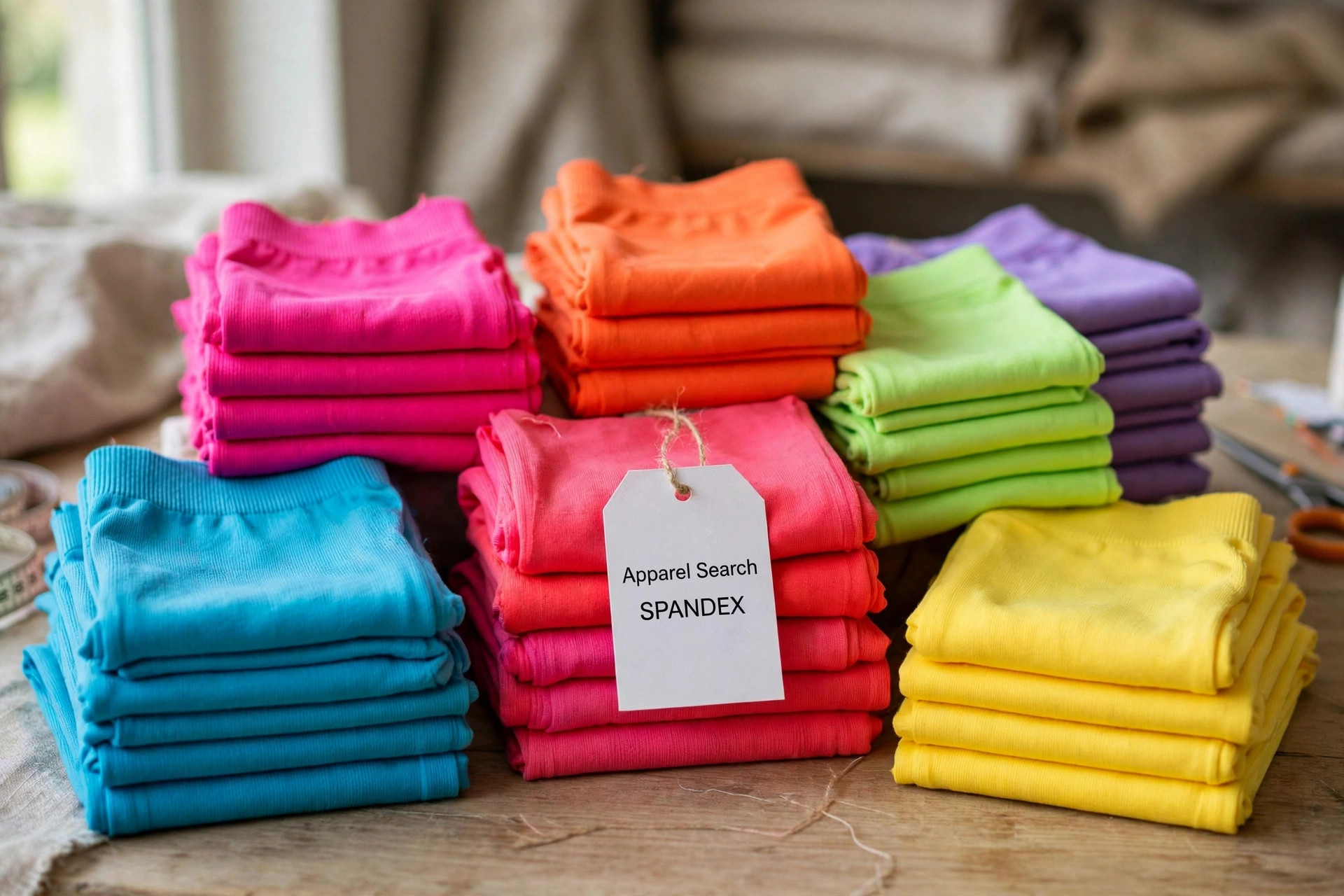
Spandex is the fiber you never see on its own and almost never take off. A few percent of it turns stiff denim into jeans that bend, a plain cotton tee into one that keeps its neckline, and a swimsuit into a second skin. It is also the most fragile fiber in most garments - usually the first to give out. This guide explains what spandex is, why it goes by three names, how much of it different garments actually contain, and how to buy and care for stretch clothing so the stretch lasts.
01 / The fiber
What Spandex Is
Spandex is a manufactured elastic fiber made of segmented polyurethane. Its long molecules alternate between soft, flexible segments and short, stiff segments: the soft segments uncoil and stretch, the stiff segments act as anchor points that pull the fiber back to its original length. That built-in spring is why spandex can be stretched repeatedly - its elongation at break is commonly put at 500 to 700 percent - and still recover, something no natural fiber can match. The formal United States definition, set by the Federal Trade Commission, is a manufactured fiber in which the fiber-forming substance is a long-chain synthetic polymer comprised of at least 85 percent of a segmented polyurethane.
One fiber, three names. Spandex is the generic name in the United States - the word is usually explained as a rearrangement of "expands." Elastane is the generic name in Europe and in the international ISO list, and it is accepted on United States labels as well. Lycra is neither: it is a trademark, originally DuPont's brand for its spandex, so all Lycra is spandex but not all spandex is Lycra. Whichever word a label uses, the percentage beside it is what matters.
The fiber was invented at DuPont by chemist Joseph Shivers in 1958, after a long search for an elastic fiber to replace rubber thread in foundation garments; DuPont developed it as "Fiber K" and brought it to market as Lycra in the early 1960s. For the formal definition, see the spandex fiber definition.
02 / Performance
How Spandex Feels and Performs
Spandex itself is not strong, soft or warm - its one talent is stretch with recovery, and it lends that talent to whatever fiber hosts it. Added to a fabric, it provides power (the force that holds a garment close), recovery (springing back instead of bagging at the knees, seat and elbows) and fit range (one garment comfortably fitting more bodies). Because the fiber is almost always wrapped in or knitted beside another yarn, the hand feel of a spandex fabric is the host fiber's feel - cotton, nylon or polyester - with stretch added.
The trade-off is durability. Spandex is slowly degraded by the things stretch garments meet most: chlorine in pool water, high heat in washing and drying, ultraviolet light, and body oils and lotions. It rarely fails all at once; instead a waistband goes wavy, leggings lose their snap, or a swimsuit turns slack and thin-feeling - the spandex filaments have broken down while the host fabric still looks sound. That is why the care section of this guide matters more for spandex than for almost any other fiber: how a stretch garment is washed decides how long it stays a stretch garment.
Strengths
- Stretches several times its length and recovers its shape
- Adds fit, comfort and shape retention at very low percentages
- Lightweight - a little transforms a fabric
- Resists wrinkling in the blends it supports
- Works in knits and wovens alike
Trade-offs
- Degraded by chlorine, high heat, UV light and body oils
- Usually the first fiber in a garment to fail
- Not strong on its own - always needs a host fiber
- Can lose recovery gradually, so garments bag out over time
- Makes blended garments harder to recycle
03 / Varieties
How Much Spandex? Blends by Garment
- Stretch denim and trousers - a small share does the work: core-spun yarns for denim commonly carry a few percent of spandex in the yarn, enough to let jeans bend and sit comfortably while still looking and wearing like denim.
- Cotton jersey and t-shirts - knitting yarns around 5 percent spandex are typical, giving tees, underwear and leggings-style tops their recovery; the neckline and cuffs keep their shape instead of stretching out.
- Leggings and activewear - higher shares, commonly in the teens and beyond, paired with nylon or polyester for the firm, close fit and full range of movement that training clothing needs.
- Swimwear - the highest everyday shares: measured swimwear fabrics commonly run from about 20 percent spandex upward, because a swimsuit must stretch, recover and hold its shape wet, when the host fibers are at their weakest.
- Hosiery, socks and foundation garments - spandex is what replaced rubber thread here: it gives stockings their cling, socks their stay-up grip and shapewear its smoothing power, in shares matched to how much compression the garment is meant to deliver.
- Woven stretch fabrics - a little spandex in the weft of a cotton or rayon woven gives shirts, dresses and suiting a measure of give without changing their woven character.
04 / Construction
How Spandex Reaches the Fabric
Spandex is never used alone - a garment of pure spandex would be a rubber band, not clothing. Instead the fine filament is combined with the host yarn in one of several forms. As a bare filament it is fed, stretched, directly into a knit alongside the ground yarn, as in plated cotton jersey. Covered yarn wraps a filament of nylon or polyester around the stretched spandex core. Core-spun yarn feeds the spandex through a spinning frame so staple fibers - cotton, for stretch denim - wrap it completely, hiding it inside a yarn that looks and feels like pure cotton. Air-covered yarn intermingles spandex and filament with air jets, a faster route used widely in denim and hosiery.
The covering is more than camouflage: it protects the fragile core from abrasion and light, and it decides how the fabric behaves. In a knit, spandex can be plated into every row for firm, even stretch, or into alternate rows for a lighter touch. In wovens it usually runs in the weft only, giving crosswise stretch while the warp keeps the cloth stable. When you read a label, the construction explains the percentage: a core-spun denim needs only a little spandex because it sits in half the yarns, while a swimsuit knit needs a fifth or more because the spandex is doing the structural work of holding the garment on the body.
05 / Buying
How to Choose Stretch Clothing
Match the percentage to the job. For everyday comfort - jeans you sit in all day, tees that keep their shape - a few percent is plenty, and more would only make the garment cling. For leggings, compression wear and swimwear, look for the higher shares listed in this guide and a reputable host fiber: nylon-spandex for swim and smooth activewear, polyester-spandex where sun and chlorine resistance matter most, since polyester tolerates both better than the spandex it carries.
Then judge the recovery, not just the stretch. Pull the fabric and let go: good spandex fabric snaps back flat, with no ripples at the edge of the stretched area. Check waistbands and straps for even tension, and hold thin knits up to the light - a shiny, grin-through look on leggings means the spandex is already straining. Finally, read the care label before you buy: if your routine is a hot wash and a hot dryer for everything, know that stretch garments will age faster in your laundry than in anyone's, and choose accordingly.
06 / Care
Caring for Spandex
Wash stretch garments in cool or warm water on a gentle cycle, and air dry them whenever you can - heat is spandex's enemy in the dryer just as chlorine is in the pool. Skip fabric softener, which coats the fibers and dulls their recovery, and keep chlorine bleach away entirely. Rinse swimwear in clean water promptly after every swim, and wash out sunscreen and body oils regularly, since both work on the fiber while it sits. See the fabric care guide for the full routines by fabric.
Storage helps too: fold stretch garments rather than hanging them by their straps or waistbands, which loads the spandex continuously, and keep them out of strong light. Treated this way, the spandex in a garment can last nearly as long as its host fabric; treated roughly, it will be the reason an otherwise sound garment is retired - waistband first, then knees, then all over.
Spandex at a Glance
Common Questions
Are spandex, elastane and Lycra the same thing?
Spandex and elastane are the same fiber under two generic names: spandex is the United States generic name and elastane is the European and ISO name, and both are defined as at least 85 percent segmented polyurethane. Lycra is different in kind - it is one producer's trademark for its spandex, originally DuPont's brand. All Lycra is spandex, but not all spandex is Lycra.
How much spandex should a garment have?
It depends on the job. A few percent is enough to make denim and trousers comfortable and to keep cotton jersey in shape. Leggings and activewear commonly use shares in the teens, and swimwear commonly runs from about 20 percent upward, because a swimsuit has to stretch and recover while wet. More is not automatically better - beyond what the garment needs, extra spandex just adds cling.
Why did my leggings lose their stretch?
The spandex filaments have degraded - usually from heat in washing and tumble drying, chlorine, ultraviolet light, or body oils and lotions left in the fabric. Spandex is typically the first fiber in a garment to fail, so the cotton or nylon around it can look fine while the recovery is gone. Cool washing, air drying and prompt rinsing after swimming slow the process considerably.
Can you put spandex in the dryer?
Only on low heat if the care label allows it, and air drying is always kinder. High dryer heat breaks down the polyurethane segments that give spandex its recovery, so repeated hot drying is one of the fastest ways to make a stretch garment baggy. If you do tumble dry, remove the garment while it is still slightly damp.
More to Explore
Explore more: Fabric Directory | Fabric Industry Guide
Search Apparel Search
Fabric Guides
- Fabric Guides Hub
- Cotton Fabric Guide
- Denim Fabric Guide
- Silk Fabric Guide
- Linen Fabric Guide
- Wool Fabric Guide
- Polyester Fabric Guide
- Cashmere Fabric Guide
- Nylon Fabric Guide
- Spandex Fabric Guide
- Rayon Fabric Guide
- Corduroy Fabric Guide
- Satin Fabric Guide
- Chiffon Fabric Guide
- Twill Fabric Guide
- Velvet Fabric Guide
- Jersey Fabric Guide
- Fleece Fabric Guide
- Lace Fabric Guide
- Tulle Fabric Guide
- Poplin Fabric Guide
- Fabric Care Guide