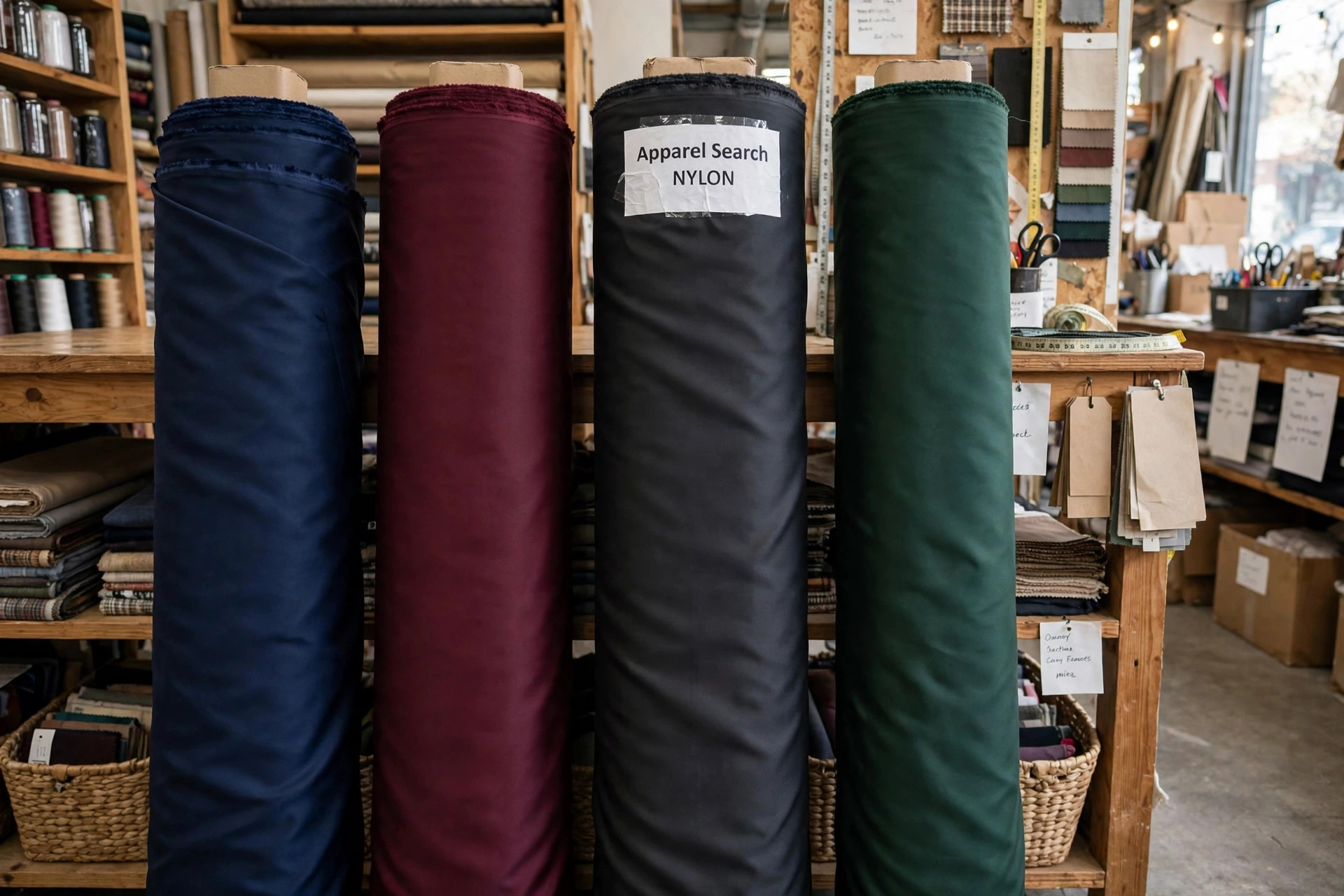
Nylon was the first fully synthetic fiber sold to the public, and it changed what clothing could do: stockings that did not ladder as easily as silk, swimwear that dried in minutes, and rain jackets that weighed almost nothing. Yet "nylon" on a label covers two related polymers and a wide range of cloth, from sheer hosiery to rugged ripstop. This guide explains what nylon is, how nylon 6 and nylon 6,6 differ, what the fiber does well and where it needs care, and how to choose and look after nylon garments.
01 / The fiber
What Nylon Is
Nylon is a polyamide - a synthetic polymer whose long chains are joined by amide linkages. On European labels the same fiber is usually called polyamide; in the United States it is nylon, and the two words name the same material. Because nylon is a thermoplastic, it is made by melting polymer chips and extruding them through a spinneret into fine filaments, which are then drawn - stretched - to align the molecules and build strength. That melt-spinning is why nylon can be made as a smooth filament yarn for stockings or textured into bulky yarns for outerwear and carpets.
The fiber was created at DuPont, where Wallace Carothers' research group first synthesized nylon 6,6 on 28 February 1935. DuPont announced nylon in 1938, and its first commercial use was humble: nylon-bristled toothbrushes, sold that year. The famous use followed quickly - women's stockings, shown at the 1939 New York World's Fair and put on national sale on 15 May 1940, sold out so fast that "nylons" became the everyday word for stockings themselves. During the Second World War, nylon production was diverted to parachutes, ropes and other military supplies, and civilian stockings became scarce until the war ended.
DuPont's work built in part on the company's experience with rayon, the earlier manufactured fiber - but nylon was something new: a fiber made entirely from chemicals rather than from a natural polymer. For the formal definition, see the nylon fiber definition.
02 / Performance
How Nylon Feels and Performs
Nylon's reputation rests on toughness. It is a strong fiber for its weight and has the best abrasion resistance of the common apparel fibers, which is why it is chosen where cloth rubs: hosiery, sock heels, bag straps, and the seat and knees of outdoor trousers. It is elastic and resilient, so nylon garments recover their shape well, resist wrinkling, and keep a crisp finish. Nylon takes up a moderate amount of moisture - a moisture regain of about 4 percent, more than polyester but far less than cotton - so it feels less clammy than polyester in wear yet still dries quickly.
Heat is nylon's main weakness. As a thermoplastic it softens well below its melting point and melts rather than burns: about 220 °C for nylon 6 and about 260 °C for nylon 6,6. A too-hot iron can glaze or hole it, and nylon should be ironed, if at all, on the lowest setting. Sunlight is the second weakness: prolonged ultraviolet exposure weakens and yellows nylon, and chlorine - in bleach and, more slowly, in pool water - attacks the fiber, so nylon swimwear and whites need rinsing after the pool and should never meet chlorine bleach.
Strengths
- Very strong for its weight, with excellent abrasion resistance
- Elastic and resilient - resists wrinkles, keeps its shape
- Lightweight and quick-drying
- Takes dye well, in deep, even colors
- Resists mildew and most alkalis
Trade-offs
- Melts instead of burning; glazes under a hot iron
- Weakened and yellowed by prolonged sunlight
- Degraded by chlorine bleach and pool chlorine
- Can build static in dry conditions
- Absorbs more moisture than polyester, so dries a little slower
03 / Varieties
Nylon 6, Nylon 6,6 and Other Types
- Nylon 6,6 - the original DuPont polymer, made from two starting chemicals, hexamethylenediamine and adipic acid, each with six carbon atoms - hence the name. It is the stiffer, harder-wearing of the two main nylons, with the higher melting point, about 260 °C.
- Nylon 6 - a different polymer, made from a single starting chemical, caprolactam. Developed in Germany by Paul Schlack in 1938, it melts lower, at about 220 °C, processes more easily, and takes color readily. In garments the two feel much alike; the difference shows up in heat resistance and processing.
- Textured and high-tenacity nylon - filament yarns can be crimped or air-textured for bulk and a softer, more fabric-like hand, or spun to high-tenacity grades for demanding uses such as parachutes, luggage and reinforcement cord.
- Ripstop nylon - a construction rather than a polymer: a plain weave with stronger threads woven in a grid at intervals, so a tear stops at the next grid line instead of running. It is the standard cloth of lightweight jackets, kites and pack fabric; see the ripstop nylon definition.
- Nylon blends - nylon is blended for the job: with cotton for soft, hard-wearing casual cloth, and very often with spandex, whose stretch turns nylon tricot into swimwear and activewear that moves with the body.
04 / Construction
Nylon Fabrics and Constructions
Because nylon filament is smooth and strong, it excels in fine, sheer cloth. Tricot, a warp knit, is the smooth, slightly stretchy fabric of lingerie, linings and swimwear. Taffeta is a crisp plain weave used in linings, windbreakers and formal dresses. Ripstop weaves, described above, make ultralight outerwear and gear, often with a water-repellent or coated finish that turns a breathable cloth into a weatherproof shell.
Heavier nylon cloth includes canvas and ballistic-style weaves for bags, luggage and workwear, where abrasion resistance matters more than softness. Knitted nylon ranges from the fine denier of hosiery - where nylon's strength lets a stocking be both sheer and serviceable - to brushed and textured knits for base layers and fleece-style tops. And a large share of nylon never becomes clothing at all in the narrow sense: it is the support fiber inside blends, adding wear life to socks, gloves and the knees and seats of trousers made chiefly from other fibers.
05 / Buying
How to Choose Nylon
Choose nylon when abrasion, lightness or quick drying leads the brief: swimwear and rash guards, rain shells and windbreakers, hosiery and socks, travel clothing that must pack small and resist wrinkles, and bags or straps that will be dragged and rubbed. For swimwear, look for a nylon-spandex tricot and rinse it after every swim - chlorine, not water, is what shortens its life. For outdoor clothing that will live in strong sun, remember that polyester tolerates ultraviolet better; nylon is the pick where rubbing wear, not sunlight, is the main threat.
Read the label for the blend and the finish. A coating (often polyurethane) makes nylon water-resistant or waterproof but can stiffen the hand and will eventually age; an uncoated ripstop breathes better and suits windproof rather than waterproof use. Denier tells you the fineness of the yarn - low denier means sheer and light, high denier means heavy-duty - and textured yarns feel softer and less synthetic than flat filament. Finally, check the care label's iron and wash temperatures before you buy: nylon asks for low heat everywhere, and a garment you cannot keep out of a hot dryer will not stay at its best.
06 / Care
Caring for Nylon
Machine wash nylon in cool or warm water with similar colors, and keep chlorine bleach away from it entirely - use an oxygen-based bleach if whites need brightening. Nylon dries quickly, so line dry it in the shade or tumble dry on low; high dryer heat and strong sun both damage it, one by glazing and shrinking, the other by weakening and yellowing. If ironing is needed, use the lowest setting, ideally through a cloth. See the fabric care guide for the full routines by fabric.
Two habits matter most for nylon swimwear and activewear: rinse promptly in clean water after exposure to pool chlorine or salt, and wash out body oils and sunscreen, which work on the spandex partner in the blend as well as on the nylon. Stored clean, dry and out of direct light, nylon keeps its strength for years - it is sunlight and heat, far more than washing, that age it.
Nylon at a Glance
Common Questions
Is nylon the same as polyamide?
Yes, for clothing. Polyamide is the chemical family name and nylon is the name the fiber was launched under at DuPont. United States labels usually say nylon and European labels usually say polyamide, but they describe the same fiber - most often nylon 6 or nylon 6,6.
What is the difference between nylon 6 and nylon 6,6?
They are different polymers. Nylon 6,6 is made from two starting chemicals and melts at about 260 degrees Celsius; nylon 6 is made from caprolactam alone and melts at about 220 degrees Celsius. Nylon 6,6 is a little stiffer and more heat-resistant; nylon 6 processes more easily and takes color readily. In a finished garment they feel very similar.
Does nylon shrink?
Not in a normal wash. Nylon fabric is heat-set during finishing, which fixes its dimensions, so washing in cool or warm water does not shrink it. Heat is the risk: a hot dryer or a hot iron can release the set, distort the fabric, or glaze and even melt it, so always use low heat.
Can you bleach nylon?
Never with chlorine bleach. Chlorine attacks the polyamide chains, weakening the fiber and yellowing whites, and pool chlorine does the same damage more slowly - which is why nylon swimwear should be rinsed after every swim. If whites need brightening, use an oxygen-based bleach instead.
More to Explore
Explore more: Fabric Directory | Fabric Industry Guide
Search Apparel Search
Fabric Guides
- Fabric Guides Hub
- Cotton Fabric Guide
- Denim Fabric Guide
- Silk Fabric Guide
- Linen Fabric Guide
- Wool Fabric Guide
- Polyester Fabric Guide
- Cashmere Fabric Guide
- Nylon Fabric Guide
- Spandex Fabric Guide
- Rayon Fabric Guide
- Corduroy Fabric Guide
- Satin Fabric Guide
- Chiffon Fabric Guide
- Twill Fabric Guide
- Velvet Fabric Guide
- Jersey Fabric Guide
- Fleece Fabric Guide
- Lace Fabric Guide
- Tulle Fabric Guide
- Poplin Fabric Guide
- Fabric Care Guide