Apparel Search · Fabric Construction Guide
Honeycomb Weave: The Cellular Waffle Structure
Warp and weft floats arranged in rings leave a sunken plain-woven centre in every cell — a three-dimensional grid of pockets that drinks water, traps air and gives waffle towels their texture.
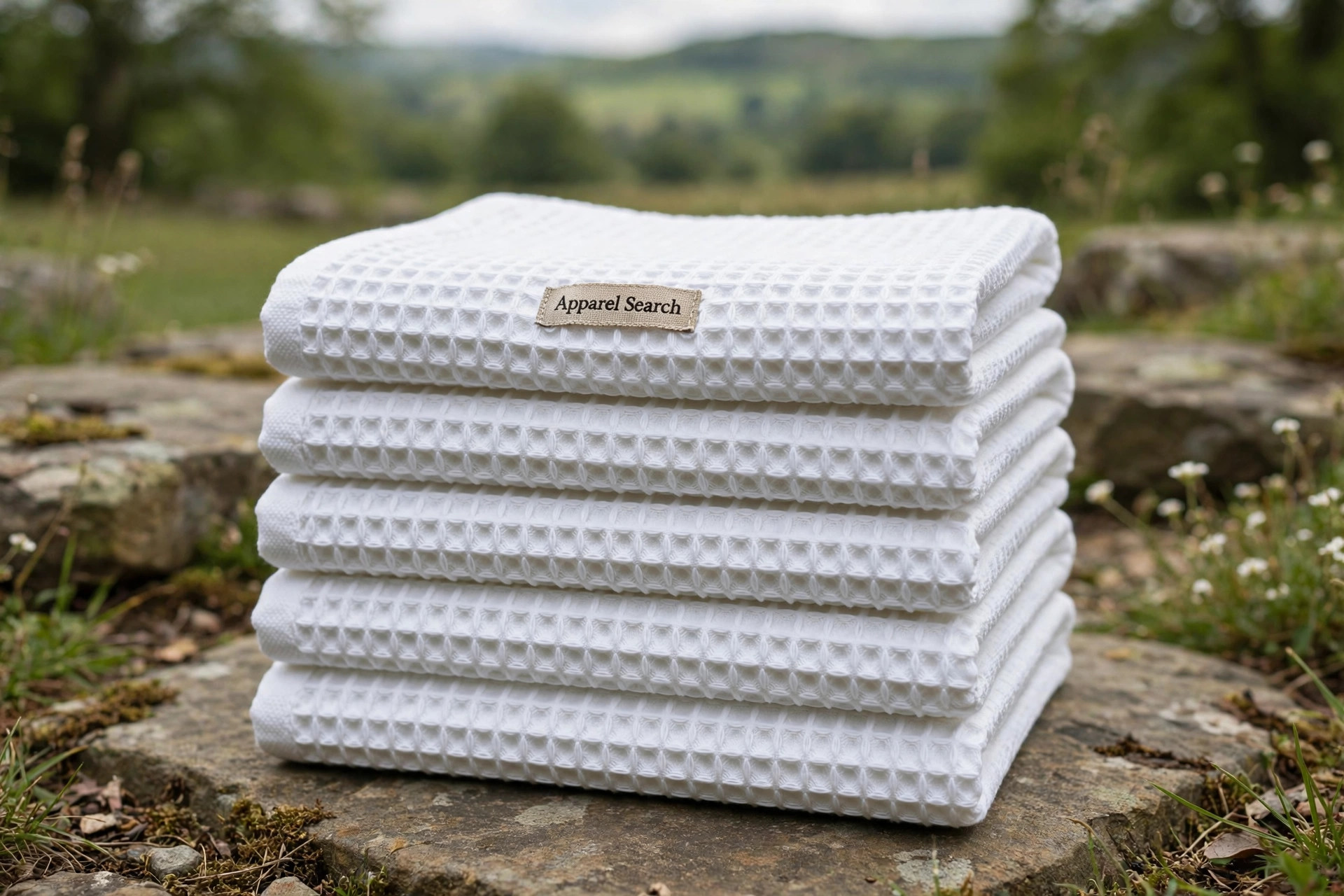
Run a fingertip across a good waffle towel and the structure announces itself before you ever look at it: a regular grid of soft ridges with a distinct hollow at the middle of every square. That grid is not printed, embossed or applied in finishing — it is the weave itself. Honeycomb weave, called waffle weave in everyday usage, builds its cells directly on the loom out of nothing more exotic than warp floats, weft floats and plain interlacing arranged in the right order. It is one of the most satisfying structures in the Weaving & Woven Fabric Construction guide: a modest pattern of floats produces a cloth that is three-dimensional, thirsty, warm and unmistakable.
Honeycomb belongs to the family of patterned structures that grow out of the three fundamentals covered in Basic Weave Structures. Where plain weave binds every yarn at every crossing and satin lets yarns float in one direction only, honeycomb organises its floats into closed rings — warp floats standing up on two sides of each square, weft floats lying across the other two — and leaves the middle of the square woven tight and plain. The contrast between the loose ring and the bound centre is the whole design. In the loom state the cloth looks fairly flat; it is in washing and finishing, when the float yarns relax and contract more than the tightly bound centre, that the middle of each cell is pulled down and the familiar pockets open up.
Honeycomb Weave, Defined
Honeycomb weave (waffle weave) is a dobby-woven structure in which warp and weft floats are arranged in rings around a centre of plain weave. The floats form raised ridges on the four sides of each square cell while the bound centre contracts in finishing and sinks below them, producing a regular three-dimensional grid of pockets resembling a honeycomb — or the indented face of a breakfast waffle.
How the Interlacing Works: Floats Around a Sunken Centre
Simple honeycomb repeats on about eight to ten ends and eight to ten picks, and even the deep, bold waffles woven for bath towels rarely need more than twice that. That is well beyond the two shafts of plain weave, so honeycomb is woven with a dobby mechanism controlling the extra shafts — the pattern is small, geometric and repeats identically across the full width, which is precisely the work dobbies exist to do. Within one repeat, read the draft below as a map of a single cell: filled squares show the warp uppermost at that crossing, and the rust dots mark the picks where the weft floats to the face.
On the left and right sides of the cell, the same few warp ends float over six or seven consecutive picks. Freed from frequent binding, those ends stand slightly proud of the surface and read as two vertical ridges. On the top and bottom sides the roles reverse: the weft floats over four consecutive ends, forming the two horizontal ridges and completing the ring. Every ridge is therefore a float — a short length of yarn lying on the surface, anchored only at its ends — which is why honeycomb ridges feel softer and fuller than the ground cloth around them, and why the ridges, not the centres, meet your hand first.
Inside the ring, warp and weft interlace in strict one-over-one-under plain weave, the most tightly bound interlacing there is. At the four corners the pattern turns: the floats end, binding points multiply, and the cloth is pinned flat and firm. The corners matter more than their size suggests — they are the anchors that stop the ridges from sliding, and they give the finished cloth its surprising stability for a structure built from so many floats.
The third dimension arrives after weaving. Float yarns, held under tension on the loom and bound only occasionally, contract strongly when the cloth is relaxed in washing; the plain-woven centre, already interlaced at every crossing, can contract very little. The centre is therefore drawn inward and downward by the ring around it, the ridges rise correspondingly, and a flat draft on paper becomes a pocketed cloth in the hand. This is also why new waffle towels often look disappointingly flat on the shelf and only develop their full depth after the first wash or two, as the yarns complete their relaxation and the cells settle into shape.
Structure and Properties
Absorbency is the property the structure is famous for, and it works three ways at once. The floats present far more yarn surface to water than a flat cloth of the same weight; the sunken pockets hold water mechanically, the way the holes of a sponge do; and the channels between ridges spread liquid sideways across the cloth instead of letting it bead and run off. A honeycomb towel therefore drinks faster and holds more than a plain-weave towel of equal weight, which is why the structure owns the towel rail despite being centuries old.
The same openness that admits water lets air through, so honeycomb dries noticeably faster than a dense terry cloth of similar absorbency and stays fresher between washes. Still air held in the cells insulates, which is why waffle blankets and bathrobes feel warm out of proportion to their weight. The broken, shadowed surface hides soil and creasing well — a practical virtue in white hotel and spa textiles that must look clean under hard use and frequent laundering.
The floats set the limits. Long surface yarns can snag on rough edges, jewellery and wash-drum fittings, and the ridges abrade sooner than a tightly bound ground, so honeycomb is a poor choice where the cloth will be dragged or scuffed. The cells also relax with age: after many washes the pockets soften and shallow, though the cloth remains serviceable long after its crispest texture has gone. Larger, deeper cells maximise absorbency and insulation; smaller, shallower cells give a firmer, more durable cloth.
| Cell part | What the yarns do | What it contributes |
|---|---|---|
| Warp-float ridge | A few warp ends float over six or seven picks on each side of the cell | Raised lengthwise ridges; extra yarn surface for absorbency |
| Weft-float ridge | The weft floats over about four ends across the top and bottom of the cell | Raised crosswise ridges that complete the ring around the pocket |
| Sunken centre | Warp and weft interlace in plain weave, bound at every crossing | Contracts least in finishing, so it is pulled down into the absorbent pocket |
| Cell corner | Floats end and binding points concentrate where the ridges meet | Anchors the cell, stops the floats sliding and keeps the grid square |
Fabrics and End Uses
Towels are the structure's home ground. Bath towels, hand towels and washcloths in cotton honeycomb are standard issue in hotels, spas, gyms and hospitals across much of Europe and increasingly elsewhere, valued because they wash, dry and store in bulk far more cheaply than terry while performing nearly as well. Bathrobes and spa wraps use a larger, bolder repeat for a deep, soft grid that feels luxurious at a fraction of the weight of a terry robe — and packs into a suitcase far more willingly.
Cellular blankets are the second classic: the pockets trap warm air against the sleeper while the open structure still breathes in summer, a combination that made honeycomb the traditional hospital and cot blanket. In the kitchen, honeycomb dish cloths and glass cloths exploit the same absorbency and fast drying, and the ridges give a gentle scouring action on glassware. Finer, shallower repeats appear in shirtings and summer dress fabrics, where the texture reads as a quiet self-pattern rather than a bold grid.
One naming trap deserves a clear warning. The waffle of thermal underwear, henley shirts and much casual knitwear is usually not this weave at all: it is a knitted imitation, its grid formed by textured knit stitches in a stretchy fabric. Woven honeycomb does not stretch like a knit and is made on a loom, not a knitting machine; the woven versus knit comparison shows the structural difference, and the FAQ below answers the question directly.
How to Recognize Honeycomb Weave
The fingertip test is the quickest: draw a finger slowly across the cloth and you will feel the regular rise and fall of ridge and hollow, in both directions, at even intervals. Hold the fabric to the light and the geometry sharpens — the ridges catch light and shadow alternately, and the grid reads as clearly as graph paper. Cell size is a useful clue to purpose: small, tight cells suggest shirting or glass cloth, while large, deep cells point to towels, robes and blankets.
Turn the cloth over. True honeycomb shows the same cellular pattern on the back, in reverse — where the face carries a warp ridge, the back shows the corresponding weft arrangement — because the structure is built through the full thickness of the cloth, not applied to one face. An embossed or printed imitation, by contrast, is smooth or merely patterned on the back. Set beside its neighbours in the woven fabric types by structure survey, honeycomb is unmistakable: no other common structure combines a sunken square pocket with float ridges standing on all four sides, and once you have handled one genuine example the identification becomes instant.
More Weave Structures
Common Questions
Are honeycomb and waffle weave the same thing?
Yes. Honeycomb is the traditional weaver's name and waffle the everyday name — especially in North America — for one and the same structure: rings of warp and weft floats surrounding a sunken plain-woven centre. One name looks at the bee's cell, the other at the breakfast waffle; the cloth on the loom is identical.
Why are waffle towels so absorbent?
The cells work three ways at once. The float ridges present extra yarn surface to the water, the sunken pockets hold water the way a sponge's holes do, and the channels between ridges spread liquid across the cloth instead of letting it run off. The open texture then lets the towel dry quickly between uses.
Is honeycomb a dobby or jacquard weave?
A dobby weave. The repeat is small — commonly eight to ten ends and picks — and the same float pattern repeats identically across the width, which is exactly the work a dobby head performs. Jacquard control of individual ends is reserved for large figured designs and would be wasted on so regular a grid.
Is the waffle in thermal shirts this weave?
Usually not. Most thermal and henley shirts sold as waffle are knitted, not woven: their grid is formed by a textured knit stitch in a fabric that stretches with the wearer. True honeycomb is woven on a loom and does not stretch that way. The woven versus knit guide explains how the two families differ.
Back to the Weaving & Woven Fabrics Guide
The Weaving & Woven Fabrics hub maps the whole construction story — the loom cycle, loom types, patterned weaving and the named fabrics each structure produces.
Search Apparel Search