Purchasing Agent Job Description
Buying for the business itself — materials, services and contracts, negotiated with precision
A purchasing agent buys what a business needs to operate: raw materials and components, machinery and equipment, packaging, office supplies and contracted services. Unlike a retail buyer, whose customer is the shopper, the purchasing agent's customer is the organisation itself — so success is measured in continuity of supply, specification compliance and total cost, not in seasonal fashion judgement. In a clothing company this can mean fabric and trim contracts running alongside logistics and IT services, coordinated with the merchandising buyers whose ranges those materials will become. This description explains the procurement craft end to end.
More Buying Job Descriptions by Letter:
Specifying Needs Before Talking to Suppliers
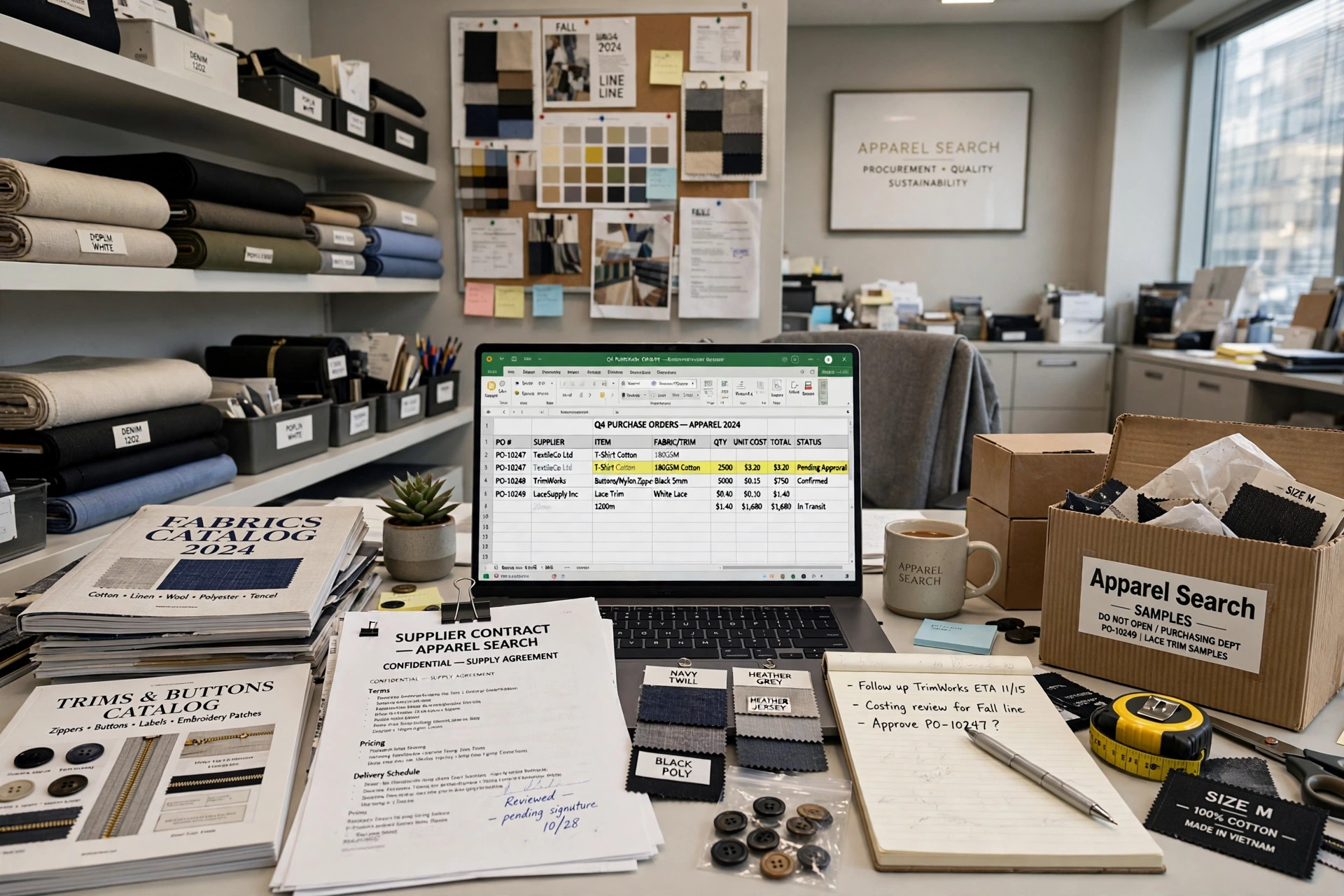
Every purchase begins with a specification written in measurable terms: fibre content and weight for a fabric, tolerance for a trim, service-level terms for a contractor, delivery windows for a component. The purchasing agent works with the departments that will use the goods — production, design, warehousing, administration — to pin those requirements down, because an imprecise specification produces incomparable quotations and disputes on delivery. Approved-supplier lists, sample evaluations and trial orders are maintained as working tools, not paperwork.
Requirement forecasting is part of the job. Production schedules, seasonal peaks and maintenance cycles are translated into forward demand, so contracts can be negotiated before urgency removes bargaining power. A purchasing agent who only reacts to requisitions is always paying the urgent price; the effective ones keep a forward calendar of renewals and re-tenders and start the process while alternatives still exist.
Supplier Evaluation, Tendering and Negotiation
Supplier selection weighs more than unit price. Financial stability, production capacity, quality systems, delivery reliability, geographic risk and, increasingly, environmental and labour standards are scored before a contract is signed. For significant contracts the agent runs formal tenders: invitation documents, comparable bid formats, clarification rounds and a documented award rationale that stands up to internal audit.
Negotiation then covers the full commercial picture — price breaks by volume, payment terms, minimum orders, lead times, quality tolerances, penalties for late or non-conforming delivery, and exit clauses. Experienced agents negotiate total cost of ownership rather than headline price: a cheaper fabric that raises defect rates, or a service contract that excludes weekend cover the business actually needs, is no bargain at all.
Contracts, Orders and Delivery Management
Once awarded, the purchase is embodied in a contract or purchase order that the agent administers: confirming acknowledgements, tracking production and shipment milestones, resolving specification queries, and authorising payment only against goods or services received and accepted. Inspection regimes — incoming quality checks, random sampling, service-performance reviews — are agreed in advance and applied consistently, so suppliers know the standard and the buyer knows the evidence.
Disruption management is a daily reality: a mill closure, a shipping delay, a supplier quality failure. The agent's contingency planning — dual sourcing on critical inputs, safety stock where the economics justify it, and pre-qualified alternates — determines whether a disruption becomes a production stop or a brief reschedule. Records of supplier performance feed the next tender, closing the loop between today's delivery and tomorrow's award.
Working With Buyers, Officers and the Wider Business
In larger organisations the purchasing function is layered: buyers may hold category responsibility, purchasing officers administer orders and supplier records, and the agent coordinates the whole flow, resolving conflicts between a merchandising buyer's fashion deadline and a production schedule's material reality. Clear internal communication prevents the classic failure in which a beautiful range is sold before its fabric is secured, or a factory is booked before its trims are ordered.
The agent also manages the boundary with finance and legal colleagues: spend reporting against budgets, contract compliance, and audit trails for decisions involving significant sums. Stakeholders who understand why a supplier was chosen — and what it costs to switch — support procurement decisions instead of circumventing them with direct orders that undermine volume leverage.
Qualifications, Skills and Where Procurement Leads
Entry routes include business, supply-chain or textiles qualifications, and administrative roles inside purchasing departments where order processing and supplier contact teach the trade. Professional credentials in procurement and supply management are widely recognised and increasingly expected for senior posts, while negotiation training and contract-law literacy are practical advantages throughout.
Progression runs from purchasing officer or assistant buyer to purchasing agent with category ownership, then to procurement or supply-chain manager, head of procurement and, in manufacturing businesses, operations leadership. The discipline also transfers into consultancy and into category-management roles on the supplier side, where buyers who understand how procurement decisions are really made are in demand.
Buying Agent, Clothing Buyer or Purchasing Agent?
Three titles in this corner of the trade are often confused. A purchasing agent — this page — procures the materials, machinery and services a business itself needs. A Buying Agent is an independent intermediary who sources overseas suppliers for clients, while the Clothing Buyer is the in-house retail role that selects the ranges a store sells.
Common Questions
How is a purchasing agent different from a retail buyer?
The customer differs. A retail buyer purchases merchandise for shoppers to buy, judged on fashion, sales and margin. A purchasing agent buys goods and services for the business itself, judged on specification compliance, continuity of supply and total cost.
What does a purchasing agent actually negotiate?
Far more than unit price: volume breaks, payment terms, lead times, quality tolerances, delivery penalties, service levels and exit clauses. The measure is total cost of ownership — including defects, disruption and service — not headline price.
What qualifications help someone become a purchasing agent?
Business or supply-chain study helps, as do professional procurement credentials for senior roles. Practical experience in a purchasing department — order administration, supplier contact, tender support — is the most common and respected entry path.