Working in the Fashion Industry
How fashion jobs fit together — design, production, merchandising, sales and media, and the routes into each
A fashion industry job is not one job — it is a place in a chain. A garment begins as research and a sketch, becomes a pattern and a sample, is costed, bought, manufactured, shipped, marketed and sold, and at every step a different specialist does work the others depend on. People who thrive in the industry usually start in one specialism but succeed by understanding the whole chain: what the pattern room needs from a sketch, what a factory needs from a tech pack, what a store needs from a delivery date. This page maps the main job families, explains how they connect across a season, and sets out the realistic routes into each — the overview to read before the individual job descriptions in this directory.
More Design Job Descriptions by Letter:
The Main Job Families
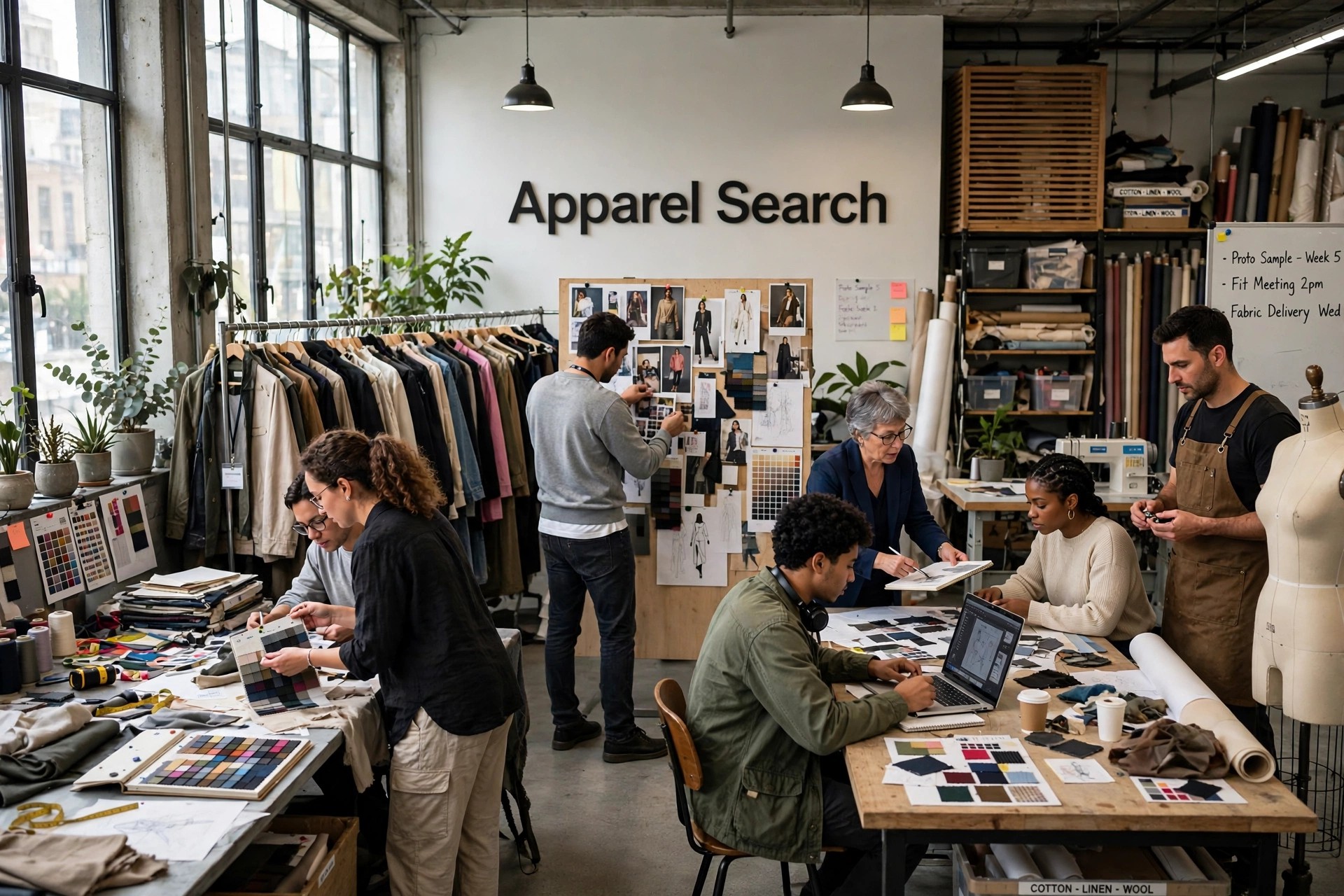
Design and product development create the goods: fashion designers, assistant and associate designers, textile and graphic designers, illustrators, pattern cutters, garment technologists and sample machinists. Merchandising and buying decide what is made and sold in what quantities: merchandisers plan ranges and stock, buyers select product for stores, and planners and allocators move it to where it will sell. Production and sourcing make it happen physically — production managers, sourcing specialists, quality controllers and the factories themselves — while technical roles guard fit, construction and compliance with safety and labelling standards.
The second half of the chain sells and explains the product. Sales teams and showroom staff sell ranges to retail buyers; marketing, PR and social media teams create demand; visual merchandisers and retail staff present goods in stores; e-commerce teams present them online. Around all of it sit the supporting professions the industry cannot run without: photographers and stylists, journalists and publishers, agents and recruiters, logistics and warehouse teams, and the finance and administration staff of every fashion business. The job descriptions in this directory are organised by these families so you can compare neighbouring roles.
How a Season Connects the Jobs
Fashion works to seasonal calendars, and the calendar is the industry's connective tissue. Designers develop a collection months before it reaches stores; merchandisers build the range plan around the designs; production places orders against factory capacity and fabric lead times; marketing plans campaigns around delivery dates; and retail teams plan space and staffing around the launch. A delay anywhere — a fabric shipping late, a fit round needing one more sample — moves everyone else's deadlines, which is why the industry prizes people who communicate early and understand what their lateness costs colleagues downstream.
Following one garment through the chain is the fastest fashion education available. The sketch becomes a tech pack; the pack becomes a costed sample; the sample is fitted, corrected and approved; buyers order it in quantities merchandisers sanity-check; a factory produces it; quality control passes or rejects it; it is shipped, warehoused, photographed, described, displayed and sold — then its sales figures become research for the next season's sketch. Every job description in this directory is one station on that journey, and knowing where your station sits is the beginning of professional judgement.
Entry Routes and Qualifications
Entry routes differ by family. Design roles are usually reached through fashion degrees and internships, with portfolios deciding appointments; merchandising and buying through fashion business or numerate degrees, retail experience and demonstrable commercial flair; production and technical roles through garment technology, textiles or manufacturing training, often with factory-floor experience valued above paper qualifications. Media, PR and marketing draw on communications and journalism backgrounds plus a demonstrable obsession with fashion brands and audiences. Across all families, internships, placements and junior assistant posts are the common first foothold.
Formal education is only part of the preparation. The industry runs on product knowledge — fabrics, construction, brands, price architecture, retail formats — and candidates who have worked in stores, handled garments, followed seasons and can talk intelligently about why a collection succeeded stand out at interview. Computer fluency is assumed almost everywhere now: spreadsheets in merchandising, CAD in design, content and commerce platforms in marketing and retail. Languages help in sourcing and international sales, where suppliers and customers span continents.
Building a Career Across the Industry
Careers grow by deepening a specialism first. The recognised ladders — assistant to associate to senior in design, assistant merchandiser to merchandiser, junior buyer upward, production coordinator to production manager — reward people who master their station's craft and its tools. Promotion then starts to depend on the cross-chain understanding this page began with: senior people are paid for judgement about other families' constraints as much as their own, for anticipating the fit problem, the fabric delay or the range imbalance before it lands.
Movement between families is common and often healthy: designers move into product development and range planning, merchandisers into e-commerce trading, journalists into brand communications, retail experts into buying. Freelance and portfolio careers run alongside employed ones in creative and media roles. The constant is change — new channels, new materials rules, new consumer expectations — and the professionals who last are those who keep learning the chain rather than defending one station of it. The individual descriptions that follow give the duties, skills and qualifications of each role in detail.
Common Questions
What kinds of jobs are there in the fashion industry?
Design and product development, pattern cutting and garment technology, merchandising and buying, production and sourcing, sales, marketing and PR, visual merchandising and retail, e-commerce, photography and styling, journalism and media — plus logistics, finance and administration supporting them all.
Do you need a degree to work in fashion?
For design, merchandising and buying roles a relevant degree is the usual route, and portfolios or commercial evidence decide appointments. Technical, production, retail and sales routes also value hands-on experience highly. Internships and assistant-level posts are the common first step in nearly every family.
Where should a newcomer start exploring fashion careers?
Start with the job family that matches your strengths — creative, numerical, technical or people-facing — then read the individual job descriptions for those roles, note the qualifications they ask for, and build the portfolio, experience or training evidence those descriptions call for.