Swimwear Report — Executive Summary — Sample Pages: Sourcing Swimwear from China
China Sourcing Report — Swimwear: executive summary — sample pages
This page presents sample pages from the executive summary of the Swimwear China Sourcing Report — the short opening section that compresses 115 pages of industry analysis, 65 supplier profiles and a 193-product gallery into the findings a decision-maker needs first. An executive summary in a sourcing report is not a sales pitch; it is the argument of the whole report, stated with its evidence, so a busy buyer can decide where to read deeply. The navigation directly below this introduction carries every link on this page, including the table of contents and the sample pages for the industry overview, supplier profile and product gallery.
Directory, Report and Magazine Links on This Page
Executive Summary: Swimwear
China is the world's largest exporter of swimwear, accounting for approximately 70 percent of global shipments, and exports continue to show strong growth: most suppliers anticipated overseas shipments to increase by at least 20 percent in 2006, and exports at the beginning of 2006 had already risen by more than 20 percent in value. In 2005 the country shipped more than 259 million pieces of men's, women's and children's swimwear worth about US$383 million — up 26 percent in volume and 38 percent in value on the previous year. The elimination of all WTO textile quotas in 2005 helped propel the US to become the top single importer of China-made swimwear, purchasing US$79 million worth in that year, an increase of more than 500 percent in value from 2004; regionally the EU takes the top spot with 92 million pieces worth US$128 million, with Germany, the UK, Italy, France and Spain the main destinations. OEM orders make up the bulk of shipments, especially to the US and the EU — about 70 percent of exports are for OEM clients, and many small companies devote their entire production to OEM work, while OBM products go mainly to Eastern Europe, South America and Africa.
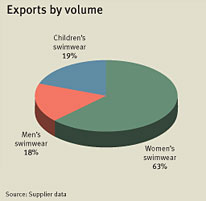
The key trends: more suppliers will produce upscale designs in 2006 as low-end price competition intensifies, enhancing models with performance fabric, unique prints, beadwork and embroidery; buyers can expect more functional releases, with UV resistance, shape retention and chlorine resistance among the common features in new products; many companies are upgrading facilities to improve efficiency and design capability, investing in advanced equipment from Japan and the US; and women's swimwear will remain China's largest export line in the category, while more suppliers venture into children's designs, a line with high growth potential on demand from the EU and Asia. The report covers suppliers producing swimwear for men, women and children, with features and prices discussed by low end, midrange and high end. The report contains 15 in-depth company profiles, 50 short company profiles and 193 top-selling export products.
What the Summary Does — and What It Hands Over
A good executive summary does three jobs. It states the market's condition in numbers a reader can repeat in a meeting. It separates the forces acting on every supplier — costs, competition, regulation, demand — from the choices individual suppliers are making in response, because a buyer negotiates with the second list, not the first. And it points forward: the overview for the full analysis, the profiles for company-level evidence, the gallery for product-level proof and the contact details for action. What it deliberately does not do is replace those sections. Prices quoted without the overview's context, or a supplier chosen from the summary alone, would waste the research the report contains — the summary's role is to make the rest of the report faster to use, not unnecessary.
For the Swimwear report specifically, the summary also earns its place by timing. It was published in May 2006 from research conducted on factory floors, at a moment when the conditions it describes — costs, capacity and competition in swimwear garments — were still moving. A summary that names its evidence and its moment lets a reader judge how far its conclusions travel, and which of its figures to re-test first when conditions change. That honesty about evidence is what separates a researched summary from a brochure, and it is why the sample pages here reproduce the summary's reasoning rather than just its conclusions.
Swimwear Report at a Glance
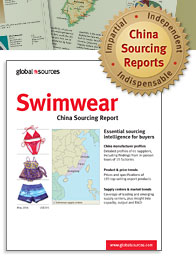
Suppliers profiled: 65 | Products in the gallery: 193 | Pages: 115 | Published: May 2006 | Price: US$395
All information in the China Sourcing Reports is the result of independent, impartial research conducted by Global Sources analysts, based on in-person factory tours. Apparel Search works in association with Global Sources to promote these sourcing reports to the international fashion community. Questions about a report or the status of an order go to the Global Sources contact named in the navigation on this page.
Photos
Common Questions
What is in the executive summary of the Swimwear report?
The report's headline findings with their evidence: market scale, cost and price movements, competition, supplier responses and the outlook — the argument of all 115 pages compressed into the opening section.
Who should read the executive summary first?
Any buyer or manager deciding whether and how to source swimwear garments from China: it gives the findings needed for that decision, then points to the overview, profiles and gallery for depth.
How does the summary relate to the rest of the Swimwear report?
It summarises the industry overview and sets up the 65 supplier profiles and the 193-product gallery; it is a route into the report, not a substitute for its detail.