01Height and Finish First
Choose the Height, Then the Finish
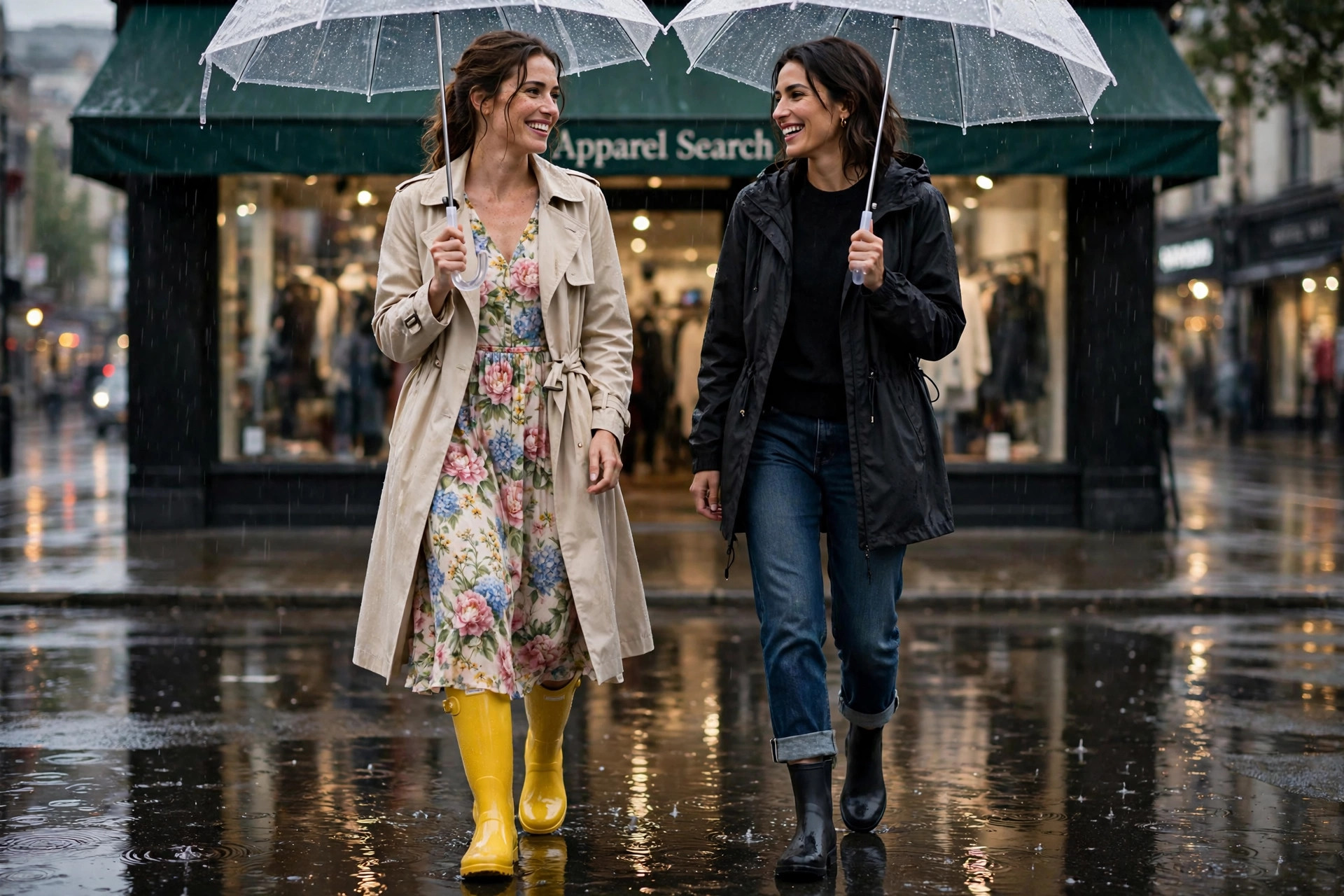
Rain boots — Wellingtons, wellies, galoshes — are the one shoe bought purely for weather, which is exactly why they so often look like an afterthought. Styled deliberately, they stop reading as equipment and start reading as a boot choice. The two decisions that decide everything come before the outfit: how tall the shaft is, and whether the rubber is matte or glossy.
Height sets the silhouette. Ankle rain boots, often cut like a Chelsea boot, are the easiest to wear: they behave like an ordinary ankle boot, work under trousers and with bare legs, and suit light rain and wet pavements. Mid-calf boots are the practical middle — deep enough for real puddles, short enough to wear with dresses without swamping the leg. Knee-high Wellingtons are the classic: the most weatherproof, the most visible, and the pair that becomes part of the outfit rather than hiding under it. Choose by your rain, not just your taste — the types and fits are set out in the women’s rain boots guide and the men’s rain boots guide.
Finish sets the register. Glossy rubber catches the light, makes color look richer and reads as a deliberate fashion choice — a glossy boot in yellow, red or polished black can carry an otherwise plain outfit. Matte rubber disappears into an outfit the way a leather boot does, which makes it the safer choice for work and for anyone who wants the rain boot to be invisible.
02Dresses and Skirts
Rain Boots With Dresses and Skirts
A dress is the rain boot’s best partner, because bare legs and tights solve the oldest Wellington problem — there is no trouser hem to tuck, bunch or soak. With a knee-high boot, let the dress hem end above the top of the shaft with a clear gap of leg, or wear a midi that overlaps the shaft entirely; the awkward version is a hem that lands exactly on the boot’s top edge and catches on it as you walk. Tights in a tone close to the boot make the leg one long line on grey days.
Shorter boots widen the options. Mid-calf and ankle rain boots work with knee-length and midi dresses and skirts in the same proportions as ordinary boots — the ankle boot rules in how to style ankle boots apply unchanged, because at ankle height a matte rain boot simply is an ankle boot that happens to be waterproof. Glossy boots earn their keep here: a shiny boot under a plain dress is the one deliberate shine in the outfit, and it works the way a patent shoe does in dry weather.
03Jeans and Trousers
Rain Boots With Jeans and Trousers
Jeans and rain boots meet at one question: does the denim go inside the shaft, outside it, or end above it? Skinny and slim jeans tuck inside knee-high and mid-calf Wellingtons — the oldest formula there is, and still the neatest, because the boot protects the whole lower leg and nothing flaps. Add chunky socks folded over the top edge if the shaft is roomy; the sock line softens the transition and stops the rubber chafing.
Straight and wide-leg jeans stay outside, and then ankle rain boots are the right height: the hem falls over the boot exactly as it would over a Chelsea boot. What fails is the middle arrangement — a straight hem stuffed into a tall shaft, bunching at the knee, or a wide leg half-tucked. Cropped jeans and trousers split the difference with any height: the hem ends above the shaft, a strip of sock or leg shows, and nothing needs tucking at all. The rubber itself — weights, linings and tread — is covered in the women’s rubber rain boots guide.
04Work and Rainy Days
Work Outfits and the Full Rainy-Day Formula
Rain boots can go to work if two conditions hold: the boot is matte and dark, and the rest of the outfit is unmistakably office clothing. A matte black ankle rain boot under tailored trousers, or a matte mid-calf boot with a dress and tights, reads as a plain boot at any distance that matters. Glossy and brightly colored Wellingtons are weekend boots in most workplaces — wonderful, but they announce the weather louder than the job allows. Many commuters keep the formula simple: rain boots for the journey, ordinary shoes waiting at the desk.
The complete rainy-day formula is a system, not a shoe: waterproof or water-resistant coat with a hood or a hat you actually like, hems held clear of the wet ground, and the boots chosen to match the coat’s register. The trench is the classic partner — belted over a dress with knee-high boots it turns a downpour into a look, as how to style a trench coat shows. Finish with care: rinse mud off rubber boots, let them dry away from radiators, and store tall pairs upright with their shape kept, so the pair that saves your outfit in October is still standing straight in April. For the colder end of wet weather, how to style snow boots covers the insulated cousins.
Questions
Common Questions
Can you wear rain boots when it is not raining?
Yes — a matte ankle rain boot is visually a Chelsea-style boot, and nobody can tell the difference on a dry day. Tall glossy Wellingtons read as a deliberate weather statement, so on a dry day wear them as one: with a dress or tucked jeans, as the outfit’s main event rather than an accident.
Matte or glossy rain boots — which is more versatile?
Matte, for most wardrobes: it slips into work and everyday outfits unnoticed, in the way a leather boot does. Glossy is the better choice if the boot is meant to be seen — bright colors look richer with a shine, and a glossy boot carries a plain outfit the way a patent shoe does.
Should jeans go inside or outside rain boots?
Skinny and slim jeans go inside tall and mid-calf shafts; straight and wide legs go outside ankle-height boots; cropped hems end above the shaft and need no arrangement at all. The one version to avoid is a full-length straight hem forced into a tall boot, which bunches at the knee.
More to Explore
Search Apparel Search