Women's Rubber Rain Boots Guide
Rubber rain boots are a material story — natural rubber, synthetic rubber and PVC behave differently in flexibility, weight and cold.
Shop Women's Rubber Rain Boots Now
Shop Women's Rubber Rain Boots on Amazon Shop Women's Rubber Rain Boots on eBayThe Amazon and eBay links on this page are affiliate links. If you make a purchase through them, Apparel Search may earn a commission.
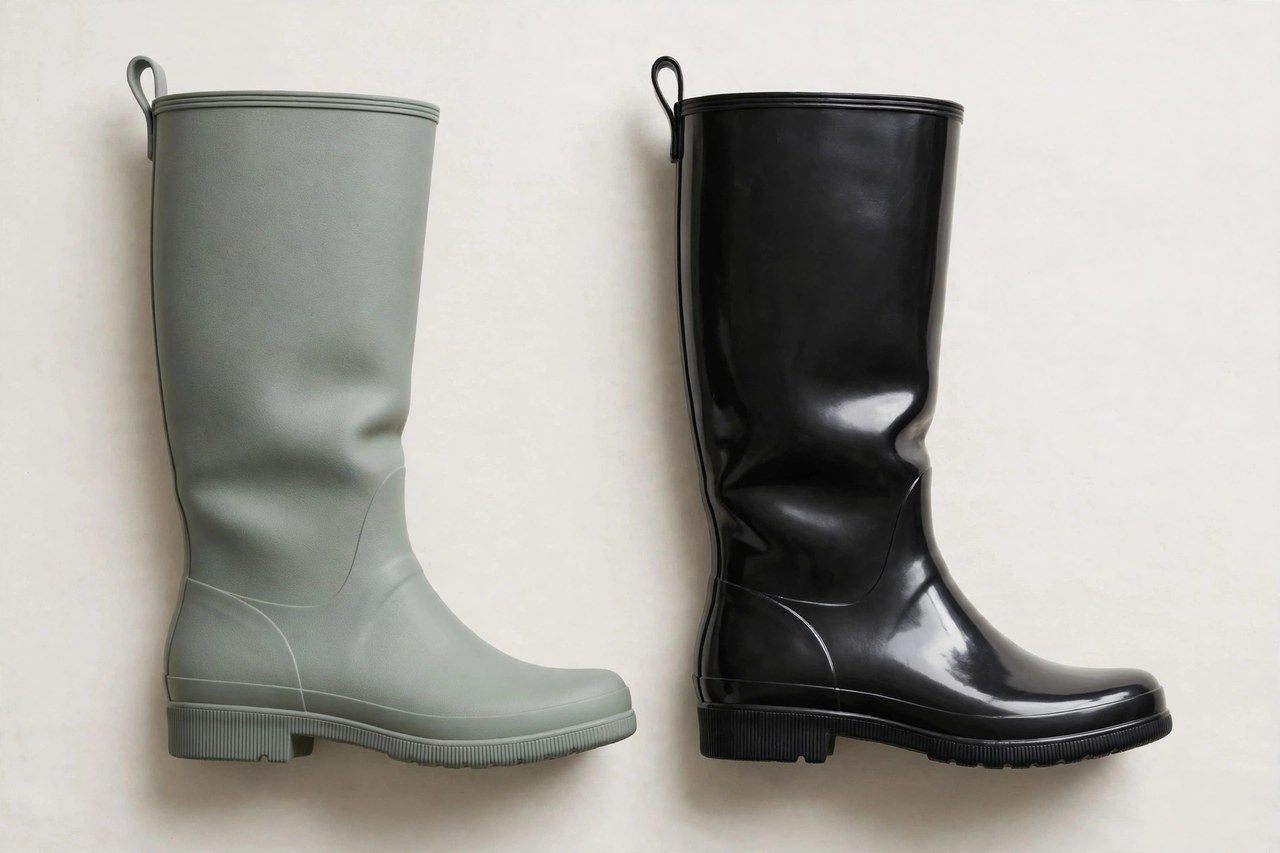
This page is about rubber rain boots as a material. The general rain boots page on this site covers heights, soles and fit as footwear; here the subject narrows to what the boot is made of, because in this category the material is the product. Rain boots are commonly made from rubber — natural or synthetic — with PVC and neoprene as the main alternatives: PVC is a flexible, durable thermoplastic, not a rubber, though it can be formulated to have rubber-like characteristics.
Material decides how a boot flexes at the ankle, how heavy it feels at the end of a wet walk, whether it stiffens in cold weather, and how many years the shaft survives before cracking. Those differences are invisible in a product photograph, where a PVC boot and a handmade natural rubber boot can look identical. This guide gives you the questions and hand-tests that separate them before the first puddle does it for you.
Natural Rubber vs Synthetic Rubber
Natural rubber, from latex, is the premium boot material: highly flexible, resistant to cracking, comfortable across a wide temperature range, and typically used in boots built from shaped sheets joined by hand. Premium handmade boots may contain a high proportion of natural rubber — one maker uses sheets of 85 percent natural rubber — with seams rolled, gussets fitted and the whole boot vulcanized, baked for around two hours in an autoclave, to cure it into a single waterproof piece. Hardwearing natural rubber is the benchmark other materials are measured against.
Synthetic rubber is manufactured to imitate and sometimes improve on the natural product, offering consistent quality and good water and abrasion resistance, often at lower cost and weight. In practice, many boots blend natural and synthetic rubber, and a well-made synthetic boot outperforms a poorly made natural one. The honest tests are flexibility — bend the shaft and ankle and watch for resistance or surface whitening — and construction detail, rather than any single word on a label. What you want is a boot that flexes where your ankle flexes, thousands of times, without protest.
PVC, Neoprene and Lined Alternatives
PVC boots are typically injection-molded in one piece, which makes them inexpensive, completely waterproof and easy to clean, with a slightly stiffer, more plastic feel and more weight than comparable rubber. They serve gardeners, festival-goers and occasional users well, and their molded construction allows colors and prints at prices rubber cannot match. Their weaknesses appear in deep cold, where PVC stiffens, and over years of flexing, where it can crack sooner than good rubber.
Neoprene, the synthetic rubber used in wetsuits, appears as full boots and more often as shafts and linings on rubber-footed boots, adding insulation and a snug, stretchy calf fit that rigid shafts cannot give. Lined rubber boots — jersey, cotton or fleece linings inside a rubber shell — address cold from inside instead. When comparing, decide which condition you are really dressing for: cold wet, warm wet, or occasional wet, because the best material for each is different and no boot wins all three at once.
Construction Details That Reveal Quality
However a rubber boot is made, its waterproof promise lives at the seams and joins. Handmade sheet-rubber boots should show smooth, even seams with reinforced back trims and neatly finished gussets; molded boots should show no thin spots, bubbles or rough flashing at the sole join. Flex the boot and inspect the ankle crease area, the first place poor material fails. Check that the sole is bonded or vulcanized evenly all the way around, and that any zip or gusset has a waterproof construction behind it rather than a hopeful flap.
Weight in hand tells a story too. A substantial natural rubber boot feels dense and supple, springing back when the shaft is squeezed; a thin molded boot feels light in a way that can mean either travel-friendly or short-lived. Soft, flexible rubber is a genuine feature, because a boot that moves with the leg is worn longer and complained about less.
Rubber Care: Bloom, Cracking and Storage
Rubber's enemies are ultraviolet light, heat, ozone and neglect. Store boots upright, cool and out of sunlight, never folded at the ankle and never beside a heater or boiler, whose heat and ozone age rubber fastest. Clean them with water and mild soap, dry them naturally, and use a rubber conditioner or silicone treatment occasionally to keep the surface supple, especially on natural rubber that will be stored through a dry season.
Expect bloom on natural rubber: a whitish film of waxes rising to the surface, which wipes off or conditions away and indicates real rubber rather than a fault. Cracking is the true end-of-life sign — fine surface crazing at the ankle flex point deepening into splits that no treatment reverses — and it arrives years sooner in boots stored badly than in boots stored well. Chosen in the right material and kept with minimal sense, rubber rain boots are among the longest-serving footwear you can own, which is precisely why their material deserves a page of its own.
Related Women's Guides
Photos

Looking for Women's Clothing Stores?
This guide helps you choose women's rubber rain boots. To browse where to buy, visit our women's clothing store directory, where you can find retailers that carry them.