Calendar Watches
Date, day, month and moon, on the dial
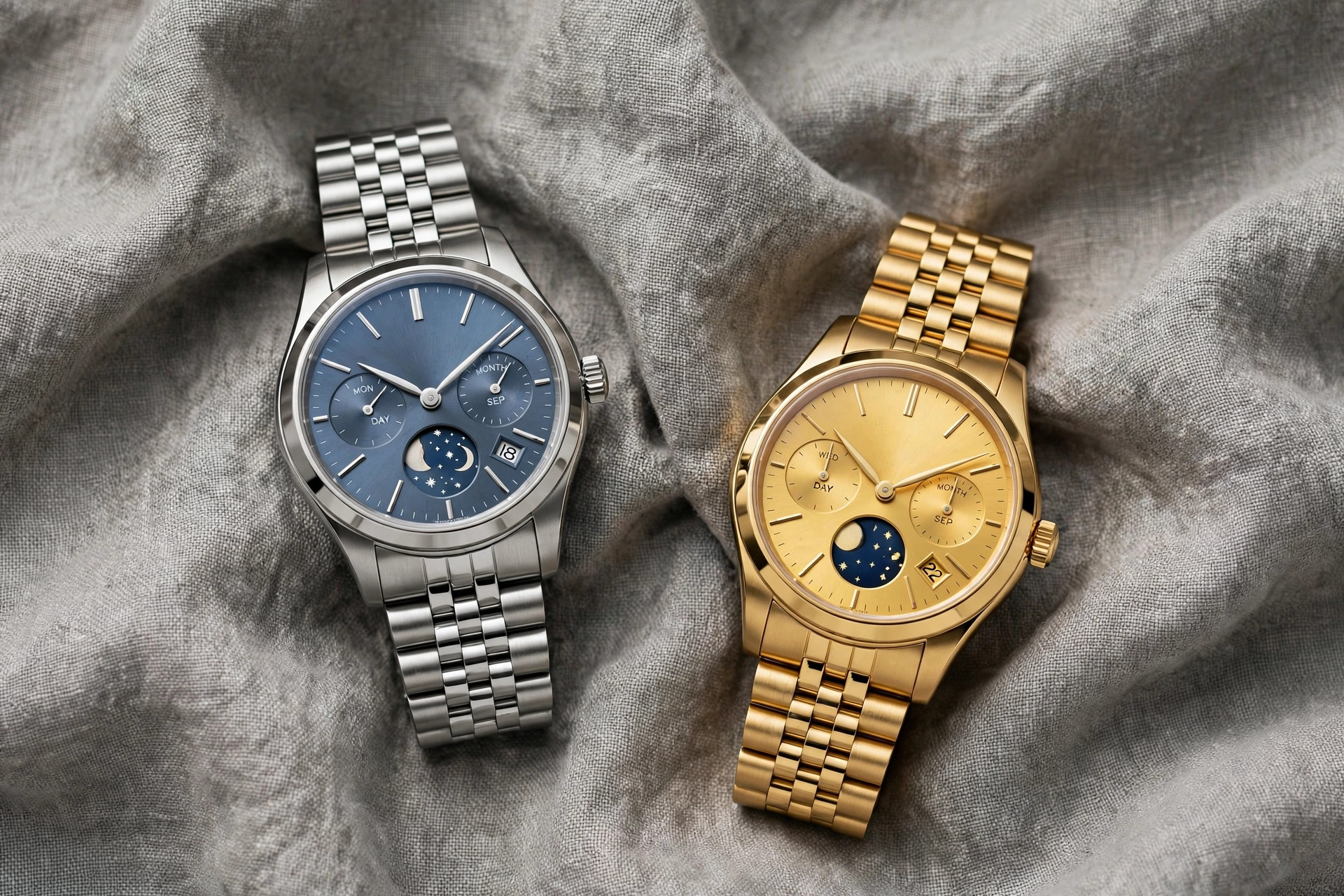
A calendar watch displays the date, and in its developed forms the day, month and phases of the moon, alongside the time. Calendar features entered portable timepieces in the Renaissance, when watchmakers and astronomers began integrating them into mechanical watches, and by the late 16th century pocket calendar watches showed the date, often with moonphase indications. The 18th century produced sophisticated calendar watches including early perpetual calendars, with Breguet among the first makers of the perpetual mechanism in the late 1700s. In the 19th century, day and month displays were refined and Adolphe Nicole contributed the annual calendar mechanism, and in the 20th century houses such as Patek Philippe and Audemars Piguet made high-end calendar watches a specialty, combining perpetual calendars with chronographs. The calendar family now runs from the simple date window, which must be corrected after short months, through day-date and complete calendar displays, to the annual calendar that needs one correction a year and the perpetual calendar that tracks month lengths and leap years automatically. This guide explains each level of mechanism, the history behind them, and the setting care calendar watches need.
Calendar Watches: A Journey through Time and Precision
History and Invention
The concept of calendar watches, also known as date watches, dates back centuries. The earliest form of a calendar watch can be traced to ancient civilizations where sundials and astrolabes were used to measure time and celestial events. However, the evolution of calendar watches as we know them today began during the Renaissance period.
Renaissance:
The Renaissance was a period of significant scientific and artistic advancements. During this time, watchmakers and astronomers began integrating calendar features into mechanical timepieces.
Late 16th Century:
The first pocket-sized portable calendar watches emerged in the late 16th century. These early calendar watches displayed the date, often accompanied by moon phase indications, on the dial.
Historical Evolution
The evolution of calendar watches saw remarkable advancements in complexity and functionality:
18th Century:
The 18th century witnessed the creation of more sophisticated calendar watches, including perpetual calendars. Breguet, a renowned watchmaker, designed one of the earliest known perpetual calendar watches in the late 18th century.
19th Century:
The 19th century saw further refinements and the inclusion of additional calendar features like day and month displays. Adolphe Nicole, a Swiss watchmaker, contributed to the development of annual calendar mechanisms during this era.
20th Century:
In the 20th century, calendar watches became more accessible and gained popularity. Brands like Patek Philippe and Audemars Piguet emerged as pioneers in the production of high-end calendar watches, introducing perpetual calendars and chronograph complications.
21st Century:
Calendar watches have continued to evolve, incorporating modern materials, advanced movements, and cutting-edge technology. Many brands now produce calendar watches with innovative designs, precision, and longevity.
Popular Companies for Calendar Watches
Several prestigious watchmaking companies are renowned for their expertise in crafting exceptional calendar watches:
Patek Philippe:
- Patek Philippe is highly acclaimed for its intricate and accurate calendar watches, including perpetual calendars and annual calendars. Models like the Patek Philippe Perpetual Calendar Chronograph are iconic in the world of horology.
Audemars Piguet:
- Audemars Piguet is known for its Royal Oak and Royal Oak Offshore collections, which include chronograph and perpetual calendar complications, showcasing a blend of luxury and functionality.
Vacheron Constantin:
- Vacheron Constantin has a rich heritage in producing high-quality calendar watches, including perpetual calendars and complete calendar timepieces. The Vacheron Constantin Overseas Perpetual Calendar is a notable example.
Jaeger-LeCoultre:
- Jaeger-LeCoultre is celebrated for its Master Calendar collection, featuring elegant designs and precise calendar functions, including date, month, and day displays.
IWC Schaffhausen:
- IWC Schaffhausen offers a range of calendar watches, including perpetual calendars and annual calendars. The IWC Portuguese Perpetual Calendar is a standout model in their lineup.
Calendar watches are not only a display of horological mastery but also a testament to the enduring human fascination with measuring time and celestial cycles. These timepieces continue to captivate collectors and enthusiasts, showcasing the perfect blend of tradition, innovation, and elegance.
You may also want to learn about self-winding watches and alarm watches.
Calendar watches are helpful for keeping track of fashion events. You may want to check out the fashion week calendar of events.
Learn more about a fashion calendar.
You may also find interest in vintage watches and antique watches.
Reading a Calendar Dial
Calendar information reaches the dial in several layouts: a date window at 3 o'clock, day and month windows beneath 12, subdials that combine date with moonphase, and pointer dates read from a central hand against numerals around the dial's edge. Legibility is the practical test. A calendar that cannot be read at a glance has failed its purpose, however complex the mechanism, so compare window size, contrast and the amount of dial space the calendar takes from the time display itself.
Moonphase, the oldest calendar display, shows the moon's age through an aperture as a painted or gold moon crossing a starry disc, completing its cycle every 29.5 days. Astronomical moonphase mechanisms correct the small error in that figure and stay accurate for a century or more, while simple versions drift a day every few years and are reset by the wearer. In modern lines the moonphase survives as much for its beauty as for its information.
Common Questions
What is the difference between an annual and a perpetual calendar watch?
An annual calendar knows the difference between 30 and 31 day months and needs manual correction once a year, at the end of February. A perpetual calendar also knows leap years, tracking February 29 correctly, and a correctly kept perpetual calendar needs no date correction until the year 2100, when the Gregorian calendar skips a leap year. The perpetual mechanism is considerably more complex and expensive, while the annual calendar offers most of the convenience at a lower price and with simpler construction.
What is a complete or triple calendar watch?
A complete calendar, also called a triple calendar, displays the day of the week, the date and the month, usually with a moonphase, but it does not know how long each month is, so the date must be advanced by hand after any month with fewer than 31 days, five times a year. Many classic mid-century watches are complete calendars, and their dials, with day and month windows and a pointer date around the edge, are a recognizable style of vintage watch design.
Is there a wrong time to set a calendar watch?
Yes. On most mechanical calendar watches, the date change mechanism is engaged around midnight, and using the quickset date function roughly between 9 in the evening and 3 in the morning can damage the mechanism on many movements. The safe habit is to move the hands to a daytime hour, such as 6 o'clock, before quick-setting the date, then set the time. Makers' instructions for the specific movement come first, since modern movements vary in how protected their calendar works are.