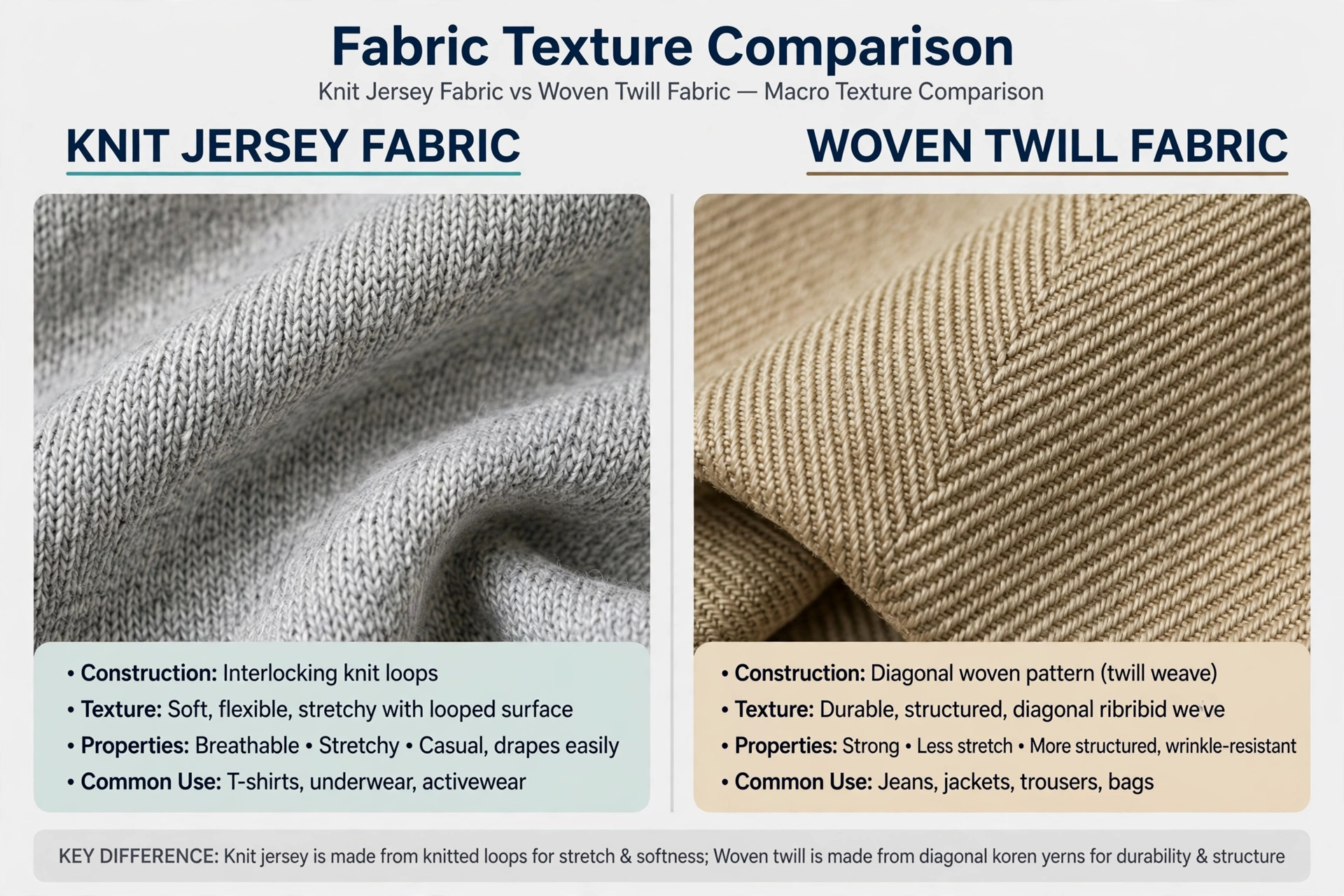
Every garment starts as either a knit or a woven fabric — and that single choice shapes your factory selection, machinery, costing, and timeline. Knits (t-shirts, leggings, sweaters) stretch and drape; wovens (dress shirts, denim, suiting) hold structure. Manufacturing them is genuinely different work.
The Fundamental Difference
Woven fabrics interlace warp and weft yarns at right angles on a loom — stable, structured, minimal stretch unless elastane is added. Knits interloop a single yarn (weft knits) or many yarns (warp knits) — inherently stretchy, softer, and prone to curling and distortion. That structural difference drives every downstream manufacturing decision.
How Production Differs
Knit factories run cutting tables with special spreading equipment (knits relax and distort), overlock and coverstitch machines, and handle high-volume basics at speed. Woven factories invest in fusing presses, buttonholers, and precise single-needle work for structured garments. A factory excellent at one is rarely excellent at the other — always match the factory to the fabric type.
Choosing for Your Product
Choose knits for comfort, stretch, casual categories, and lower sewing complexity per unit. Choose wovens for structure, tailoring, formal categories, and perceived quality. Hybrids exist — ponte, scuba, and stretch wovens blur the line — but be honest in your tech pack about which world your garment lives in so the right factory quotes it.
FAQs
- Can the same factory make knits and wovens?
- Some large factories handle both, but most specialize. For best quality and pricing, use a knit specialist for knit garments and a woven specialist for wovens.
- Which is cheaper to manufacture?
- Knits are generally cheaper per unit: simpler construction, faster sewing, and high-volume machinery. Structured wovens need more operations and skilled labor.
- What machines are specific to knit manufacturing?
- Overlock (serger) machines for seaming, coverstitch machines for hemming, and flatlock machines for activewear. Woven shops lean on lockstitch, fusing, and buttonhole equipment.
- Do knits or wovens shrink more?
- Knits typically shrink more and less predictably — always pre-shrink test knit fabrics and allow extra in markers. Wovens are more dimensionally stable.
Apparel Search: explore more production & sourcing resources for the fashion industry.