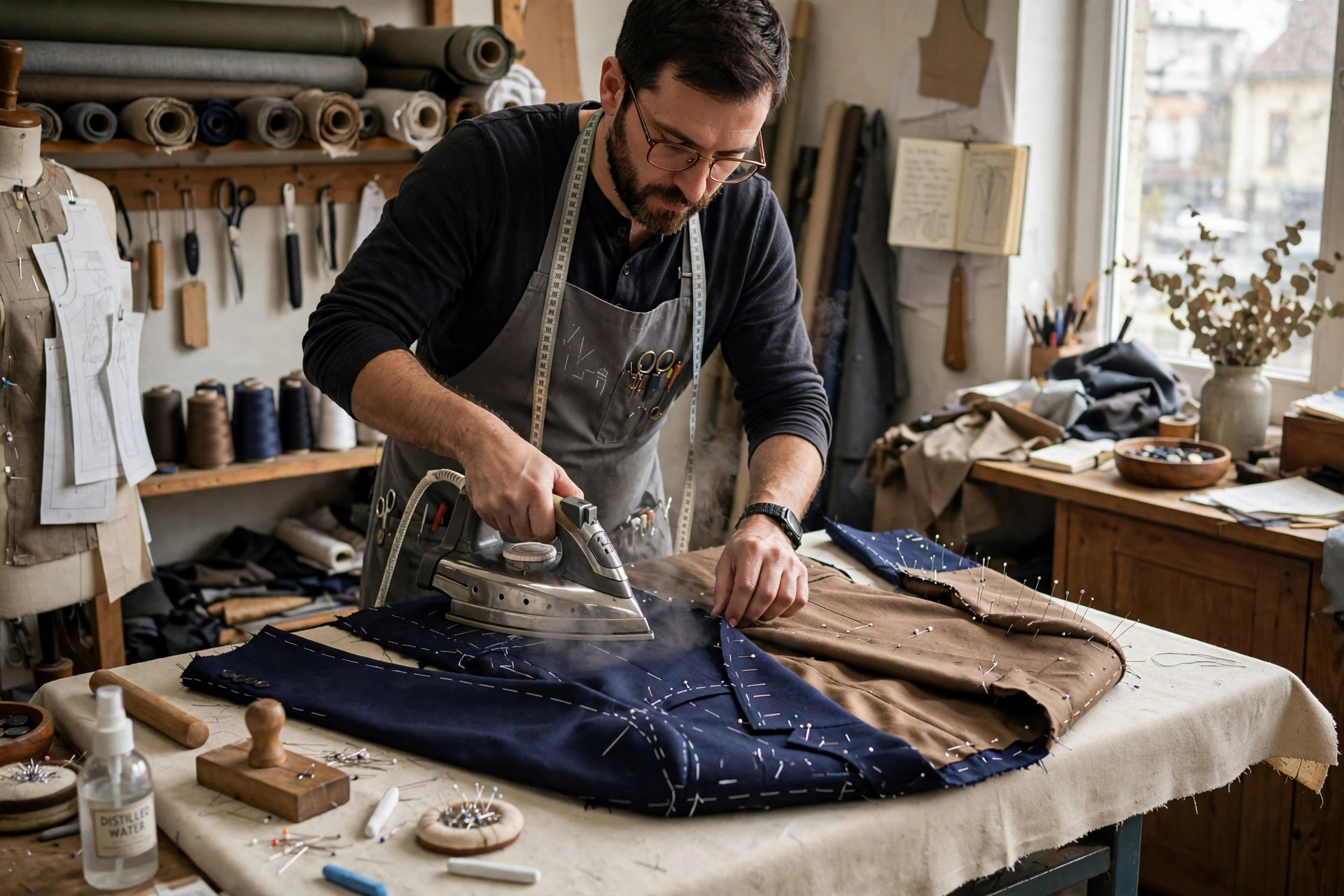
A tailored jacket — suit jacket, blazer, sport coat — is the most technically demanding garment in menswear and womenswear alike. Dozens of operations, internal structure you never see, and handwork that machines still can't replicate. Understanding its construction is essential whether you're designing tailoring or sourcing it.
Anatomy of a Tailored Jacket
Beneath the shell fabric lies the engineering: a canvas interlining (traditionally horsehair) gives the chest its shape and roll; shoulder pads and sleeve heads build the shoulder line; tape stabilizes edges; the lining (usually cupro or viscose) lets the jacket slide over clothing. A quality jacket contains 30+ components and 100+ manufacturing operations.
Full Canvas vs. Half Canvas vs. Fused
Full canvas: canvas runs the full front length, hand-padded — the gold standard, molds to the wearer over time. Half canvas: canvas in chest and lapel only, fused below — the sweet spot of quality and cost for most brands. Fused: glued interlining throughout — cheapest, but can bubble or delaminate and never drapes like canvas. Specify which you want in your tech pack; factories will default to fused unless told otherwise.
Manufacturing Considerations
Tailoring demands skilled labor that is scarce and expensive — which is why quality tailoring concentrates in specific regions (Italy, Portugal, Romania, China for better makers). Expect MOQs of 200–500 units per style, 3–4 sample rounds, and per-unit costs several multiples of casual outerwear. QC must check lapel roll, button stance, pattern matching at seams, and lining cleanliness — the details customers notice.
FAQs
- What is jacket canvas made of?
- Traditionally horsehair (from the mane/tail) blended with wool or cotton. It provides resilient structure that fusing cannot match.
- How can I tell if a jacket is fused?
- Pinch the front below the bottom button: if you feel a stiff, papery layer glued to the shell, it's fused. Canvas feels like a separate floating layer.
- Why do tailored jackets cost so much to make?
- Labor intensity: 100+ operations, many requiring skilled handwork (pad stitching, buttonholes, pressing). A single jacket can take several hours of skilled labor.
- What is pattern matching?
- Aligning checks, stripes, or plaids so they continue uninterrupted across seams and pockets — a hallmark of quality tailoring that consumes extra fabric and cutting time.
Apparel Search: explore more production & sourcing resources for the fashion industry.