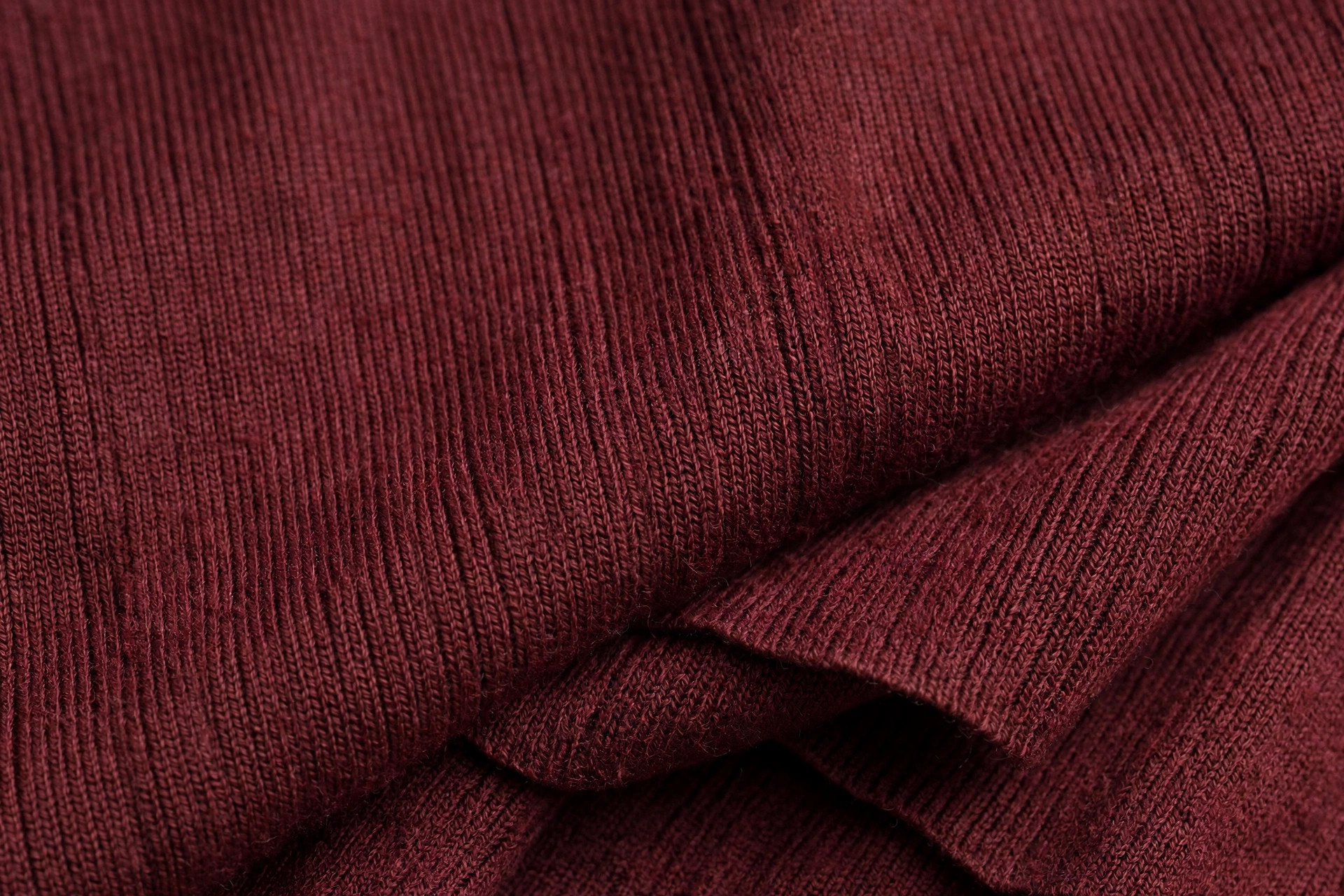
What Milano Rib Is
Some knits are made to drape; Milano rib is made to stand. It is the double knit designers reach for when a jacket must hold its shoulders, a dress must skim without clinging, and a skirt must keep the line it was cut to — all without a woven fabric’s stiffness or fusing. Milano rib is a weft-knit double structure with a deceptively simple recipe: one course knitted as rib across both needle beds, followed by two courses knitted as separate jerseys, one on each bed, repeated for the whole fabric. That three-course rhythm gives Milano rib its signature combination of a smooth face, a firm body and a quiet, resilient spring.
Readers have met Milano rib in structured knit jackets, tailored dresses, ponte-style trousers with a softer hand, premium skirts and the kind of knit blazer that survives a suitcase and still looks deliberate. The name reflects the structure’s Italian tailoring associations: this is knitwear engineered for garments that borrow their silhouette from tailoring. In the parent survey, Knit Stitches & Structures, Milano rib appears among the double-knit derivatives; this page gives its course sequence, properties and best uses in full.
Milano rib is often shelved next to Ponte di Roma, and the two are genuinely close cousins — both are smooth-faced double knits from two needle beds, both use only the knit stitch, and both serve tailored knitwear. The difference is in how the two layers are joined, and it is large enough to feel: ponte ties its faces with dedicated intermeshing courses, while Milano rib ties its faces with a full rib course in every three. That rib course is the character of the fabric, and understanding it explains everything else on this page.
Technical definition: Milano rib is a weft-knit double-jersey structure with a three-course repeat: course 1 knits rib on both needle beds (needles alternating between beds in rib gating), course 2 knits jersey on the front bed only, and course 3 knits jersey on the back bed only. Only the knit stitch action is used, on a two-bed (ribber) machine. Both faces present as smooth jersey; the rib course, hidden inside, supplies widthwise spring and body.
How Milano Rib Is Knitted
Read the diagram from the bottom as the machine knits it. Course 1 — the rib course: needles on both beds knit together in rib gating, each front-bed needle alternating with a back-bed needle, so the yarn zigzags between the beds and the two future faces are stitched to each other across every single wale. Course 2 — front jersey: only the front bed knits, laying a plain jersey course on the face side. Course 3 — back jersey: only the back bed knits, laying the matching jersey course on the reverse. Then the sequence repeats: rib, jersey, jersey, for hundreds or thousands of courses.
The elegance of the arrangement is that every structural job is done by a specialist course. The two jersey courses provide the smooth, unbroken faces — two courses of face yarn for every one of rib yarn, so the surface reads as pure jersey with no rib shadow showing through. The rib course, sandwiched between them, does the invisible work: because rib contracts widthwise, each rib course gently gathers the fabric, storing spring that the jersey courses then hold in check. The cloth leaves the machine already balanced, with no tendency to curl, twist or separate.
In needle notation the repeat is written as three lines — knit across both beds in rib set-out, knit front bed, knit back bed — with no tucks, misses or transfers anywhere. Compare the tuck-and-miss plans of Piqué Knits, where texture is the goal, or the bed-alternating courses of Purl Knit, where reversal is the goal: Milano rib changes only which bed knits, and lets course order do everything. Production is straightforward on any double-jersey or ribber machine, and gauge follows the usual rules in Knit Gauge Explained — finer gauges give the dressiest, most tailored cloth.
Properties: Hand, Stretch and Stability
Hand and appearance. Milano rib feels smooth, firm and expensive: a fine jersey face with a faint underlying resilience when the cloth is squeezed, and a tailored, low-shine surface that photographs like a light woven. It folds in clean, deliberate folds and holds a pressed edge better than almost any other weft knit.
Stretch and recovery. The hidden rib courses give Milano rib lively widthwise stretch with outstanding recovery — the fabric extends to fit, then returns flat and unbagged, which is why it excels in jackets and dresses worn all day. Lengthwise stretch is moderate. Recovery is structural rather than fibre-dependent, so even Milano rib without elastane keeps its shape well; with a small elastane content it becomes exceptional.
Stability and weight. Expect a mid-to-heavy, opaque, low-curl cloth with excellent dimensional stability: it neither grows nor skews readily, cuts cleanly, and sews like a stable woven while wearing like a knit. Its costs are those of all double knits — more yarn per metre than jersey, more warmth, slower drying — plus a firmness that rules it out for fluid, draped designs. In wool and wool-blend yarns it is a classic suiting-weight knit; in cotton or viscose blends it softens toward premium day dresses.
Where Milano Rib Is Used
Milano rib’s home is structured knit tailoring: knit blazers and jackets, tailored and semi-tailored dresses, structured skirts, smart trousers, and coordinated knit suits. It is the fabric behind the modern promise of tailoring without discomfort — garments that present like woven suiting in a meeting and behave like knitwear on a train. Designers also use it for premium uniform dresses, occasion knitwear that must hold a sculpted line, and high-quality separates where a cheaper double knit would bag or shine.
It is less at home in casual T-shirts, fluid evening drape or ultra-light summer pieces, where its body is wasted or its weight is a burden. Within the double-knit family it is chosen over interlock when firmness matters, and over ponte when a touch more spring and a slightly softer, more knitted hand are wanted — a comparison set out in detail in the final section below and in the parent guide to Knit Stitches & Structures.
Milano Rib vs Ponte di Roma
Place the two fabrics side by side and the family resemblance is obvious: smooth faces, firm body, tailored uses, no curl. The differences reward a closer look. Construction: ponte intermeshes its two jersey layers with bridging courses shared between beds; Milano rib joins its layers with a complete rib course in every three, then adds a full jersey course to each face. Feel: ponte is denser and more board-like, the closest a knit comes to a woven; Milano rib is springier across the width, with a livelier recovery and a marginally softer hand. Best use: ponte for trousers, leggings-as-pants and maximum stability; Milano rib for jackets, dresses and anywhere a garment must both hold a line and move with the body.
To recognise Milano rib in the wild, stretch a swatch across its width: the give feels elastic and snaps back flat, betraying the hidden rib courses, and the face stays perfectly smooth while it stretches. Against the other structures in this series — the reversed-course softness of Purl Knit, the tuck-built texture of Piqué Knits — Milano rib is the quiet structural engineer: nothing to see on the surface, everything happening in the course order underneath. Both Milano rib and Ponte di Roma are pure weft knits, built course by course from continuous yarn feeds.
Common Questions
- What is Milano rib made of, structurally?
- Three courses, repeated: one rib course knitted on both needle beds, then one jersey course on the front bed and one jersey course on the back bed. The rib course hides inside the fabric and supplies spring and body, while the jersey courses form the two smooth faces.
- Is Milano rib the same as ponte?
- No, though both are smooth double knits for tailored garments. Ponte ties its two jersey layers with intermeshing bridging courses and feels denser and more woven-like. Milano rib joins its layers with a full rib course in every three, giving more widthwise spring and a slightly softer hand. See the comparison section on this page.
- Why is Milano rib good for jackets and dresses?
- The hidden rib courses give lively stretch with excellent recovery, so garments fit closely without bagging, while the double jersey faces keep the surface smooth, opaque and tailored. The fabric holds a silhouette like a light woven suiting but wears with knit comfort.
- Does Milano rib curl or need special finishing?
- No. The balanced double construction cancels the curling forces of single jersey, so Milano rib lies flat, cuts cleanly and needs no special edge treatment. That stability is one of the main reasons tailors are willing to work with it.
- What fibres is Milano rib knitted in?
- Traditionally wool and wool blends for suiting-weight jackets and dresses; today also cotton, viscose and polyester blends, often with a small percentage of elastane for extra recovery. The structure, not the fibre, is what makes a fabric Milano rib.
More Knit Structures
- Knit Stitches & Structures — the parent guide to all knit structures
- Ponte di Roma — the firm double knit with two smooth jersey faces
- Purl Knit (Links-Links) — texture by reversing courses: the reversible bump fabric
- Piqué Knits — tuck-and-miss texture: single piqué and Lacoste structures
- Weft vs Warp Knitting — how weft and warp knitting differ, machines and fabrics compared
- Knit Gauge Explained — what gauge means for stitch size, weight and hand
Back to Knit Stitches & Structures
This page is one part of Knit Stitches & Structures, Apparel Search’s deep guide to the structures inside the Knitwear Construction Guide series on how knitted fabric is made.
Search Apparel Search