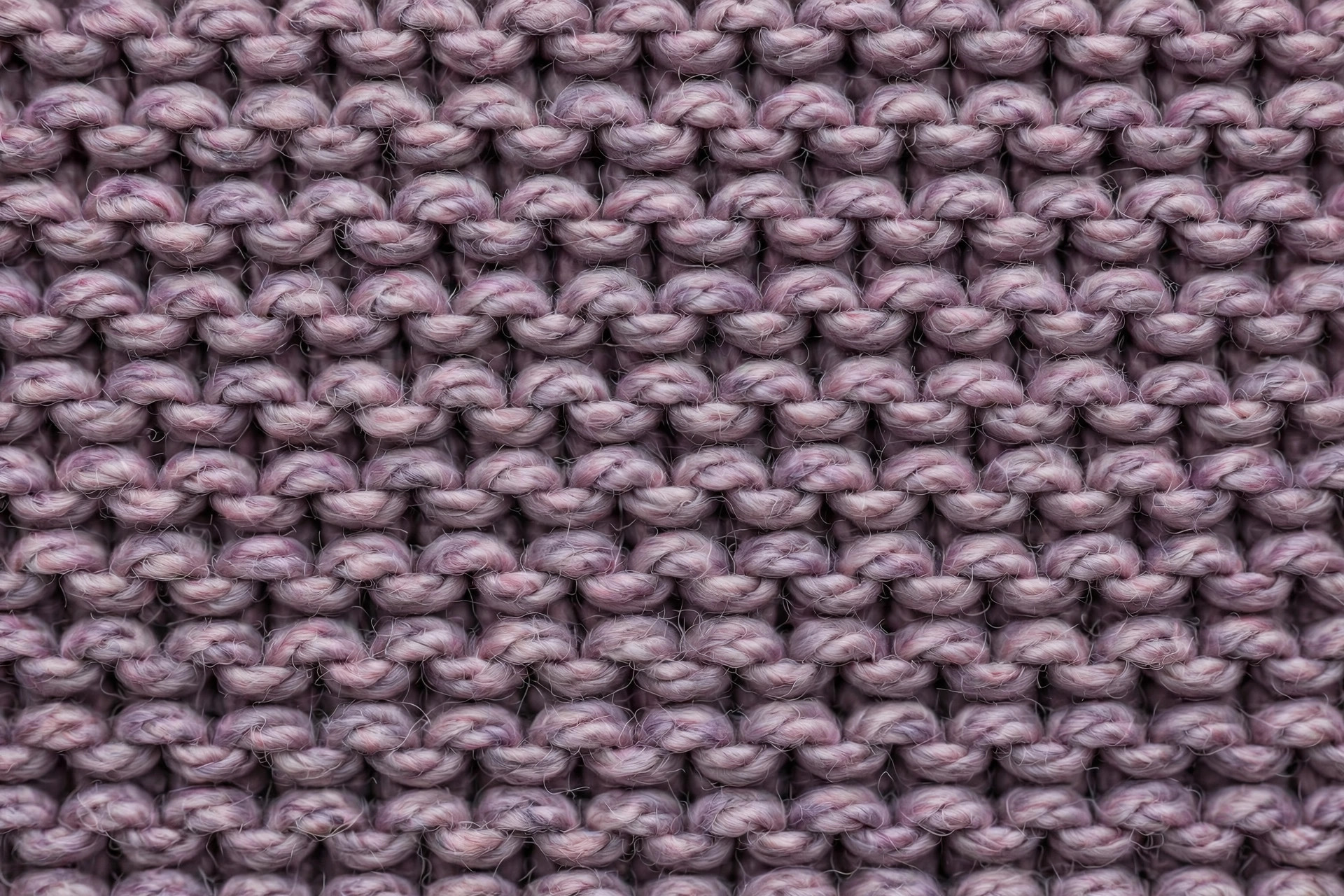
What Purl Knit Is
Turn a plain jersey T-shirt inside out and you are already looking at purl. Every weft-knitted loop has two faces: the smooth V-shaped side knitters call the knit face, and the bumpy, arc-shaped side called the purl face. A purl knit — traditionally called links-links — is the structure built by deliberately alternating the two, course by course, so that neither face wins. One course is knitted so its loops present as knit stitches, the next is knitted from the opposite direction so its loops present as purl stitches, and the fabric that results looks much the same on both sides, covered in soft horizontal rows of bumps.
Readers have met this fabric without knowing its name. It is the cloth of cosy, slightly spongy sweaters that feel the same inside and out, of baby blankets and scarves that never seem to have a wrong side, and of textured knitwear where the designer wanted a quiet, all-over grain instead of a bold pattern. In the parent guide, Knit Stitches & Structures, purl appears as one of the three basic weft structures alongside jersey and rib; this page gives it the full treatment it deserves, because once you understand purl you understand why so many familiar fabrics behave the way they do.
The name links-links comes from the German knitting tradition, where links means the reverse or left side: a fabric of links and links, reverse upon reverse. Hand knitters know the same idea as garter stitch when every row is worked to show purl bumps, and as reverse stocking stitch when the purl side is worn outward. On machines, true links-links needs special equipment, which is why it is less common than jersey — and why, when you do find it, it tends to signal a deliberate, quality choice.
Technical definition: Purl (links-links) is a weft-knit structure in which successive courses are formed in opposite directions — alternate courses of knit stitches and purl stitches — so both fabric faces show a mixture dominated by purl arcs. It requires a links-links machine or a double-bed machine with stitch-transfer or reversible needle action: needles must be able to draw loops through the fabric in both directions. Only the knit stitch action is used, but it is used from both sides in turn.
How Purl Knit Is Knitted
The formation is simple to state and demanding to mechanise. In a normal single-jersey machine every loop is pulled through the previous loop in the same direction, so one side of the fabric is always the knit side. To make purl, the machine must reverse that direction every course: course 1 is drawn toward the knitter, course 2 is drawn away, course 3 toward, and so on. Each reversal flips which stitch element faces outward. Where a knit course shows the legs of the loops as neat Vs, a purl course shows the heads and sinker arcs of the loops as rounded bumps — the same yarn, seen from behind.
Dedicated links-links machines solve this with double-headed needles that can be passed from one needle bed to the other, so the same needle can knit from either side. On modern flat-bed (V-bed) machines the effect is achieved by transferring stitches between beds or by knitting alternate courses on opposite beds. Either way, the repeat is just two courses: one knit, one purl. There is no width repeat at all — every needle does the same thing in a given course — which makes purl one of the simplest structures to programme and one of the most instructive to read.
In stitch notation the structure is written as alternating rows of K (knit) and reverse-K: a course plan that reads knit, purl, knit, purl up the fabric. Compare that with the tuck-and-miss plans used for Piqué Knits, where texture comes from holding and floating yarn instead of reversing it, and with the two-bed course sequences of Ponte di Roma, where reversal is replaced by intermeshing. Purl is the purest demonstration in the whole weft-knitting family that stitch direction alone can create a completely different cloth.
Because every course reverses, purl is slower to produce than jersey and is usually knitted at relaxed tensions. The loops need room to turn: a tight purl fabric fights itself, while a slightly open one lets the bumps settle into their characteristic soft ridges. Yarn choice matters for the same reason — smooth, resilient yarns show the bump rows crisply, while hairy yarns blur them into a general cosiness.
Properties: Hand, Stretch and Stability
Hand and appearance. Purl feels soft, full and slightly spongy, with a matte, grainy surface of horizontal bump rows on both faces. There is no shiny smooth side and no obvious right side, which gives garments a relaxed, homespun honesty. The bumps catch light unevenly, so plain colours look richer and heathered yarns look deeper than they do in jersey.
Stretch and recovery. The structure stretches generously in both directions, and notably along its length — the direction in which jersey is comparatively stable. The reason is geometric: purl arcs are not locked into flat Vs, so the loops can open and close like a concertina along the course direction and rock against each other down the wale. That lengthwise give is why purl is loved for blankets and scarves, and why garment makers must allow for growth: a purl sweater can lengthen on the hanger if it is heavy.
Stability and edges. Here purl scores its biggest win over jersey. Single jersey curls relentlessly toward the purl side because every loop is bent the same way. In purl fabric the bending alternates course by course, so the curling forces cancel and the cloth lies flat at the edges without blocking or hemming tricks. It is also thicker than jersey from the same yarn, because the reversed courses cannot nest as tightly, and that extra thickness brings warmth and opacity. The trade-offs are a tendency to snag on the proud bumps and a surface that shows abrasion sooner than a flat jersey face.
Where Purl Knit Is Used
Classic uses follow directly from the properties. Sweaters and cardigans in purl or purl-rich textures gain body and a reversible, crafted look. Scarves, throws and baby blankets exploit the flat edges and identical faces — no curling, no wrong side, nothing to finish. Childrenswear uses soft purl textures where a gentle, non-shiny surface is wanted against the skin. Designers also use purl as a ground for pattern: a panel of knit stitches stands out in relief against a purl background, which is exactly how cable and diamond textures are made to pop on traditional knitwear — the smooth motif is framed by the bumpy ground.
Beyond garments, purl appears wherever a weft knit must stay flat and look finished from both sides: reversible hats and cowls, cushion covers, and double-faced accessories. It is rarely used for high-volume basics like T-shirts, where jersey is faster and cheaper, and rarely for tailored pieces, where the firmer double knits such as Milano Rib hold a sharper line. Its home ground is comfort knitwear with visible craft.
Recognising Purl — and Its Neighbours
To recognise purl, look for horizontal rows of rounded bumps on both faces and edges that lie flat when the fabric is relaxed. Stretch it lengthwise: purl gives noticeably more than jersey. If one face is smooth Vs and the other is bumps, you are looking at ordinary jersey worn inside out, not purl — in true purl, neither face is smooth.
Within the family gathered under Knit Stitches & Structures, purl sits between jersey (one direction only, curls, two distinct faces) and rib (stitches reversed side by side within the same course, giving vertical cords and strong widthwise stretch). Purl reverses course by course; rib reverses wale by wale. The double knits — Ponte di Roma and Milano Rib — reverse between two needle beds instead, trading purl’s softness for firmness and a smooth face. Stitch size in all of them is set by machine gauge, covered in Knit Gauge Explained: a fine-gauge purl looks like a refined grain, a chunky-gauge purl like bold, hand-knitted garter stitch.
Common Questions
- Is purl knit the same on both sides?
- Nearly. Alternate courses face opposite ways, so each side shows the same mixture of knit legs and purl bumps and neither side looks like a wrong side. That is why purl (links-links) is chosen for scarves, blankets and reversible knitwear.
- Why does purl fabric lie flat when jersey curls?
- Jersey loops are all bent in one direction, so the fabric curls toward the purl side. In purl knit the bending alternates course by course, the opposing forces cancel, and the cloth lies flat at the edges without extra finishing.
- Is purl the same as garter stitch in hand knitting?
- They are close relatives. Hand-knitted garter stitch shows purl bumps on both faces because every row is worked the same way from alternating sides. Machine-made purl (links-links) achieves the same two-faced bump texture by reversing the loop direction every course.
- What machines can knit purl fabric?
- True purl needs needles that can form loops in both directions: a dedicated links-links machine with double-headed needles, or a double-bed flat machine using transfer or opposite-bed knitting. Ordinary single-bed jersey machines cannot make it.
- Does purl knit stretch more than jersey?
- Yes, especially lengthwise. The purl arcs let loops open and rock against each other along the fabric length, where jersey is relatively stable. Garments in purl should be stored folded rather than hung, to avoid gradual lengthening.
More Knit Structures
- Knit Stitches & Structures — the parent guide to all knit structures
- Piqué Knits — tuck-and-miss texture: single piqué and Lacoste structures
- Ponte di Roma — the firm double knit with two smooth jersey faces
- Milano Rib — the structured double knit of one rib and two jersey courses
- Weft vs Warp Knitting — how weft and warp knitting differ, machines and fabrics compared
- Knit Gauge Explained — what gauge means for stitch size, weight and hand
Back to Knit Stitches & Structures
This page is one part of Knit Stitches & Structures, Apparel Search’s deep guide to the structures inside the Knitwear Construction Guide series on how knitted fabric is made.
Search Apparel Search