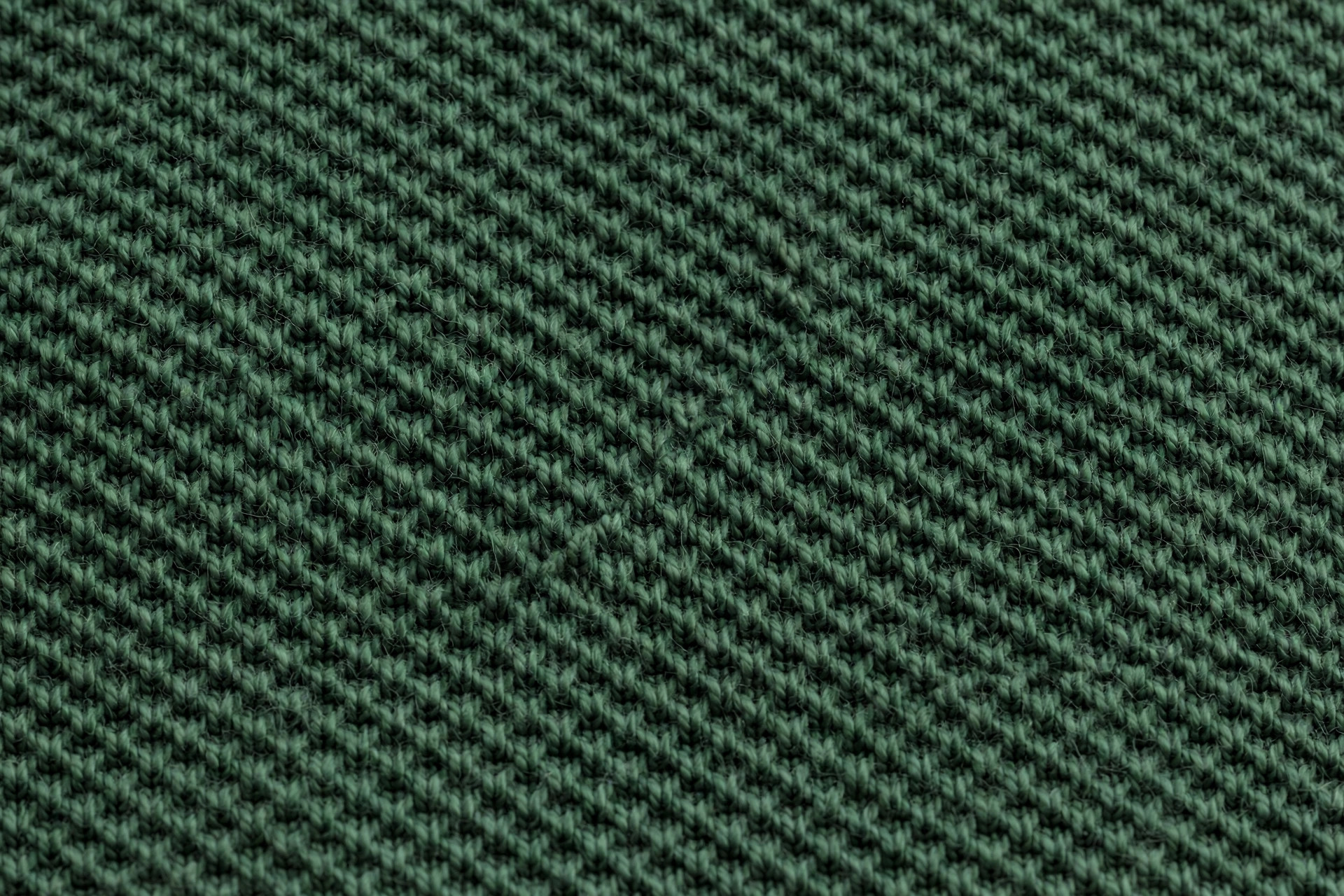
What Piqué Knit Is
Run a fingertip over a classic polo shirt and you feel it at once: not the flat smoothness of a T-shirt, but a fine, firm texture of tiny cords and dimples that grips the skin lightly and lets air move. That texture is piqué knit, a weft-knitted structure in which tuck stitches are placed in a strict repeating pattern inside a jersey ground. The tucks pull the ground out of flatness, course by course, until the whole face becomes a miniature landscape — and the shirt stays cooler, crisper and more opaque than plain jersey ever could.
One confusion must be cleared away first. There is also a woven piqué — sometimes spelled pique and sold as marcella — a stiff woven cotton with raised cords, used for white-tie waistcoats and dress-shirt bibs. That cloth is woven on a loom and has nothing to do with this page. The piqué here is knitted: a loop structure, with stretch, made on weft-knitting machines, and it is the fabric of polo shirts, golf shirts and smart summer knitwear worldwide. For buying and sourcing the finished cloth, see the companion Piqué Fabric Directory; this page is about how the structure itself is knitted.
Piqué belongs to the derivative family described in Knit Stitches & Structures: start with jersey, then add a second stitch action. Jersey alone uses only the knit stitch. Piqué adds the tuck — a loop held in the needle while a new yarn is fed, then cast off together with the next knit stitch — and in its firmer form the miss, where a needle skips the yarn and the yarn floats behind. Where those tucks and floats fall decides everything: the size of the texture cells, the firmness of the cloth, and whether the fabric is a light single piqué or the substantial double piqué the world knows as Lacoste.
Technical definition: Piqué is a weft-knit derivative of single jersey in which tuck stitches (and, in double piqué, miss stitches with floats) repeat in a fixed needle-and-course pattern, distorting the jersey ground into a textured, cellular face. Single piqué is knitted on a single needle bed with knit and tuck actions only; double (Lacoste) piqué uses a longer course repeat combining knit, tuck and miss actions. No second needle bed is required.
How Single Piqué Is Knitted
In single piqué the repeat is small enough to hold in the mind: four needles wide by four courses deep. Two of the four courses knit plain on every needle. The other two are tuck courses, and in each of them only alternate needles tuck while their neighbours knit — and crucially, the tucking needles swap between the two tuck courses, so the tucks are staggered like bricks in a wall. Follow the plan from the bottom: course 1 tucks on needles 1 and 3, course 2 knits plain, course 3 tucks on needles 2 and 4, course 4 knits plain, and the repeat begins again.
Each tuck does two jobs. While it is held, the yarn that should have formed a loop lies across the needle hook as an extra strand; when it is finally cast off with the next course, it pulls its neighbouring knit loops sideways and downward. Thousands of those small pulls, staggered in both directions, pucker the jersey ground into the familiar pattern of tiny raised cords separated by dimples. Because the tucks also add yarn, single piqué is heavier, wider and more stable than the jersey it came from, with less edge curl and better opacity — exactly what a shirt worn on its own requires.
Lacoste: the double piqué structure
Double piqué, universally called Lacoste piqué after the tennis-shirt cloth that made it famous, stretches the idea over a 12-course repeat. Plain knit courses still form the ground, but now tuck courses and miss courses both take part. On a miss course, selected needles do not receive yarn at all: the yarn floats across their backs and knits only on the needles that rise. Those floats, locked in by the tuck courses around them, pull the ground into deeper, more regular cells than single piqué can make, and they add a hidden layer of yarn inside the fabric.
The result is a cloth with a more pronounced honeycomb face, a firmer and more tailored hand, and noticeably better shape retention through washing — the reasons Lacoste piqué became the standard for premium polo shirts. The cost is complexity and weight: twelve courses must be cammed or programmed exactly, yarn consumption rises, and production is slower than single piqué. Between the two sit many commercial variants — mini-piqués with finer repeats, birdseye effects, and piqués knitted with an elastane feed for recovery — but all of them obey the same grammar of knit, tuck and miss set out in the two plans above. Stitch size, and therefore the scale of the texture, follows machine gauge as explained in Knit Gauge Explained.
Properties: Why Piqué Feels Different
Hand and surface. Piqué feels dry, firm and textured rather than soft and flat. The cellular face touches the skin only on its raised cords, so the fabric feels cooler and less clingy than jersey in hot weather, and the broken surface hides show-through and minor creasing. Held to the light, a good piqué shows its regular cell pattern clearly on the face and a flatter, float-streaked back.
Stretch and stability. The tuck architecture shortens and widens the cloth compared with jersey: tucks consume yarn across the width, so piqué stretches less across, recovers better, and resists the bagging and edge-curl of plain jersey. Lengthwise stretch remains comfortable, especially in Lacoste piqué, where the internal floats act like a light scaffold. Adding a small percentage of elastane, common in modern polos, sharpens recovery further without changing the visible texture.
Weight and breathability. Expect a midweight cloth: heavier than a T-shirt jersey of the same yarn, lighter than the true double knits such as Ponte di Roma. The dimples trap still air yet the structure remains openly breathable, a combination that made piqué the natural uniform of warm-weather sport long before technical fibres existed. Cotton remains the classic yarn; cotton-polyester blends trade a little of the dry hand for easier care and colour fastness.
Where Piqué Knit Is Used
The polo shirt is piqué’s defining garment — in single piqué for everyday and promotional shirts, in Lacoste piqué for premium ones. The same qualities carry it into golf and tennis apparel, team and corporate uniforms, school knitwear, and children’s shirts that must survive hard washing while still looking structured. Piqué also appears in smart-casual dresses, skirts and light jackets where a jersey would look too casual, and in trims and collars, where its firmness holds an edge.
Choosing between the two structures is a cost-and-character decision. Single piqué is the economical workhorse: lighter, softer, quicker to knit. Lacoste piqué is the choice when the garment must keep a crisp, almost tailored surface season after season. Both are introduced, alongside the other derivatives, in the parent survey of Knit Stitches & Structures, and both are pure weft knits — a single yarn path forming every course.
Recognising Piqué — and Its Neighbours
Recognise knitted piqué by stretching it gently: a woven marcella will barely give, while knitted piqué extends and recovers like other weft knits, and its back shows floats and loop structure rather than a woven grid. On the face, look for the regular dimpled cells; on the back of Lacoste piqué, look for the fine horizontal float lines that betray the miss courses.
Among its neighbours on this site, piqué is the tuck-texture counterpart to Purl Knit, which textures a fabric by reversing whole courses instead of tucking single stitches, and a lighter, single-bed alternative to the double knits Ponte di Roma and Milano Rib, which gain their firmness from a second needle bed rather than from tucks and floats. If the texture is the point of the fabric, it is usually piqué; if smoothness and body are the point, it is usually a double knit.
Common Questions
- What is the difference between single pique and Lacoste pique?
- Single pique uses a small 4-needle by 4-course repeat of knit and tuck stitches only, giving a light, fine texture. Lacoste (double) pique uses a 12-course repeat that adds miss stitches and internal floats, giving a deeper honeycomb texture, a firmer hand and better shape retention.
- Is pique knit or woven?
- Both exist. The polo-shirt fabric covered on this page is knitted, with stretch. Woven pique, also called marcella, is a stiff woven cotton used for formal waistcoats and dress-shirt fronts. If the fabric stretches and shows loops on the back, it is the knit.
- Why are polo shirts made from pique?
- The tuck-built cellular face touches the skin only on raised cords, so the shirt feels cooler and less clingy than flat jersey, while the structure resists curl, bagging and show-through. It looks smarter than a T-shirt and survives repeated washing well.
- What does a tuck stitch do in pique?
- A tuck holds the yarn in the needle without casting off, then clears it together with the next knit stitch. Each tuck pulls neighbouring loops out of line; staggered across thousands of stitches, those pulls pucker the jersey ground into pique’s dimpled texture. See the stitch plans on this page.
- Does pique shrink or lose its texture in washing?
- Cotton pique can shrink on first washes like other cotton knits, so follow the garment care label. The texture itself is structural — built from tucks and floats, not a finish — so it does not wash out, although heavy tumble drying can soften the crispness of Lacoste pique over time.
More Knit Structures
- Knit Stitches & Structures — the parent guide to all knit structures
- Purl Knit (Links-Links) — texture by reversing courses: the reversible bump fabric
- Ponte di Roma — the firm double knit with two smooth jersey faces
- Milano Rib — the structured double knit of one rib and two jersey courses
- Weft vs Warp Knitting — how weft and warp knitting differ, machines and fabrics compared
- Knit Gauge Explained — what gauge means for stitch size, weight and hand
Back to Knit Stitches & Structures
This page is one part of Knit Stitches & Structures, Apparel Search’s deep guide to the structures inside the Knitwear Construction Guide series on how knitted fabric is made.
Search Apparel Search