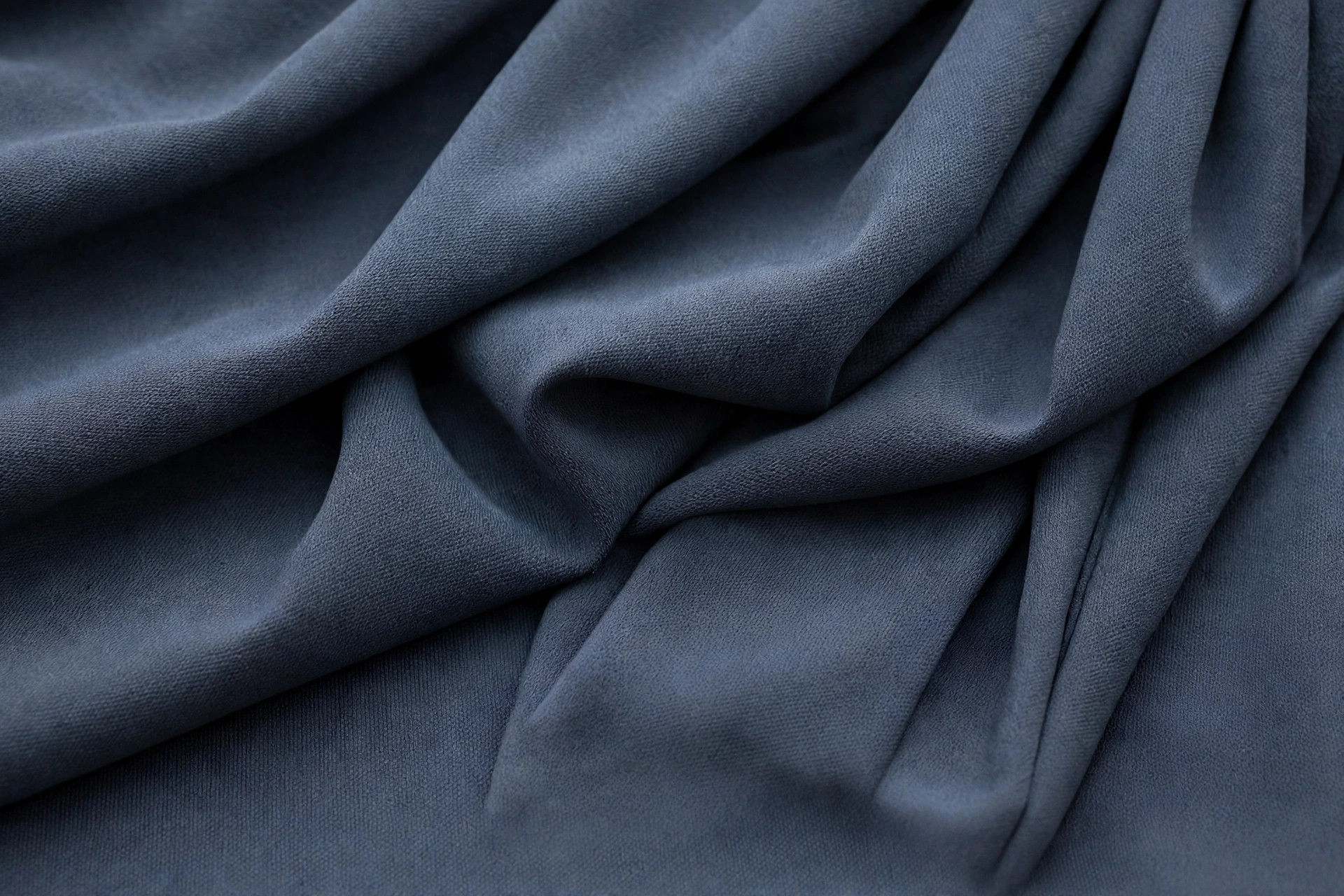
What Ponte di Roma Is
Pick up a pair of well-cut ponte trousers and the fabric explains itself before any label does: smooth on both sides, firm in the hand, opaque, with a clean tailored fall that behaves almost like a woven — yet it stretches. Ponte di Roma, usually shortened to ponte, is a double knit: two layers of single jersey knitted at the same time on two needle beds, intermeshed so thoroughly that they form one stable cloth. The name is Italian for “bridge of Rome,” a nod to the way the yarns bridge between the two faces, course after course, locking them together.
Most readers have met ponte as the fabric of “smart” leggings, pull-on trousers, structured dresses, blazers and ponte skirts — the garments that brought knit comfort into tailored wardrobes. If you want the short version, the glossary explainer at Ponte covers the fabric in brief; this page is the construction guide, explaining how the double structure is knitted and why it behaves so differently from the single jersey of a T-shirt. Ponte is one of the double-knit family introduced in Knit Stitches & Structures, alongside interlock and Milano rib.
Understanding ponte starts with the machine. A T-shirt jersey needs one set of needles. Ponte needs two sets facing each other — the cylinder and dial of a circular double-jersey machine, or the two beds of a flat machine — knitting two jerseys simultaneously and stitching them to each other as they form. The result is not two fabrics glued or sewn together: separate them and there is nothing to separate, because every course is shared. That shared-course construction is the whole secret of ponte’s firmness, opacity and smooth double face.
Technical definition: Ponte di Roma is a weft-knit double-jersey structure knitted on two needle beds. In its classic form, each repeat uses two yarn feeds: the first knits on the needles of both beds in a rib-like intermeshing course, and the second knits jersey on one bed only, with the pattern of bed selection arranged so that both outer faces present as plain jersey. Only the knit stitch action is used; firmness comes from the intermeshed double construction, not from tucks or floats.
How Ponte di Roma Is Knitted
Picture two jersey fabrics being knitted face to face. The front bed knits its jersey with the smooth V side outward; the back bed knits its jersey with its smooth side outward too. Between them, at every repeat, a course is knitted on needles drawn from both beds in alternation, so the yarn zigzags from one layer to the other and ties them together. Knitters call this the intermeshing course; tailors never see it, because it is buried inside the cloth, but it is what stops the two faces from behaving like separate skins.
The classic ponte repeat is compact: two feeds (two courses) per repeat in the simplest constructions, extended in finer commercial pontes to four-course sequences that distribute the intermeshing more evenly. Notation writes the bed selection course by course — knit on front bed, knit on back bed, knit across both beds in rib gating — rather than the tuck and miss symbols used for Piqué Knits, because ponte uses the plain knit stitch throughout. What changes from course to course is simply which needles are allowed to knit.
That restraint is deliberate. With no tucks to pucker it and no long floats to snag, the surface stays perfectly smooth, while the double thickness does the structural work. Yarn feeds are usually identical, so both faces match; feed a different colour or fibre to one bed and ponte becomes reversible with two genuinely different faces. As with every structure in this series, stitch size is governed by machine gauge — see Knit Gauge Explained — and ponte is normally knitted at gauges that give a fine, dense, almost woven-looking surface.
Properties: Hand, Stretch and Stability
Hand and appearance. Ponte feels smooth, cool, dense and substantial, with a matte tailored surface on both faces and no visible stitch pattern at normal viewing distance. It drapes in firm folds rather than fluid ripples, holds a crease surprisingly well for a knit, and cuts with clean edges that barely fray or curl.
Stretch and recovery. Ponte stretches mainly across the width, and less than jersey — typically a comfortable ease rather than a sporty spring, unless elastane is added, as it very often is. The double construction gives excellent recovery for a weft knit: knees and seats bag far less than in single jersey, and garments keep their tailored outline through a day’s wear. Lengthwise stretch is modest, which is precisely why ponte trousers stay the length they were cut.
Stability and weight. This is one of the most stable weft knits made: low curl, low skew, good opacity even in light colours, and a mid-to-heavy weight that reads as clothing rather than underwear. The penalties are warmth (the double layer insulates), slower drying, and a hand that some wearers find almost too firm for next-to-skin summer wear. Fibre blends tune the balance: rayon-rich pontes drape softer, polyester-rich pontes resist pilling and hold colour, nylon-faced pontes add abrasion resistance, and a few percent of elastane transforms fit retention.
Where Ponte di Roma Is Used
Ponte owns the category of tailored knitwear: pull-on trousers and leggings worn as pants, pencil and A-line skirts, structured sheath dresses, knit blazers, ponte jackets and smart ponte tops. Designers choose it when a garment must look cut-and-sewn like a woven but wear with knit comfort — travel clothing is a classic ponte brief, since the fabric resists creasing and needs no ironing to look composed.
It is equally at home in uniforms and workwear dresses for the same reasons: opacity, recovery and a surface that takes embroidery and printing cleanly. Ponte is less suited to fluid, draped styles, to very light summer garments, or to anything that needs jersey’s full stretch; for those, single jersey or the softer double knit Milano Rib may serve better. For the brief fabric-level summary and shopping context, see the Ponte glossary page.
Ponte vs Interlock vs Milano Rib
All three are double knits with two smooth faces, and telling them apart is a favourite trade question. Interlock is the softest and most jersey-like: two interlocked rib-based layers, excellent for T-shirts and underwear, with more stretch and less firmness than ponte. Ponte di Roma is firmer and more tailored, its intermeshing concentrated in dedicated bridging courses, giving the most woven-like stability of the three. Milano Rib builds its body differently again — one rib course followed by two separate jersey courses — and lands between the two in softness, with a slightly more knitted hand and superb shape retention for jackets and dresses.
A practical test: cut a small swatch (where sampling is allowed) and stretch it across. Interlock springs back softly, ponte resists firmly and recovers flat, Milano rib feels springy yet structured. Then check the edge: ponte and Milano barely curl; interlock curls a little more. All three sit under the double-jersey umbrella in Knit Stitches & Structures, and all three are weft knits — for the lighter, single-bed textured alternative, compare Piqué Knits.
Common Questions
- What does ponte di roma mean?
- It is Italian for “bridge of Rome.” The name describes the structure: yarns bridge between the two needle beds, course by course, tying the two jersey faces into one firm double-knit fabric. In shops the name is shortened to ponte.
- Is ponte a knit or a woven fabric?
- Ponte is a knit — a weft-knit double jersey made on two needle beds. It is often mistaken for a woven because it is firm, stable, opaque and holds tailored shapes, but it stretches and recovers like a knit and is knitted loop by loop.
- What is the difference between ponte and interlock?
- Both are double knits with two smooth faces. Interlock is softer, stretchier and more T-shirt-like. Ponte is firmer and more stable, with its layers tied by dedicated intermeshing courses, so it suits trousers, skirts and blazers that must hold a tailored shape.
- Does ponte pill or bag at the knees?
- Good ponte resists bagging well because the double structure recovers flat; elastane blends recover best of all. Pilling depends on fibre: rayon-rich pontes can pill with abrasion, while polyester- and nylon-rich pontes resist it better. Washing inside out helps every type.
- Is ponte see-through in light colours?
- No. The double construction makes ponte one of the most opaque knits available, which is why it is trusted for leggings and trousers worn as pants, including in pale colours that would be risky in single jersey.
More Knit Structures
- Knit Stitches & Structures — the parent guide to all knit structures
- Milano Rib — the structured double knit of one rib and two jersey courses
- Purl Knit (Links-Links) — texture by reversing courses: the reversible bump fabric
- Piqué Knits — tuck-and-miss texture: single piqué and Lacoste structures
- Weft vs Warp Knitting — how weft and warp knitting differ, machines and fabrics compared
- Knit Gauge Explained — what gauge means for stitch size, weight and hand
Back to Knit Stitches & Structures
This page is one part of Knit Stitches & Structures, Apparel Search’s deep guide to the structures inside the Knitwear Construction Guide series on how knitted fabric is made.
Search Apparel Search