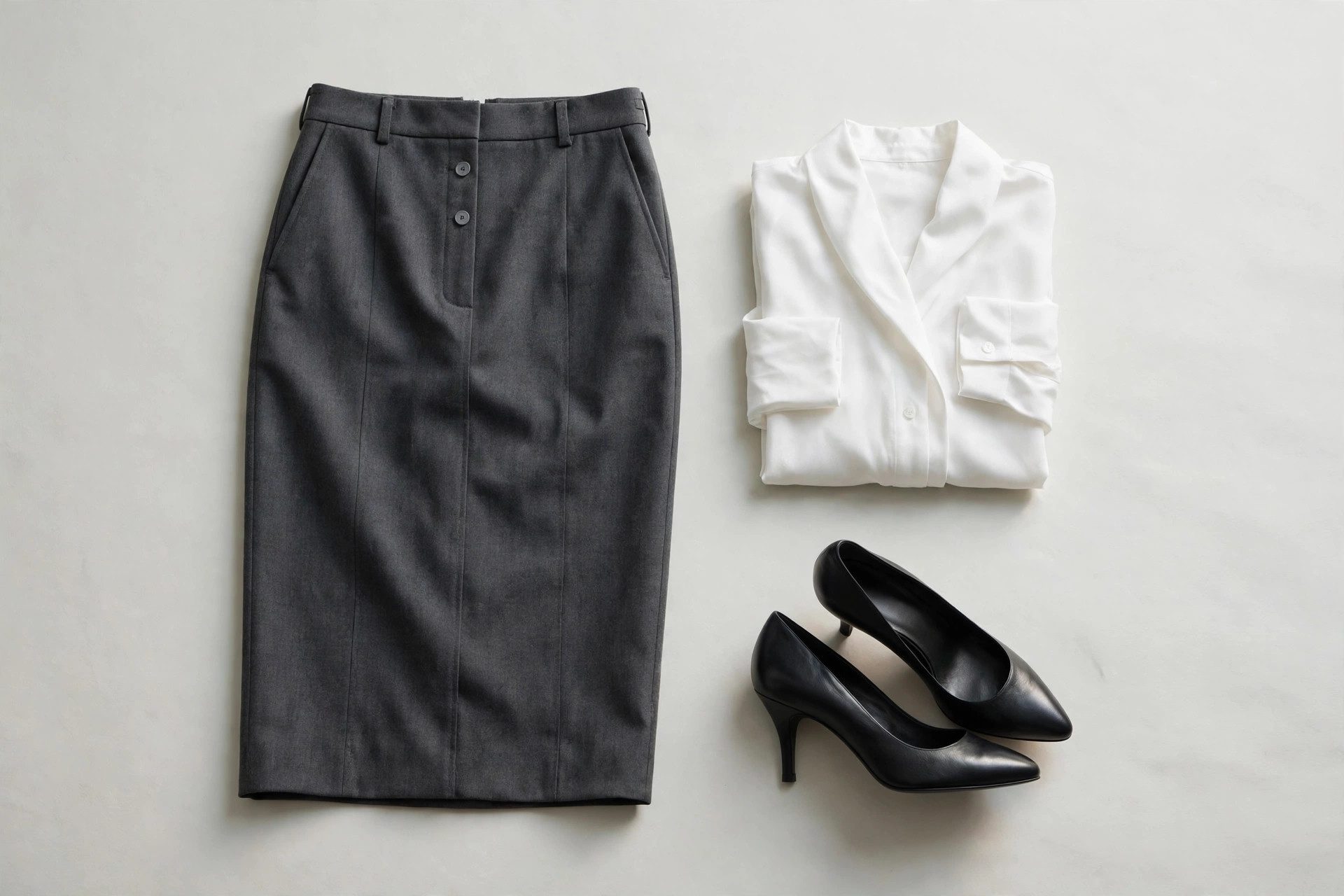
A pencil skirt is a straight, narrow skirt that follows the line of the body from waist to hem, ending at or just below the knee. It is cut with darts rather than gathers or pleats, so its shape comes from tailoring, not from added fabric — the silhouette is a column. The style descends from the narrow skirts of the late 1940s and Christian Dior's pencil line of the 1950s, and it has never left the wardrobe since, because it does one job supremely well: it is the most formal skirt shape that is still comfortable to work in. A back vent or slit is not decoration; on a skirt this narrow, it is what makes walking possible.
The Cut: Narrow by Design
A pencil skirt is built from shaped panels and waist darts that taper the fabric from hip to knee. There is no flare to hide in: the hem is typically only slightly wider than the stride it must allow, which is why length and venting are part of the pattern, not afterthoughts. The classic length ends at the knee or just below it, where the leg narrows — a pencil skirt that ends mid-thigh is usually sold as a mini, and one that ends at mid-calf behaves as a wiggle or hobble style and needs a generous slit.
Waist placement is usually high or at the natural waist, which is what creates the long, unbroken line the style is known for. Some versions add a wide waistband or a paperbag-free flat band; others are bandless with a facing. Pockets, when they exist, are in-seam and shallow — anything bulky fights the silhouette. Judge a pencil skirt by its seams: they should run vertically without twisting, and the darts should point at the hip without puckering.
Fit Rules and the Walking Vent
Fit is the whole garment. At the waist, a pencil skirt should sit without a gap you can pinch — a gaping waistband on a narrow skirt makes the whole piece rotate as you walk. Over the hip it should skim, not compress: horizontal creases pulling across the front mean it is too small, whatever the label says. The sitting test is the honest one — sit down, cross your legs, climb a step. The skirt should allow all three without riding up more than a few centimetres.
Movement comes from the vent: a back slit, a kick pleat or a short side slit that opens as you stride. A pencil skirt with no vent at all will restrict your stride to small steps, which is why vintage true-hobble versions are rare in modern shops. Fabric helps too: a small amount of elastane (2–3 percent) in ponte, wool or denim gives ease without bagging, while rigid fabrics demand a more generous cut. If a skirt twists as you walk, the fit at the hip is wrong, not the vent.
Fabrics and Styling, Work to Evening
For work, the reliable fabrics are ponte (a firm double-knit that holds its shape and forgives a long day), wool crepe and suiting blends, and lined cotton sateen in summer. The standard work formula is a tucked blouse or fine knit, the skirt, and a low heel or a polished loafer; add a blazer and the outfit covers most formal offices. Denim pencil skirts sit one rung down in formality and pair with shirts and ankle boots. Leather and faux-leather pencils are a long-running evening and smart-casual option worn with knitwear to soften the edge.
Evening versions use satin, lace overlays and sequins, usually keeping the same disciplined cut so the fabric does the talking. With tops, the rule is the same as for all narrow skirts: the top ends at the waist — tucked, cropped or belted — because the pencil's line is the point of it. Shoes follow formality: pumps and heeled sandals lengthen the column; flats work when the hem ends above the knee's widest point; ankle boots suit denim and leather versions in winter.
Common Questions
- Should a pencil skirt be tight?
- No — it should be close, not tight. A pencil skirt skims the hip and waist without compressing them. If horizontal creases pull across the front, if you cannot sit comfortably, or if the fabric strains at the vent, it is too small. A few percent of elastane in the fabric gives ease while keeping the narrow line.
- Why does my pencil skirt keep riding up?
- Riding up usually means the skirt is too small over the hip or the lining is gripping your tights or legs — the fabric climbs to find room. Check the hip fit first; a size up often solves it. A smooth lining, a longer vent, or wearing the skirt with a slip also helps it hang and stay in place.
- What top should I wear with a pencil skirt?
- One that ends at the waist: a tucked blouse, a fitted shirt, a slim knit or a cropped jumper. The pencil skirt's long, narrow line needs a defined waist to balance it. A longer top can work if it is belted or worn as a tailored layer, like a blazer that finishes at the hip.
- How long should a pencil skirt be?
- Classically at the knee or just below it — the point where the leg narrows, which keeps the line elegant and the stride workable with a vent. Shorter versions read as minis; longer mid-calf versions need a deeper slit and a more deliberate, vintage styling approach.
Skirt Styles & Lengths
This page is part of our series on the core skirt styles — the cuts and lengths every skirt wardrobe is built from.