Pleating Boundaries
Tucks & Pin Tucks — The Pleat's Stitched-Down Cousin
Fold a pleat, then sew it shut along its entire length, and you have made a tuck. Tucks belong on the boundary of this guide because they are built from the pleat's own fold yet behave like something else entirely — flat, stable and permanent, adding texture and shaping without any of the pleat's swing.
This page shows where the pleat family ends and tucks begin, how spaced and grouped tucks are measured and sewn, and how the tuck reaches its finest form in the pin tucks of heirloom sewing. If you can mark and fold a pleat, you already own most of the skill a tuck requires.
Where Pleats End and Tucks Begin
Cross-section of a tuck showing a fold stitched down its whole length beside a pleat left free to open Illustration by Apparel Search.
The construction begins identically. Fabric is marked with a fold line and a placement line, folded so the two meet, and pinned — the same opening moves as any pleat in this guide, and the pleats definition describes the shared fold at the root of both. The parting comes with the needle. A pleat is left free, or stitched only through its upper section so it can release and open below. A tuck is stitched down its whole length, close to the fold, so the doubled fabric is permanently fixed flat against the garment.
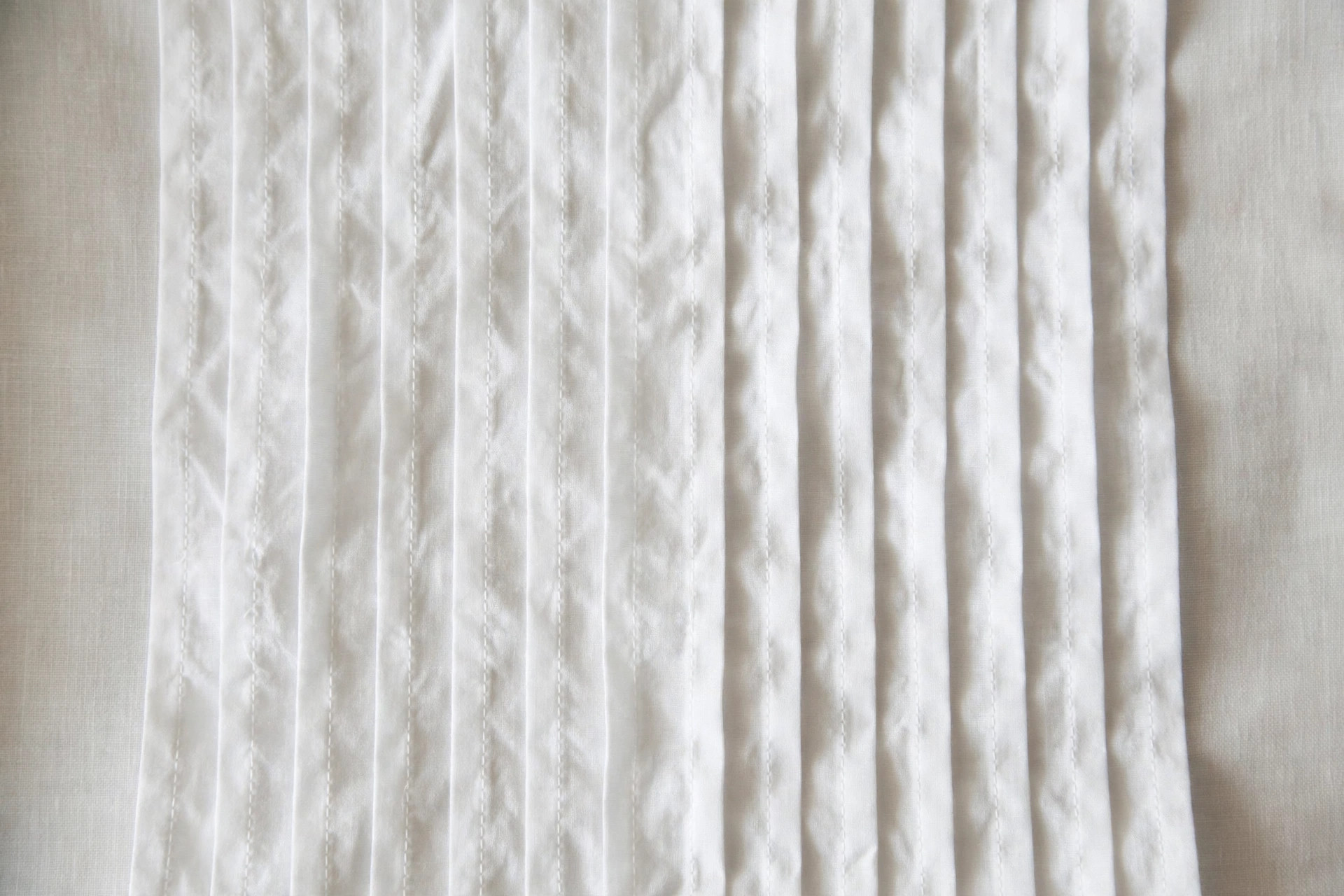
That one decision changes everything downstream. The tuck cannot open, so it adds no movement and no swing; instead it adds a raised corded line on the surface, a subtle shadow, and a small, exact take-up of width. A row of tucks reads as texture — tailored on a shirt front, soft on a blouse, precise on a child's dress. Where a pleat is fullness waiting to move, a tuck is fullness already spent, converted into surface and fit.
Because the fold is stitched flat, a tuck consumes exactly twice its own width in fabric: the fold goes out and comes back, and nothing hides beneath it. That simple two-to-one arithmetic makes tucks easy to plan — and easy to underestimate when they are used by the dozen.
Spaced and Grouped Tucks
Tucks are usually worked in families: evenly spaced across a panel, or gathered into groups — three or five close together, then a plain interval, then another group — a rhythm borrowed from classical dressmaking that suits bodices, yokes and shirt fronts. Mark every fold line and placement line before you fold anything, measuring from one datum edge as you would for pleats, because a drifting tuck is as visible as a drifting pleat and harder to forgive in a stitched-down fold.
Fold each tuck on the grain. A tuck that strays off the straight grain twists as it is stitched and will never lie flat, so check the fold against the weave before stitching, especially on soft or loosely woven cloth. Stitch close to the fold with a straight, even line — the stitching is on permanent display, and its steadiness is the tuck's quality mark. Press all the tucks in one direction unless the design says otherwise, and press from the wrong side over a soft surface so the raised lines keep their roundness.
Work tucks before the garment is assembled, while the panel is still flat and can be marked, folded and pressed on the table in comfort. Trying to add an even field of tucks to a made-up bodice means fighting seams, darts and curves at every fold. Cut the panel wider by the total take-up of the planned tucks — twice each tuck's width, summed across the row — then tuck it down to the pattern's true width and check the finished measure against the pattern before a single seam is sewn. That one check, panel flat on the table, is where tuck projects succeed or fail.
As fitting, tucks shape quietly. A pair of tucks released below the stitching at a waistline gives ease exactly where it is needed; tucks across a bodice front take in width while decorating the surface they shape. As decoration, they need nothing else: a plain fabric with a well-spaced field of tucks is a finished design, which is why tucks have served for generations on blouses, dresses, nightwear and children's clothes that must look considered without applied ornament.
Pin Tucks: The Fine Form
A pin tuck is a tuck reduced to a few millimetres — a fold so narrow it is named for the width of the pin that once gauged it. Rows of pin tucks across a bodice or down a blouse front create a fine corded texture that catches light in lines, richer the closer you look. They are a signature of heirloom sewing: christening gowns, fine children's dresses and delicate blouses where the workmanship itself is the decoration.
The technique is the tuck's technique at miniature scale. The fold is raised — traditionally by stitching beside a cord, with a twin needle, or with a dedicated pintuck foot whose grooves ride over the previous tuck to space the next one perfectly — and stitched with a fine needle and fine thread so the tiny fold is not chewed by the machine. Even spacing matters more, not less, at this size: the eye forgives a wandering wide tuck sooner than a wandering pin tuck, because the whole effect is regularity.
Pin tucks also shape. Across a bodice, each tiny tuck removes a thread of width, and twenty of them fit a front as surely as a dart while looking like pure ornament. For the tuck family worn as a garment feature, see the pin tuck dress guide, where pin-tucked bodices appear as a dress style in their own right.
Tucks Versus Pleats
| Feature | Tucks | Pleats |
|---|---|---|
| Fold | A fold brought to a placement line, exactly as a pleat is folded | A fold brought to a placement line, with a hidden underfold beneath |
| Stitching | Stitched down the whole length of the fold, permanently | Unstitched, or stitched only at the top and released below |
| Movement | None — the fold lies flat and fixed | The fold opens and closes with the wearer's movement |
| Typical use | Texture, gentle shaping and heirloom decoration on bodices and fronts | Fullness, swing and flare in skirts, dresses and kilts |
The table draws the boundary line this page exists to mark. Everything to the left of the stitching column is shared craft — the same marking, the same folding, the same respect for grain and spacing. Everything to the right is consequence: stitch the fold shut and you trade movement for texture, swing for stability. Neither trade is better. The pleat and the tuck are one fold with two destinies, and a sewer who understands both can choose, garment by garment, which destiny the cloth in hand deserves.
Search Apparel Search
Frequently Asked Questions
Is a tuck the same thing as a pleat?
A tuck is made exactly like a pleat — the fabric is folded on two lines and brought together — but it is then stitched down along its whole length, so the fold can never open. A pleat is stitched, if at all, only for part of its length and is free to open below the stitching. The stitching is the whole difference, and it changes how the fold behaves completely.
What are pin tucks used for?
Pin tucks are very fine tucks, only a few millimetres wide, used as decoration and gentle shaping on blouses, dresses, lingerie and heirloom garments for children. Rows of pin tucks add texture and quiet richness to plain fabric, and because each tuck takes up a little width, they can also ease a bodice to fit without darts.
Do tucks take up as much fabric as pleats?
A single tuck takes up exactly twice its finished width, because the fold is doubled back on itself and stitched flat. That is less than a standard pleat at three to one, but a bodice covered in grouped tucks or pin tucks can still consume a surprising amount of width, so the take-up must be allowed for when the pattern is cut.
Can tucks be used for fitting as well as decoration?
Yes. Shoulder tucks, waist tucks and bodice tucks have been used for generations to shape flat fabric to the body, releasing or stitching the tuck where the shaping is needed. A tuck that is stitched for only part of its length and released below works as both fitting and decoration at once, which is where tucks come closest to true pleats.
Keep Exploring
Step back into the pleat family proper, or follow the marking and pressing skills that tucks and pleats share.