Pleating Boundaries
Kilt Pleating — To the Stripe and To the Sett
A kilt is the most disciplined knife-pleated garment in the world: yards of tartan folded so precisely that the pattern itself becomes part of the engineering. The kiltmaker chooses between two great disciplines — pleating to the stripe, or pleating to the sett — and that single choice decides what the back of the kilt will look like from across a parade square.
This page sits at the boundary of the pleating guide because the kilt is both a pleated garment and a tradition with its own rules, terminology and supporting crafts. The pleating is explained here in full; the garment's wider history and dress context are carried on the Apparel Search pages linked throughout.
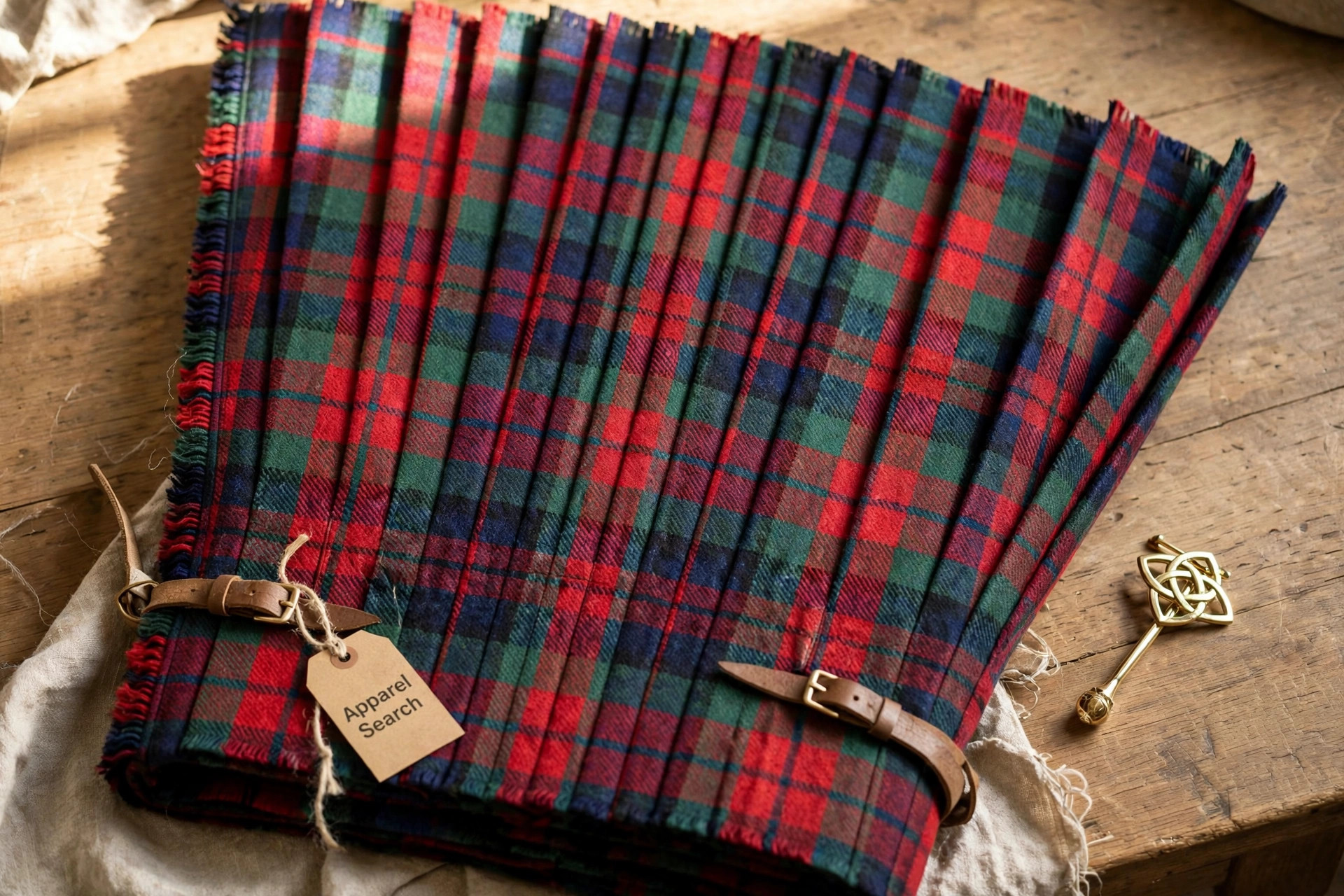
Two Disciplines, One Row of Pleats
Two tartan panels compared, one pleated to the stripe with the same stripe centred on every pleat, one pleated to the sett with the full pattern repeating Illustration by Apparel Search.
Every kilt pleat is a deep knife pleat, folded in the same direction all the way around the back and sides of the garment, leaving the front aprons flat. What the two disciplines govern is which part of the tartan pattern each pleat presents to the world. The tartan's repeating pattern unit is called the sett. Within that sett run stripes of different widths and colours, and the kiltmaker can build the pleats around either element.
Pleat to the stripe, and one chosen stripe becomes the hero of every pleat. Pleat to the sett, and the whole pattern is the hero, flowing across the pleats as if the cloth had never been folded. Both use the same depth of pleat and the same amount of cloth; they differ only in where each fold is placed within the repeating pattern — a reminder that in pleating, placement is design.
To the Stripe: The Military Discipline
In pleating to the stripe, the kiltmaker selects one prominent stripe from the sett — often a bright or strongly contrasting line — and positions every pleat so that stripe sits exactly at the centre of the pleat's visible edge. Pleat after pleat shows the identical stripe, in the identical position, from waist to hem.
The effect from behind is bold and architectural: a row of identical bright columns separated by the shadowed folds between them. The rest of the sett does not vanish — it is still there, hidden inside the underfolds — but the eye reads only the repeated stripe, so the back of the kilt looks quite different from the flat front aprons, where the full tartan shows.
Regiments historically pleated to the stripe of their own tartan, so the pleating itself became part of the uniform's identity, recognisable before a badge or a facing colour could be made out. That heritage is why the style still carries a formal, martial air even on a purely civilian kilt.
This is the traditional pleating of military regimental kilts, where uniformity across a whole regiment matters and the stripe reads clearly at a distance. It is also chosen by civilian wearers who simply prefer its stronger graphic rhythm. Because every pleat consumes the fabric up to the next occurrence of the chosen stripe, pleating to the stripe works best when the stripe repeats at an interval that suits a practical pleat depth.
To the Sett: The Pattern Unbroken
In pleating to the sett, each pleat is placed so that the visible surface continues the tartan pattern exactly as it would run on flat cloth. The fold of one pleat ends where the pattern says it should, the next pleat takes up the design at precisely the next thread, and so on across the whole back of the kilt.
The result is a small marvel: from a few paces away, the pleated back looks unpleated, a smooth field of tartan indistinguishable from the front aprons. Only movement betrays the construction, when the pleats open and close and the pattern breathes. It is the subtler and, in the judgement of most kiltmakers, the more demanding discipline, because every fold placement is dictated by the pattern rather than by a single stripe, and any drift shows at once as a break in the design.
Pleating to the sett is the standard civilian choice and the one most associated with family and clan tartans, where the point of the garment is the tartan itself, worn complete and undisturbed. The pleats are still deep, still consume their three-to-one fabric, and still give the kilt its swing — they simply spend their ingenuity on invisibility.
The Kilt Around the Pleats: Yardage, Fell and Canvas
The pleating sits inside a construction built to support it. A traditional kilt uses up to eight yards of tartan — the famous yardage is no legend but arithmetic, since deep knife pleats at roughly three-to-one take-up across the back and sides of the garment consume cloth at exactly the rate the ratio predicts. That weight of wool is the kilt's character: it hangs straight, swings as a unit and resists wind in a way no lighter pleated garment can imitate.
That yardage also explains the kilt's price and its longevity. Eight yards of good tartan, pleated deeply and stitched by hand along the fell, is a garment built to be re-made: a kilt can be taken apart, re-pleated to a different discipline or a different waist, and worn by another generation. Kiltmakers speak of the cloth outliving its first stitching, and the pleating is designed with that unpicking and remaking in mind — deep, honest folds that can be opened flat, re-marked and folded again decades later without the fabric having forgotten how to behave.
The pleats are stitched down along the fell — the shaped, fitted length from the waist to the widest point of the seat — with each pleat's stitching following its fold and the whole fell backed and strengthened so the shaping holds. Inside, a canvas interlining at the waist and fell gives the heavy pleating a firm foundation, and a lining protects both the cloth and the wearer where the stitched pleats sit. Below the fell, the pleats hang free and unstitched, edges pressed sharp, ready to open with every stride.
For the garment beyond its pleats, see the Apparel Search kilt definition, the guide to the Scotland kilt in traditional dress, the tartan definition for how setts and stripes are woven, and the men's kilts guide for the kilt as clothing today.
A Kilt Is Knife Pleating at Its Most Disciplined
Strip away the tradition and the tartan, and a kilt is a row of knife pleats — the same fold taught step by step in the knife pleats guide — executed at unusual depth, in unusual yardage, under the strictest placement rules in all of pleating. That is worth remembering in both directions. The kiltmaker's disciplines show what knife pleating can achieve when placement is treated as sacred; and the home sewer's first row of knife pleats, folded and stitched on the same principles, is a genuine if humbler member of the same family. Learn the fold, respect the placement, and the boundary between a pleated skirt and a kilt becomes a matter of degree, cloth and custom — not of kind.
Search Apparel Search
Frequently Asked Questions
What is the difference between pleating to the stripe and to the sett?
Pleating to the stripe arranges every pleat so the same chosen stripe of the tartan sits at the centre of each pleat edge, giving a regular, bold column effect down the back of the kilt. Pleating to the sett arranges each pleat so the full tartan pattern repeats across the pleats, and the pleated back looks like unpleated cloth from a distance.
Why does a kilt use so much fabric?
A traditional kilt uses up to eight yards of tartan because its pleats are deep knife pleats, each one consuming roughly three times the width it shows. The great length of cloth is what gives the kilt its weight, its swing and the fullness that lets the pleats open and close as the wearer moves.
Which style of kilt pleating is more common?
Pleating to the sett is the usual civilian choice, because it preserves the look of the tartan itself across the whole garment. Pleating to the stripe is associated with military regimental kilts and with wearers who want the stronger, more graphic effect of the repeated stripe.
Are kilt pleats stitched down?
Yes. Kilt pleats are stitched along the fell, the fitted section from the waist to the widest part of the hip, so the back of the kilt sits smooth and shaped. Below the fell the pleats are left free, which is what allows the kilt its characteristic swing when the wearer walks.
Keep Exploring
Explore the pleat family the kilt belongs to, and the wider sewing guides that surround this boundary page.