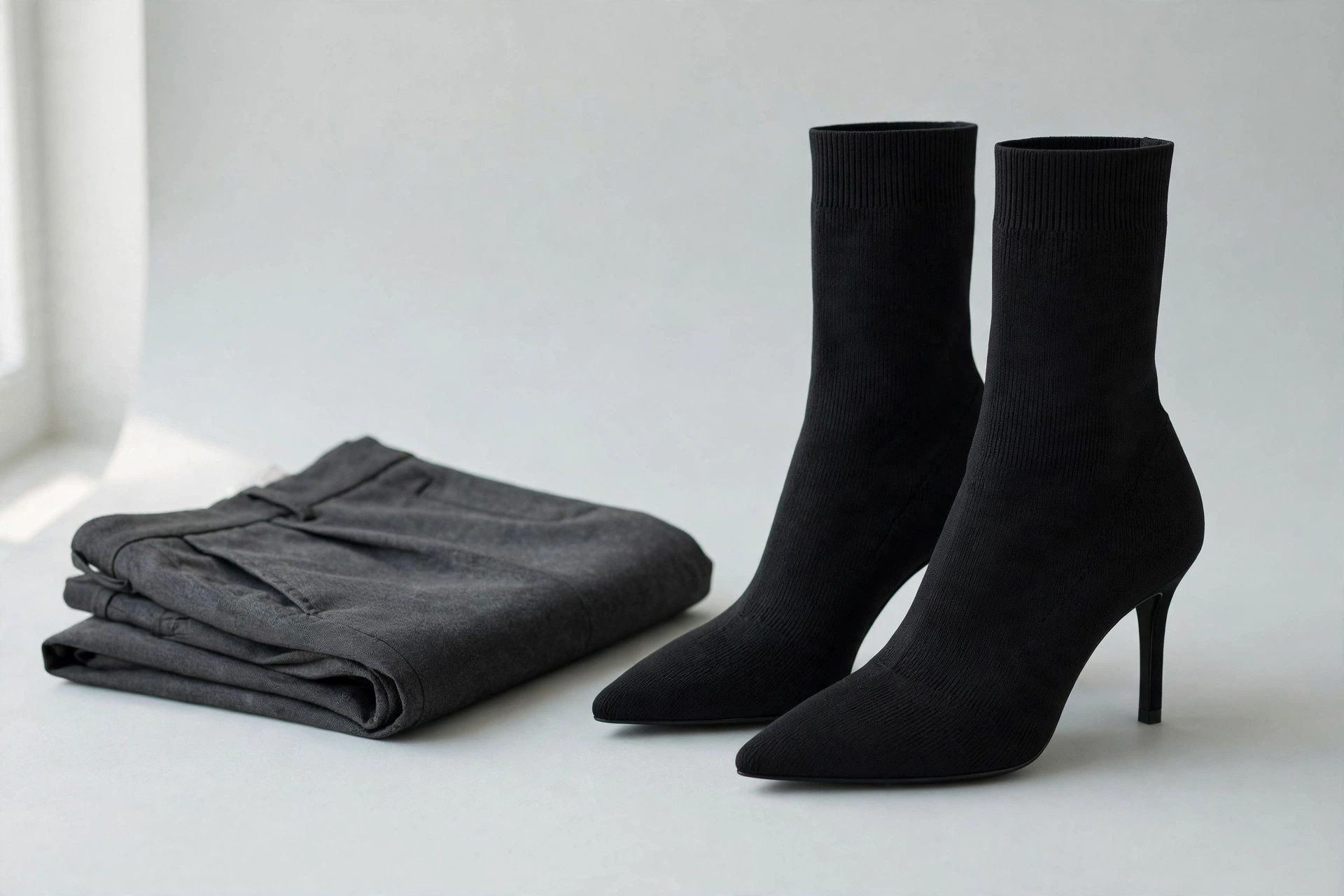
Sock boots are boots whose upper is made from a stretch knit, neoprene or similar fabric that fits the foot and leg the way a sock does — closely, smoothly, and without seams, laces or zips breaking the line. A sock boot is really a shoe with a sock attached: a heel and sole below, a knitted shaft above that hugs the ankle or calf. The style was pushed into fashion by designer labels in the 2010s, most often as a pointed-toe ankle boot on a slim heel, and it solved a real problem — boots that fit narrow ankles and wide calves equally, with no gap at the top. Its limits are just as real: the fabric gives neither support nor weather protection.
A Boot Built Like a Sock
The construction is a hybrid. The foot part is built on a normal shoe last with a real sole and heel — slim stiletto and block heels on ankle versions, flat soles on some casual ones. Above the ankle, instead of leather quarters and a zip, the upper continues as a knitted or neoprene tube, often seamless, that stretches over the calf and grips it. Some versions hold a pointed, very elongated toe that became the style's signature in its designer-led wave; rounder toes and chunkier soles mark the casual branch.
The fit consequence is the selling point: a sock boot has no fixed shaft circumference, so it accommodates slim and wide calves without the gaping or pinching that fixed leather shafts cause — the same quality that made stretch boots popular, taken further. The trade is structure. A knit shaft cannot support the ankle, protect against weather or hold polish the way leather does; a sock boot is a fashion instrument, not equipment, and its wardrobe place is beside heeled shoes rather than beside winter boots.
Sock Boots vs Stretch Boots
The two are neighbours worth separating. Stretch boots are leather or suede boots with elastic panels or stretch-backed shafts: mostly a conventional boot, with give built into the calf. They look like boots in every light, age like boots, and can be resoled and repaired. Sock boots are fabric from ankle to top: lighter, smoother, more leg-hugging, and more fragile. A stretch boot has a shaft line; a sock boot has a leg line — the outline is your own calf, uninterrupted.
Choose stretch leather for durability and all-weather duty; choose the sock boot when the outfit wants a perfectly smooth leg line — under a midi skirt hem, below cropped trousers, with a mini dress — and the day is dry. Fit test for both is the same: sit, stand, walk stairs. A sock boot should not creep down the calf, and the knit should recover its shape when flexed rather than bagging at the ankle.
Styling and Care
Sock boots earn their keep in the gaps other boots cannot fill. Under a midi skirt or dress, a knee-high sock boot continues the leg line without a shaft edge interrupting it. With cropped trousers, an ankle sock boot closes the gap between hem and shoe in one smooth piece — the standard styling move, and the reason the style survives trend cycles. Pointed sock boots with tailoring read as sharp; round-toe knit versions with knit dresses read as soft. In every case, let the shaft show: covering it with fabric wastes the design.
Care is laundry, not cobbling. Brush dust off, spot-clean marks, and use a lint roller or fabric comb for pilling on knit versions; most cannot be machine washed whatever the internet suggests. Keep them away from rain and puddles, store them standing so the shaft does not crease flat, and accept the category's honest limit: when the knit wears thin at the heel or toe, a sock boot cannot be rebuilt the way a leather boot can. Buy it as you would buy a good shoe, for the seasons it will serve, not for the decade.
Common Questions
- Are sock boots comfortable?
- For a fashion boot, yes — the knit flexes with the foot and there are no stiff seams to rub. But they offer no ankle support or cushioning structure, and slim-heeled versions are still heels. Treat them as you would a heeled shoe for walking distance, and do not expect hiking-boot behaviour from a fabric upper.
- Can you wear sock boots in the rain?
- Not willingly. Knit and neoprene uppers soak through, and the close fit means wet fabric sits against the leg. Some technical versions have water-resistant treatments, but a sock boot is fundamentally a dry-weather boot. In wet seasons, leather boots with sealed seams do this job; keep sock boots for dry days and indoor mileage.
- What pants do you wear with sock boots?
- Cropped trousers and jeans that end above the boot top, so the smooth shaft is visible and the hem does not bunch over it. Straight-leg trousers falling cleanly to the top of the boot also work. Avoid bootcut or wide hems that swallow the boot halfway — the style's whole point is the unbroken line.
- Do sock boots stay up?
- Yes, when they are correctly sized — the elastic knit grips the calf the way a sock grips, and taller versions are designed to hold at their full height. A pair that slides is usually a size or a fabric problem: very smooth, thin knits on a slim calf can creep, so choose a ribbed or firmer knit if your calves are narrow.
Boot Style Guides
This page is part of our boot style series, completing the classic boot categories with dedicated guides.