Women's Stretch Boots Guide
A stretch boot uses elastic fabric or panels in the shaft so the boot hugs the calf without zips, laces or a tailor — a close, smooth fit that adapts to the leg.
Shop Women's Stretch Boots Now
Shop Women's Stretch Boots on Amazon Shop Women's Stretch Boots on eBayThe Amazon and eBay links on this page are affiliate links. If you make a purchase through them, Apparel Search may earn a commission.
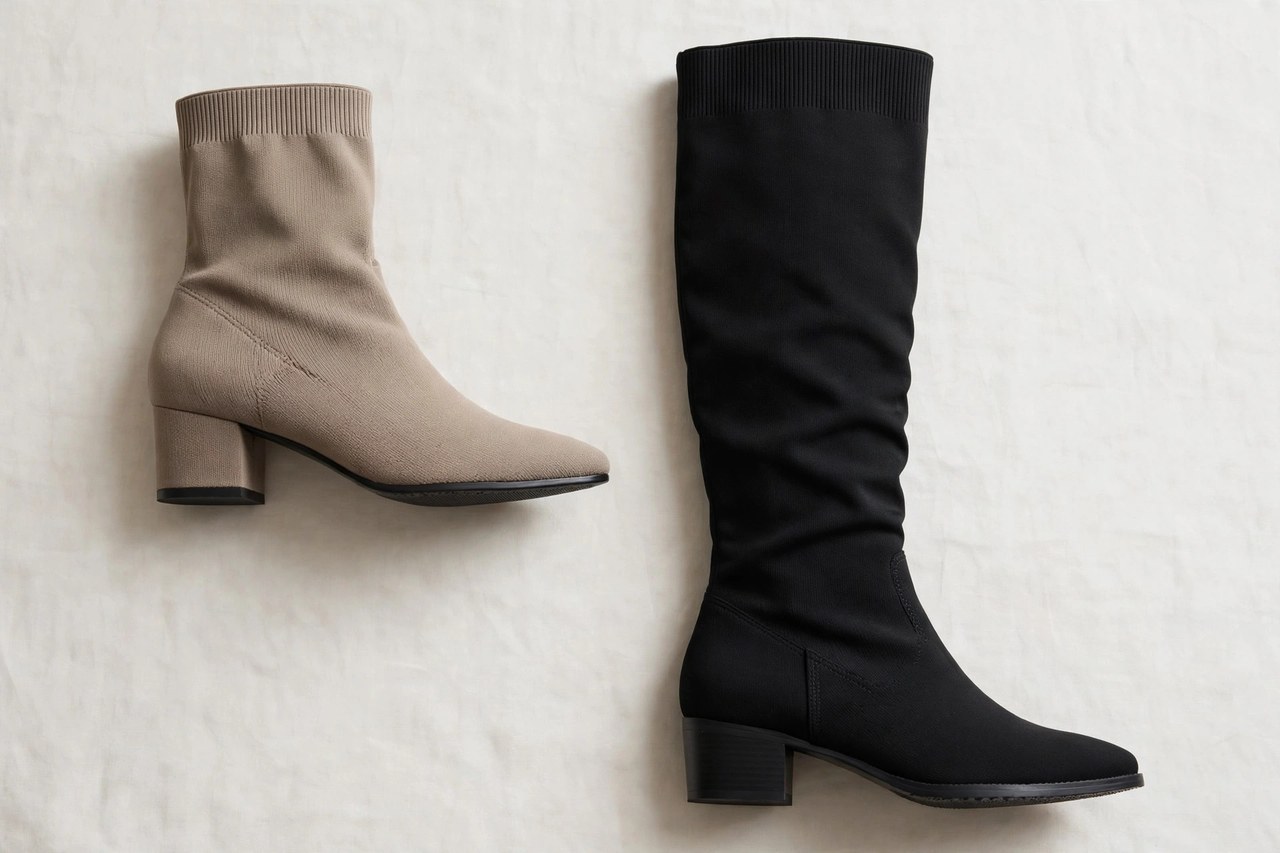
A stretch boot solves the oldest problem in tall footwear — the calf that does not match the boot's fixed tube — by making the shaft itself elastic. Stretch boots use a stretch fabric upper, an elastic gore panel, or a combination of leather with stretch backing, so the shaft pulls on and conforms closely to the leg instead of standing away from it or refusing to zip. The silhouette that results is sleek and uninterrupted: no gap at the top, no hardware breaking the line.
This guide covers the stretch boot as a fit technology: the constructions from full fabric sock boots to leather boots with a hidden stretch panel, how to judge whether a shaft will hug without strangling, which heights and heel types the stretch format suits, and the care that keeps elastic alive. If standard tall boots have always gapped or pinched on you, this is the category designed with your leg in mind.
Constructions: Sock Boots, Panels and Gores
The purest form is the sock boot: a knitted or woven stretch fabric upper, ankle or knee height, that pulls on like a thick sock over a shaped heel and sole. Sock boots give the closest fit of any boot and the lightest feel, and they pack flat. Next are fabric stretch boots in scuba-like knits, stretch suede and stretch microfiber, which hold more structure than a knit while keeping the pull-on, calf-hugging fit.
More traditional boots borrow the idea in part: a leather or suede boot with a stretch panel set into the back or inner shaft, or an elastic gore section near the top, gains an inch or more of give exactly where calves differ, while keeping a classic leather face to the world. Full-zip stretch boots also exist, using elastic fabric to ease the zip's work. Judge the construction by recovery: stretch the shaft and watch it return completely; fabric that stays bagged in the shop will bag permanently on the leg.
Calf Fit: Hug Without the Stranglehold
Stretch fit is forgiving in both directions, which is its gift and its trap. A shaft that stretches to fit a wide calf also grips a slim calf without gaping, and it accommodates the calf's natural change across a day and across a season's layers — over skinny jeans today, over bare legs with a dress tomorrow. But adequate stretch is not infinite stretch: check the boot's stated shaft circumference range, and treat a shaft stretched to its absolute limit as a poor fit, because fabric at full extension presses, shines and wears out fast.
Try stretch boots at the end of the day, when legs are at their largest, and sit, stand and walk: the top edge should hold without a tourniquet line, and the shaft should not migrate downward as you move, which signals too little grip rather than too much stretch. Knee-high stretch shafts should end below the knee's bend without the edge rolling. A well-fitted stretch boot feels like a firm sock, present but forgotten within minutes — that is the standard to shop against.
Heights, Heels and Where Stretch Works Best
Stretch construction appears at every height, and its value rises with the shaft. Ankle sock boots are a fashion staple, their close fit pairing cleanly with cropped trousers and midi hems. Mid-calf and knee-high stretch boots are where the technology earns its keep, replacing the whole wide-calf fitting struggle with a pull-on. Over-the-knee stretch boots depend on it entirely: only a gripping elastic shaft keeps a thigh-high boot up without garters or constant adjustment.
Heels range from flat to stiletto on stretch boots, and the pairing matters: a sock boot on a sculpted heel is the category's fashion signature, while flat and block-heeled stretch boots serve as everyday winter footwear. Consider the sole, too, since fabric-shaft boots are often built light; a lugged or rubber sole extends a pair from dress duty into real weather. Suede-look stretch fabrics stay dress shoes in practice, whatever the sole suggests.
Styling and Caring for Elastic Shafts
The stretch boot's smooth, close line is its styling argument: it disappears under wide trousers, completes a knit dress without competing texture, and gives short hemlines a continuous leg line that a gaping stiff boot interrupts. Because the shaft shows the leg's shape, monochrome pairings — black boot, black tight or trouser — are the sleekest, while a contrast stretch boot makes the boot itself the outfit's event. Avoid bunching bulky trousers into a stretch shaft; the category rewards a clean tuck or a hem that ends above the boot.
Elastic ages by heat, sunlight and overstretching. Store stretch boots with shapers or rolled inserts so shafts stand rather than folding, since a permanent crease at the ankle is this boot's characteristic wear mark. Clean fabric shafts with a soft brush and spot cleaning; protect stretch suede with a suitable spray. Never force a drying boot near a radiator, which cooks elastane. With the elastic respected, a stretch boot keeps its second-skin fit for seasons rather than sagging into the slouch it was bought to avoid.
Related Women's Guides
More to Explore on Apparel Search
- Women's Boots Guide
- Women's Shoes
- Women's Footwear
- Fashion
- Clothing Retail Stores
- Fashion News
- Fashion Designers
- Popular Brands
- Apparel
- Women's Clothing Stores
- Women's Clothing Wholesalers
- Women's Fashion
- Women's Shoe Stores
- Women's Footwear Guide
- Women's Shoes
- Footwear Definitions
- Shoe Search
- Fashion Videos
- Fashion Calendar
- Celebrity Fashion
- Fashion Designer Directory
- Women's Athletic Shoes
- Women's Casual Shoes
- Women's Dress Shoes
- Women's Sandals
- Women's Trend Shoes
Women’s Clothes Guide by Letter: Women's Apparel Directory N · Women's Clothes Directory O · Women's Clothing Directory P · Women's Apparel Directory Q · Women's Fashion Directory R · Women's Clothes Directory T
Looking for Women's Clothing Stores?
This guide helps you choose women's stretch boots. To browse where to buy, visit our women's clothing store directory, where you can find retailers that carry them.