Traditional Dress by Country · Cambodia
The Sampot of Cambodia
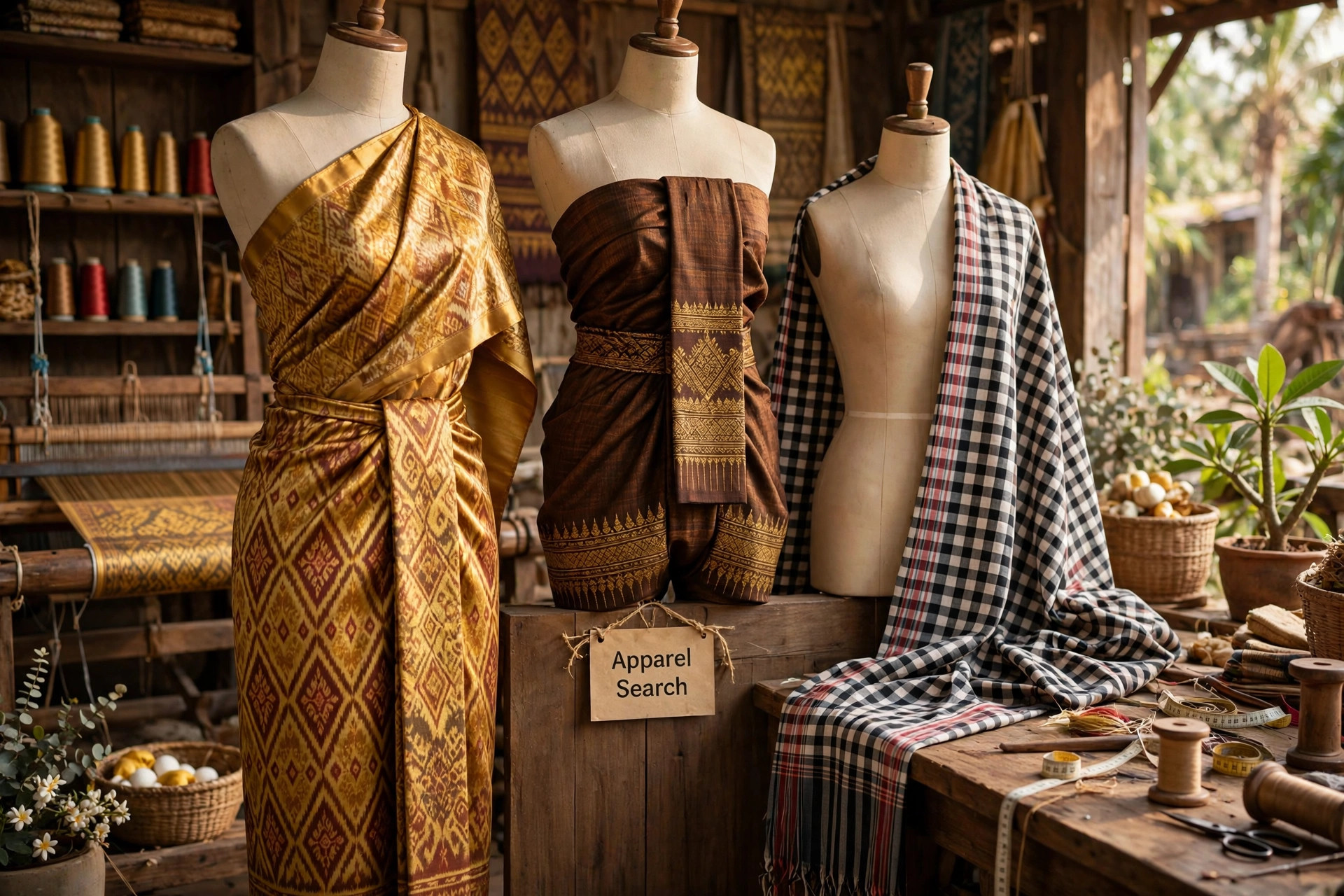
The sampot is Cambodia's national garment: a long cloth wrapped and folded at the waist, worn as the flowing sampot phamuong skirt, or drawn up between the legs in the ancient sampot chang kben style carved on the temple walls of Angkor. This guide explains both forms, the indispensable krama scarf that accompanies them, and the golden Khmer silk and ikat hol weaving that make the festive sampot one of Southeast Asia's great textiles.
The Garment
What a Sampot Is
The sampot is a rectangle of cloth with a thousand years of history in its folds. Wrapped around the lower body and secured at the waist, it is depicted on the bas-reliefs of Angkor Wat and the other great Khmer temples, where gods, kings and dancers wear the chang kben style with its cloth drawn up between the legs — proof that the garment's essential forms were settled by the height of the Angkorian empire, between the ninth and fifteenth centuries.
Unlike a sewn skirt, a sampot is made entirely by folding. The same cloth can be worn long and straight for a ceremony, shortened for work in the fields, or transformed into the chang kben for dance and court dress. That versatility, in a hot climate, kept it the everyday dress of Cambodia into modern times, and the silk version — in Cambodia's famous golden silk, patterned with ikat — remains the summit of Khmer formal dress.
Above the sampot, women traditionally wear a fitted blouse or jacket; the classical dance costume adds the sbai, a diagonal sash across the chest. And everywhere, at every level of dress, there is the krama: the checked scarf that is less an accessory than a national tool.
Anatomy
The Parts of the Outfit
A formal sampot outfit is assembled from cloth, folds and a few key pieces:
- Sampot phamuong
- The skirt form: the cloth is wrapped around the waist and folded at the front into flat, even pleats that fall from the waist, the end tucked in and the whole secured, today often with a decorative metal belt. Worn ankle-length, in silk for formal wear.
- Sampot chang kben
- The drawn-up form: wrapped at the waist, the cloth is passed between the legs and tucked into the back of the waistband, forming full, gathered breeches; the front is finished with a hanging fold or knot. The court and dance style of Angkor's carvings.
- The blouse
- Women pair the sampot with a fitted blouse — lace and embroidered blouses for festivals and weddings, plainer tailored tops for formal occasions — colour-matched or contrasted with the silk of the sampot.
- Sbai
- A long sash worn diagonally across the torso, part of classical dance costume and traditional bridal dress, often in gold cloth.
- Krama
- The checked cotton scarf: worn at the neck, as a headcloth, or carried for its hundred uses. Classically red-and-white or blue-and-white checks, woven in cotton.
- Belt and jewellery
- Formal sampot are finished with a belt — woven, silver or gold-toned — and gold jewellery for weddings, where bride and groom may both wear silk sampot outfits in matching colours.
Types
From Temple Walls to Wedding Silk
The sampot's forms divide by how the cloth is arranged, and by the cloth itself:
| Form | How it is worn | Where you see it |
|---|---|---|
| Sampot phamuong | Long skirt, front pleated flat | Women's formal, festive and pagoda dress — the modern standard |
| Sampot chang kben | Drawn between the legs into gathered breeches | Classical dance, weddings, ceremonies, temple carvings |
| Sampot tep apsara | The dance costume form, with sbai and gilded headdress | Apsara dance performance, Cambodia's classical ballet |
| Everyday sampot | Shorter, simpler cotton or mixed cloth, loosely folded | Rural daily wear and work |
Cloth separates the everyday from the ceremonial as clearly as form does. Cotton and printed cloth serve daily life. The festive sampot is silk, and the finest silk sampot is hol — weft ikat, its pattern dyed into the threads before weaving — in the deep, rich palette of Khmer tradition. A wedding sampot outfit in hol silk, worn with a lace blouse and gold belt, is the fullest expression of the garment today.
Cloth and Pattern
Khmer Silk and Hol Ikat
Cambodian silk is famous for its colour: the local silkworm, fed on mulberry, produces a naturally golden-yellow silk with a soft lustre unlike the white silk of China or Japan. Weaving is centred in villages in provinces such as Takeo, long recognised as the home of Khmer silk, where looms stand under the stilt houses and weaving is women's skilled work, passed from mother to daughter.
The prestige technique is hol, weft ikat. The weft threads are wound, bound and dyed in sequence so that the pattern — small diamonds, hooks, stars, flowers and temple motifs — exists in the threads before the loom is even dressed; weaving aligns the dyed sections into the finished design, with the soft, slightly feathered edges that mark true ikat. The same technique makes the pidan, pictorial ceremonial cloths showing scenes from Buddhist tradition. Khmer weaving was nearly lost in the Khmer Rouge years, when weavers and mulberry groves alike were destroyed; its revival since — by surviving master weavers, training centres and silk farms — is one of the great textile rescue stories, and the modern industry around it is profiled on our Cambodia clothing industry page.
Living Dress
When the Sampot Is Worn Today
The sampot phamuong is the automatic choice for a Cambodian woman dressing formally: for weddings, where guests arrive in silk sampot of every colour; for Pchum Ben, the festival of the ancestors, and Khmer New Year in April, when pagodas fill with white blouses and silk skirts; and for official functions and ceremonies. Brides wear sampot outfits through the several costume changes of a Khmer wedding, traditionally in gold and in the colours prescribed for each stage of the ceremony.
The chang kben lives on the stage and at the altar: classical dancers wear it as part of the Apsara costume, and grooms and ceremonial attendants wear it at traditional weddings. In the countryside, simpler sampot remain working clothes, and the krama is everywhere at once — around necks, on heads, carrying everything. For the sampot in modern women's fashion, see our women's sampot guide.
Wearing
Wearing Basics
Folding a sampot phamuong takes practice and a mirror. The cloth is wrapped snugly around the waist from behind, the front edge folded back in a series of flat pleats across the stomach — even, centred pleats are the mark of good dressing — and the end tucked firmly at the waist, with a belt over the top to finish and secure it. For the chang kben, the wrapped cloth is drawn down and back between the legs, then tucked up into the back waistband so the fabric blooms into gathered breeches, while the front is arranged in its characteristic hanging fold. Both styles should allow a normal stride: if you cannot walk, the wrap is too tight or too low. Classical dancers and wedding dressers are the masters of the form, and formal sampot are often folded and pinned by an experienced hand.
Keeping
Care and Storage
Silk sampot, especially hol ikat, should be washed as little as possible: air after wear, spot-clean marks, and when washing is unavoidable, use cool water and gentle handling, or trust the piece to a cleaner who knows ikat silk — the dyed pattern can bleed if soaked carelessly. Dry in shade; Cambodia's sun fades silk fast. Store folded flat with the folds varied from time to time so the silk does not crack along a permanent crease, and keep krama — honest cotton — in daily rotation, washed and sun-dried without ceremony. A good hol sampot is an heirloom: stored dry and aired, it will dress two generations of weddings.
Acquiring
Buying and Collecting
Phnom Penh's Russian Market and Central Market sell sampot cloth and ready-folded outfits at every price, and Siem Reap adds workshops and fair-trade weaving centres where the looms are part of the visit. The finest buying is at the source: weaving villages in Takeo and silk farms and training centres around the country sell hol silk by the piece. Learn to recognise true ikat — the pattern is in the cloth, feather-edged and visible on both sides, not printed on one surface — and check golden silk for its characteristic soft glow and slight irregularity. A genuine hol silk sampot length is a significant purchase; a cotton krama costs almost nothing and no visitor should leave without one.
Common Questions
Common Questions
What is a sampot?
A sampot is Cambodia's traditional lower garment: a long rectangular cloth, roughly three metres, wrapped around the waist and secured with folds, a tuck and often a belt. Women usually wear it as a long skirt, the sampot phamuong; the sampot chang kben is drawn up and passed between the legs to form an elegant trouser-like garment, the style seen on Angkor's carvings.
What is the difference between sampot phamuong and sampot chang kben?
The sampot phamuong is worn as a straight, ankle-length skirt, its front folded into neat pleats — it is the standard formal dress for Cambodian women today. The sampot chang kben is the older, unisex court style: the cloth is wrapped around the waist, drawn between the legs and tucked in at the back waist, creating gathered, knee-length breeches with a decorative knot or flap at the front. Chang kben is now worn for classical dance, ceremonies and weddings.
What is a krama?
The krama is Cambodia's checked cotton scarf, and possibly the most useful garment in the country. It is worn around the neck or head, and serves as a towel, a sling, a sunshade, a carrying cloth and a baby hammock. Woven in cotton checks — classically red or blue and white — the krama is a symbol of Khmer identity and the sampot's everyday companion.
What is hol ikat?
Hol is Cambodia's weft ikat: the weft threads are tie-dyed with the pattern before weaving, so the design emerges in the cloth itself as it is woven. Worked in silk, hol produces the patterned sampot cloth — small geometric and floral motifs in deep reds, greens, indigos and golds — for which Khmer weaving is famous. A related ceremonial cloth, the pidan, uses the same technique for pictorial hangings.
When is the sampot worn today?
The sampot phamuong is standard formal and festive dress for Cambodian women — at weddings, at Pchum Ben and Khmer New Year, for pagoda visits and official occasions — usually in silk with a fitted blouse. The chang kben appears at weddings, in classical Apsara dance costume and at ceremonies. In daily life, simpler sampot and the krama remain common in the countryside.
Keep Exploring
More to Explore
In This Series
Traditional Dress by Country
The series hub — every country guide, from the hanbok of Korea to the kilt of Scotland, as each is published.
Visit the hub ↑Cambodia Clothing Industry
Cambodia's apparel and textile industry directory — garment manufacturing and the silk-weaving revival behind the traditional craft.
Explore ↑Go Deeper
Search Apparel Search