Traditional Dress by Country · Myanmar
The Longyi of Myanmar
The longyi is the rare national garment that never retired: a simple tube of cloth, stepped into and folded at the waist, it is still the daily dress of millions in Myanmar — in offices, schools, markets and pagodas — as well as the silk glory of weddings. This guide explains the men's paso and the women's htamein, the eingyi jacket worn with them, the famous acheik weaving of Amarapura, and how a longyi is tied, worn and chosen today.
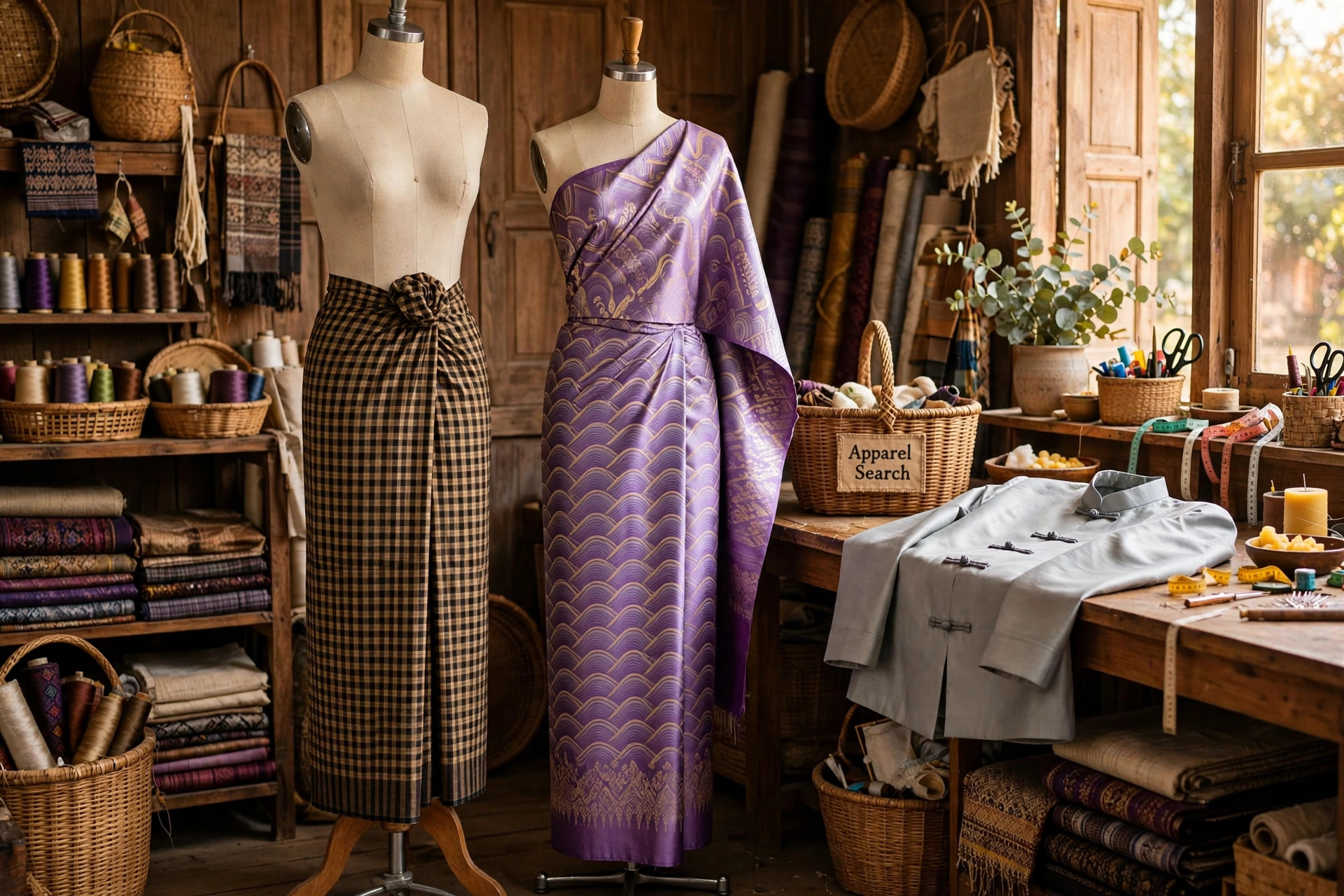
The Garment
What a Longyi Is
The longyi is a cylinder of cloth — a length of fabric sewn into a tube, worn from the waist to the ankles and held by nothing but folding and tucking. It is one of the simplest garments in the world, and one of the most successful: cool in Myanmar's heat, modest, quick to wash and dry, and endlessly adaptable, from a porter's cotton paso to a bride's silk htamein woven with waves of gold thread.
Wrapped lower garments have been worn in the region for centuries; the longyi in its present form settled during the Konbaung dynasty and the colonial period, when Indian and Malay cloth and tailoring influences met Burmese weaving. What makes the longyi distinctly Burmese is not the tube itself but what is woven into it — above all the acheik patterns of Amarapura — and the way it is worn: by everyone, every day, as ordinary dress rather than ceremony costume.
Men's and women's longyi differ in cloth, pattern and the way they are fastened, and the outfit above the waist differs too: the fitted eingyi jacket or blouse for women, a shirt or the collarless taikpon jacket for men. Velvet or leather slippers, called hnyat phanat, complete the traditional picture.
Anatomy
The Parts of the Outfit
The longyi outfit is short on pieces and long on cloth quality. Its elements:
- Paso — the men's longyi
- A sewn tube, most often cotton in checks, stripes or dark plain colours, gathered at the front and secured with a flat fold or a rolled knot at the waist. Formal paso are silk, in deep colours with fine stripes.
- Htamein — the women's longyi
- A length of cloth with a characteristic dark band (often black) along the top edge. It is wrapped around the body, the front panel pleated across the stomach and the end tucked at the hip, so the patterned field falls smooth and centred.
- Eingyi — the jacket or blouse
- The fitted top worn with the htamein: traditionally a short, shaped jacket with a front opening, in matching or contrasting cloth; modern eingyi range from lace-trimmed blouses to tailored jackets, colour-matched to the htamein for formal wear.
- Taikpon — the men's jacket
- A collarless, front-buttoning jacket worn over a shirt with the paso on formal occasions, often in a colour matching or toning with the longyi.
- Hnyat phanat — the slippers
- Backless slippers, traditionally velvet for formal wear, slipped on and off easily — a practical match for a culture where shoes are removed at pagodas and homes.
- Accessories
- Women's formal dress adds gold jewellery and flowers in the hair; thanaka, the pale cosmetic paste worn on the cheeks, is part of everyday presentation for many women and children, though it is a cosmetic rather than a garment.
Types
Paso, Htamein and the Cloths Between
A longyi wardrobe is organised by occasion, and the cloth does the talking:
| Type | Character | Worn for |
|---|---|---|
| Everyday cotton paso | Checks, stripes and plain colours in hard-wearing cotton | Work, home, school and the street — the default dress of Burmese men |
| Silk paso | Deep colours, fine woven stripes, a slight sheen | Weddings, ceremonies and formal occasions for men |
| Cotton htamein | Printed or woven patterns, bright everyday colours | Daily wear for women, with a simple eingyi |
| Acheik htamein | Interlocking wave patterns woven with many shuttles, in silk or cotton | Festive and formal wear; the silk acheik is Myanmar's prestige cloth |
| Bridal silk set | Matched acheik htamein and eingyi in rich colours with gold thread | Weddings — often the most valuable garment a woman owns |
Regional weaving adds its own voices: the striped cottons of the delta, the silk of Amarapura and Sagaing, and the distinctive dress of Myanmar's ethnic peoples — Shan, Kachin, Chin, Mon, Rakhine and others — each of whom wraps, weaves and patterns the longyi in their own way, often with jackets and bags that signal home at a glance.
Cloth and Pattern
Amarapura Silk and the Acheik Wave
The weaving town of Amarapura, the former royal capital outside Mandalay, is the heart of Myanmar's silk tradition. Its workshops line the streets with the clatter of handlooms, producing the silk longyi cloth for which the town is famous — above all acheik, the pattern of endlessly interlocking waves and curving tendrils that flows across a htamein without a break. Weaving acheik is slow, skilled work: the pattern is built weft by weft with numerous small shuttles, and a fine silk piece represents weeks at the loom, which is why genuine acheik is priced accordingly and printed imitations are everywhere.
Cotton is the everyday fibre — Myanmar grows its own, and cotton longyi cloth is woven and printed across the country. Patterns carry meaning lightly: the acheik wave suggests flowing water and continuity, checks and stripes keep their own regional associations, and colour does much of the signalling, with deep greens, maroons and indigos for men's formal wear and a full bright palette for women. Our wider coverage of the region's textile industries is on the Asia clothing industry page, and the men's side of the garment is covered in our men's longyi guide.
Living Dress
When the Longyi Is Worn Today
The longyi's great distinction is that it is not revival dress. It is what Myanmar wears: to government offices and university lectures, to drive, trade, teach and farm. School uniforms across the country are built on the longyi, and formal occasions simply raise the cloth — cotton gives way to silk, prints to woven acheik — without changing the garment itself.
Festivals turn the volume up. At Thingyan, the water festival that opens the Burmese new year in April, longyi are worn to be drenched and to dry quickly in the sun. Pagoda festivals, donation ceremonies and weddings call for the best silk a family owns, and a bride's acheik htamein, matched with her eingyi and gold jewellery, is the centrepiece of the wedding wardrobe. In the cities, younger people mix longyi with Western pieces freely — a paso with a polo shirt is an ordinary sight — which is precisely how the garment stays alive.
Wearing
Wearing Basics
Tying a longyi is a two-second skill once learned. Step into the tube, pull it to the waist and smooth it around the hips. A man gathers the extra cloth at the front, folds it flat against the stomach — or rolls it into the traditional front knot — and tucks it firmly at the waistband. A woman wraps the htamein so its dark top band sits at the waist, pleats the front panel neatly across, and tucks the final corner deep at the opposite hip; the patterned field should hang centred and straight. The test is movement: a good tie survives stairs, bicycles and a working day, and a quick re-tuck, done without thinking, is part of wearing one. Visitors are welcome to wear a longyi — sellers will happily demonstrate the tie — and it is the most practical garment imaginable for pagoda visiting, where modest, ankle-length dress is required.
Keeping
Care and Storage
Cotton longyi are washed constantly and take it in their stride — that washability is part of the design. Silk is another matter: wash silk longyi gently by hand in cool water, or have fine acheik pieces cleaned by someone who knows woven silk, and dry all longyi out of harsh direct sun to protect the colours. Because a longyi is a simple rectangle of cloth, storage is equally simple — folded flat, stacked by weight with silk on top, and aired to keep mildew away in the monsoon humidity. A torn tube can be re-sewn in minutes; a worn htamein often ends its life re-cut as household cloth, the final stage of a garment built to be used up completely.
Acquiring
Buying and Collecting
Myanmar is a wonderful place to buy cloth. Yangon's Bogyoke Aung San Market and the shops of Mandalay sell longyi at every level, and a trip to Amarapura's weaving workshops lets you watch acheik being made and buy from the weavers themselves. Judge cloth in the hand: real woven acheik shows its pattern in the structure of the cloth, visible on both sides, while prints sit on the surface. Check silk by its weight, lustre and the fineness of the weave, and remember a longyi is bought as a tube or a length — sellers will sew the seam for you on the spot. A genuine Amarapura silk acheik htamein is a serious purchase and a legitimate heirloom; a good cotton paso costs little and will be worn for years.
Common Questions
Common Questions
What is a longyi?
A longyi is a tube of cloth, about two metres around and reaching the ankles, worn by both men and women in Myanmar. It is stepped into, drawn up and secured at the waist with a fold and a tuck — no belt, zip or buttons. Men's longyi are called paso and are usually checked or striped; women's are called htamein and carry the country's most beautiful woven patterns.
What is the difference between a paso and a htamein?
The paso is the men's longyi: a sewn tube, usually in checks, stripes or plain dark colours, gathered and knotted or folded flat at the front. The htamein is the women's longyi: it has a dark band at the top, is wrapped around the body and secured with a fold and tuck at the side or front, and its lower field carries woven or printed designs — most famously the acheik wave pattern in silk.
What is acheik?
Acheik is Myanmar's most celebrated weaving: an interlocking, wave-like pattern of curving lines, woven on handlooms in and around Amarapura, near Mandalay. True acheik is woven with many small shuttles — it is nicknamed the 'hundred-shuttle' cloth — and a silk acheik htamein for a wedding can take weeks of work and command a high price. Its flowing, unbroken waves are said to echo the movement of water.
How do you tie a longyi?
Step into the tube and pull it up to the waist. For a paso, gather the spare cloth at the front, fold it flat or roll it into a knot and tuck it in at the waist. For a htamein, wrap the cloth around, pleat the front panel across and tuck the end firmly at the opposite hip. A well-tied longyi holds through a working day and is simply re-tucked when it loosens.
Is the longyi still worn every day in Myanmar?
Yes — unusually for a traditional garment, the longyi never became costume. It is standard dress for work, school, worship and home across much of the country, worn by government ministers and market porters alike. Men pair it with shirts or a traditional jacket; women pair the htamein with the eingyi blouse. Trousers and Western dress are also common in cities, but the longyi remains the default.
Keep Exploring
More to Explore
In This Series
Traditional Dress by Country
The series hub — every country guide, from the hanbok of Korea to the kilt of Scotland, as each is published.
Visit the hub ↑Asia Clothing Industry
The Asia clothing industry page — the region's apparel and textile industries, including the sector Myanmar's weavers and garment makers belong to.
Explore ↑Go Deeper
Search Apparel Search