Traditional Dress by Country · Madagascar
The Lamba of Madagascar
On Madagascar, one word covers the cloth that does everything: lamba. A lamba wraps a woman for the market, warms a man's shoulders in the highland cold, dresses a bride, honours an elder — and, in its finest silk form, accompanies the dead with a dignity no other object can give. Woven in silk, cotton and raffia by the island's many peoples, patterned with stripes and geometry, the lamba is less a garment than a civilisation's basic unit. This guide explains its forms, fibres and meanings.
The Garment
What a Lamba Is
A lamba is a woven cloth, roughly the size of a large shawl or small blanket, and in Madagascar it is the foundation garment: worn wrapped around the body or over the shoulders by women and men, used as a blanket, a carrier, a gift and a ceremonial offering. The word names the cloth rather than a cut — Madagascar's tailoring is minimal here, and the weaving is everything. A person's lamba is chosen for its fibre, its pattern and its occasion, and a fine one is kept, displayed and eventually inherited.
The island's position explains its cloth. Madagascar sits in the Indian Ocean off Africa's southeast coast, settled by peoples from both Africa and Southeast Asia, and its weaving shows both inheritances: loom traditions akin to Indonesia's, fibres from African and island plants, and patterns that developed their own Malagasy language over centuries. The highland peoples — above all the Merina, whose kingdom centred on Antananarivo — became the island's most celebrated silk weavers, while every region developed its own cloth for its own climate and ceremonies.
The lamba's most solemn role sets it apart from every other cloth in this series. Fine silk lamba are the honoured wrapping for the dead: in the famous famadihana, the turning of the bones practised in the highlands, families rewrap their ancestors' remains in new silk lamba in a ceremony of joy and remembrance, and a family's ability to give beautiful cloth to its ancestors is a matter of deep pride. A textile that serves a people's dead as faithfully as its living is not a fashion item; it is a thread through the whole of life.
For the living, the lamba is daily and festive at once. Women wrap it over a dress, men wear it over the shoulders against highland cold, elders receive it as a gift of respect, couples exchange it at engagements, and orators and officials are draped in it at ceremonies. To understand Madagascar dress, begin with the cloth on the loom.
Anatomy
The Forms of the Lamba
The family is organised by fibre and finish more than by cut:
- Lamba arindrano — the silk lamba
- The prestige cloth: woven from the silk of the island's endemic silkworm, in stripes and fine geometric patterns, classically in deep reds, whites, blacks and natural tones. Worn for ceremony, given at engagements, and used for the rewrapping of ancestors.
- Lambahoany — the printed cotton
- The everyday lamba: factory-printed cotton, bright with designs and often a printed proverb or picture, wrapped by women as skirt, dress and carrier across the island. Madagascar's answer to the kanga — practical, cheerful and everywhere.
- Cotton and mixed lamba
- Handwoven cotton cloths in regional patterns, for daily wear and warmth, woven in villages across the island.
- Raffia cloth
- Woven from raffia palm fibre, especially associated with the Sakalava and other coastal peoples: skirts, cloths and ceremonial textiles with their own geometric traditions, raffia being one of Madagascar's signature fibres.
- The tailored companions
- Under and over the lamba, Malagasy dress includes simple dresses and shirts, the highland man's Malabary-style long coat historically worn for ceremony, and hats — woven straw and raffia hats are an island specialty worn everywhere.
Variations
Weaving Across the Island
Madagascar's regions weave differently, and a lamba can often be placed by its pattern and fibre:
| Region / tradition | Cloth | Character |
|---|---|---|
| Merina highlands | Silk lamba arindrano | Fine striped silk in red, white and black; the ceremonial summit of Malagasy weaving |
| Betsileo highlands | Silk and cotton lamba | The southern highlands' weaving, closely related to Merina work, around Fianarantsoa |
| Sakalava west coast | Raffia weaving | Geometric raffia cloths and skirts from the palm-rich coast |
| The south | Cotton and bark-fibre traditions | Cloths adapted to a dry land, with their own patterns and uses |
| Island-wide | Printed lambahoany | Factory cotton prints for daily wrap dress everywhere |
The silk itself deserves note. Madagascar's traditional silk comes from the landibe, an endemic wild silkworm whose cocoons are collected and spun by hand — a fibre with a slightly textured, matte character quite unlike smooth cultivated silk, and prized for exactly that hand-made quality. Cultivated mulberry silk, introduced later, supplements it. A genuine silk lamba arindrano represents gathering, spinning, dyeing and weaving labour measured in weeks, which is why it is treasured, gifted and buried with honour.
Cloth and Pattern
Silk, Raffia and Stripe
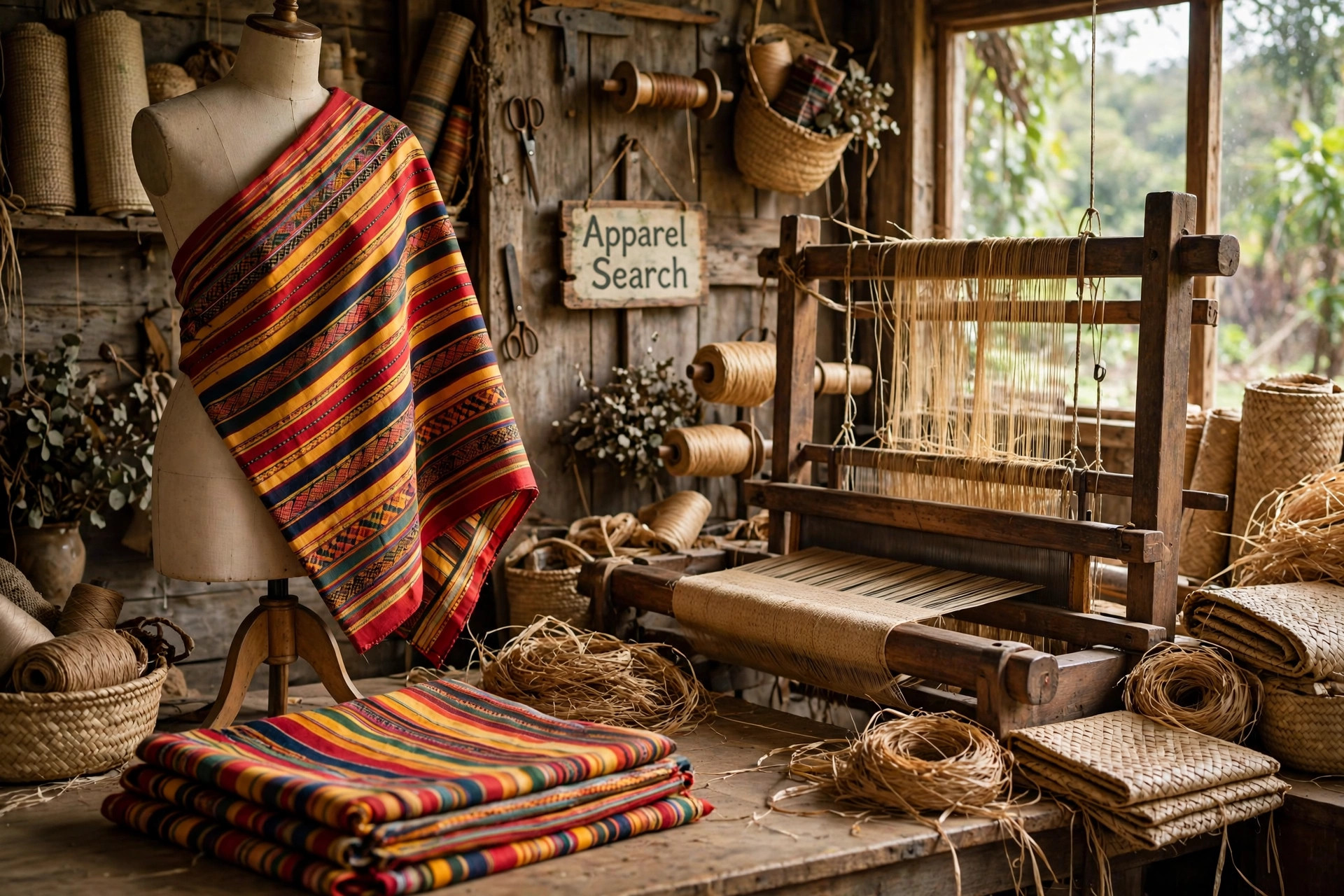
Malagasy weaving is warp-patterned at heart: the design is built into the lengthwise threads before weaving begins, producing the lamba's characteristic stripes — bands of colour and fine geometric pattern running the cloth's length, with the richest work concentrating pattern at the ends that show when worn. Natural dyes historically coloured the silk: deep reds from native dye woods and plants, blacks from mud and iron-rich sources, yellows and browns from barks and earths. Modern weavers combine natural and synthetic dyes, and the best workshops are explicit about which a cloth uses.
Raffia weaving follows a different discipline — the fibre is stiffer, the geometry bolder, the cloth used for skirts, mats and ceremonial pieces as much as for wraps. Between silk, cotton and raffia, Madagascar commands a fibre range few islands match, and its weavers — historically and still predominantly women in the highland silk tradition — hold the knowledge of all three.
These crafts sustain real livelihoods in highland towns where weaving workshops line the roads, and they sit within the wider industry surveyed on our Africa clothing industry page. Silk production, from cocoon gathering to the loom, is one of Madagascar's most complete traditional industries, and buying a genuine lamba arindrano supports every link of it.
Living Dress
The Lamba Today
Daily Madagascar still wraps up in lamba. In the highlands the cloth goes over shoulders against the morning cold; women across the island wear lambahoany as their working and marketing dress; and at ceremonies — engagements, where lamba are exchanged between families; official welcomes, where honoured guests are draped in cloth; and famadihana, where new silk is bought with pride and excitement — the lamba is irreplaceable. Highland weaving towns such as Ambositra, also famous for woodcarving, and the silk workshops around Antananarivo and the route south keep the looms busy for this living demand, not for tourists alone.
Contemporary Malagasy designers work silk lamba into jackets, dresses and accessories for urban and export markets, giving the cloth a fashion life alongside its ceremonial one. The balance is delicate and, so far, well kept: the ceremonial core of the tradition — the silk, the ancestors, the gifts — remains in Malagasy hands for Malagasy occasions, while the cloth's beauty earns its makers a wider living.
Wearing
Wearing Basics
Women wrap the lamba around the body over a dress — under the arms or at the waist as a skirt-wrap, its patterned ends displayed — or carry it over one or both shoulders as a shawl, the highland style against cold. Men wear it over the shoulders like a cloak or folded over one shoulder, traditionally with a shirt and trousers or, for ceremony, the long Malabary coat. In all cases the cloth's ends, where the weaving is richest, are arranged to be seen: a lamba worn with its patterned ends hidden has been put on without thought.
The lambahoany is tied and tucked as securely as any wrap skirt in this series, and serves as a baby carrier in the island's own styles. A visitor offered a lamba at a ceremony should accept it over the shoulders and wear it for the occasion — the draping of a guest is an honour, and wearing the cloth is the thanks.
Keeping
Care and Storage
Silk lamba want gentle handling: hand washing in cool water with mild soap, or specialist cleaning for the finest pieces, dried in shade and stored folded with tissue, away from light that fades the reds. Because silk lamba are heirlooms, families store them carefully between ceremonies — aired, refolded on different lines so creases do not set through the same threads, and kept from damp and insects. Cotton lambahoany wash as robustly as any printed cotton in this series; raffia cloth should be sponged rather than soaked and dried flat, since the fibre stiffens and cracks if abused.
A note specific to this cloth: a lamba bought for ordinary wear and a lamba intended for ceremonial or ancestral use are kept apart in Malagasy households, and travellers collecting cloth should be aware that the finest silk pieces carry obligations as well as beauty. Buy joyfully, store carefully, and record the maker's name and town — provenance is part of a textile's value everywhere, and doubly so here.
Acquiring
Buying and Collecting
Antananarivo's craft markets and the weaving towns of the highlands are the places to buy, ideally at workshops where the looms are visible and the weavers can explain their cloth. Test silk by its hand — landibe silk has a slightly dry, textured feel quite unlike shiny synthetic imitations — and by its price: weeks of work cannot sell for the price of a printed scarf, and a 'silk lamba' at a souvenir bargain price is announcing what it is. Printed lambahoany, by contrast, are honestly cheap and make the island's best everyday souvenir, proverbs and all.
Collectors seek older Merina and Betsileo silk lamba with natural dyes, documented raffia cloths, and pieces with known regional patterns; museum collections in Madagascar and abroad hold the reference examples. As with the mudcloth of Mali or the kente of Ghana, the field rewards buying from makers, asking about motifs and fibres, and keeping notes. A lamba bought that way arrives home with its story intact — which, for a cloth whose whole meaning is connection, is the point.
Common Questions
Common Questions
What is a lamba?
A lamba is Madagascar's foundational woven cloth — a large shawl-sized textile worn wrapped around the body or over the shoulders by women and men, and used as a blanket, carrier, gift and ceremonial offering. Its finest form, silk lamba arindrano, also wraps ancestors in the famadihana ceremony.
What is lamba arindrano?
Lamba arindrano is the prestige silk lamba of the highlands, woven — traditionally from the silk of Madagascar's endemic landibe silkworm — in striped and geometric patterns, classically in red, white and black. It is worn for ceremony, exchanged at engagements and used to honour the dead.
What is a lambahoany?
The lambahoany is the everyday printed-cotton lamba worn across Madagascar, bright with factory-printed designs and often a printed picture or proverb. Women wrap it as a skirt, dress and baby carrier; it is the island's practical daily cloth, as the kanga is on the Swahili coast.
What is famadihana, and why does it need silk cloth?
Famadihana, the turning of the bones, is the highland ceremony in which families rewrap their ancestors' remains in new silk lamba, with feasting and celebration. Giving beautiful new cloth to the ancestors is an act of love and pride, and it sustains the silk-weaving tradition at its highest level.
How can I tell a genuine silk lamba from an imitation?
Genuine landibe silk has a slightly dry, textured hand unlike smooth shiny synthetics, and its price reflects weeks of gathering, spinning, dyeing and weaving. Buy at workshops and reputable markets in the highlands, where weavers can explain the fibre and the pattern, and be sceptical of bargain 'silk'.
Keep Exploring
More to Explore
In This Series
Traditional Dress by Country
The series hub — every country guide, from the hanbok of Korea to the kilt of Scotland, as each is published.
Visit the hub ↑Africa Clothing Industry
Apparel Search’s Africa clothing industry page — the wider apparel and textile sector across the continent that these traditional crafts sit within.
Explore ↑Search Apparel Search