Traditional Dress by Country · Kenya
The Kanga of Kenya
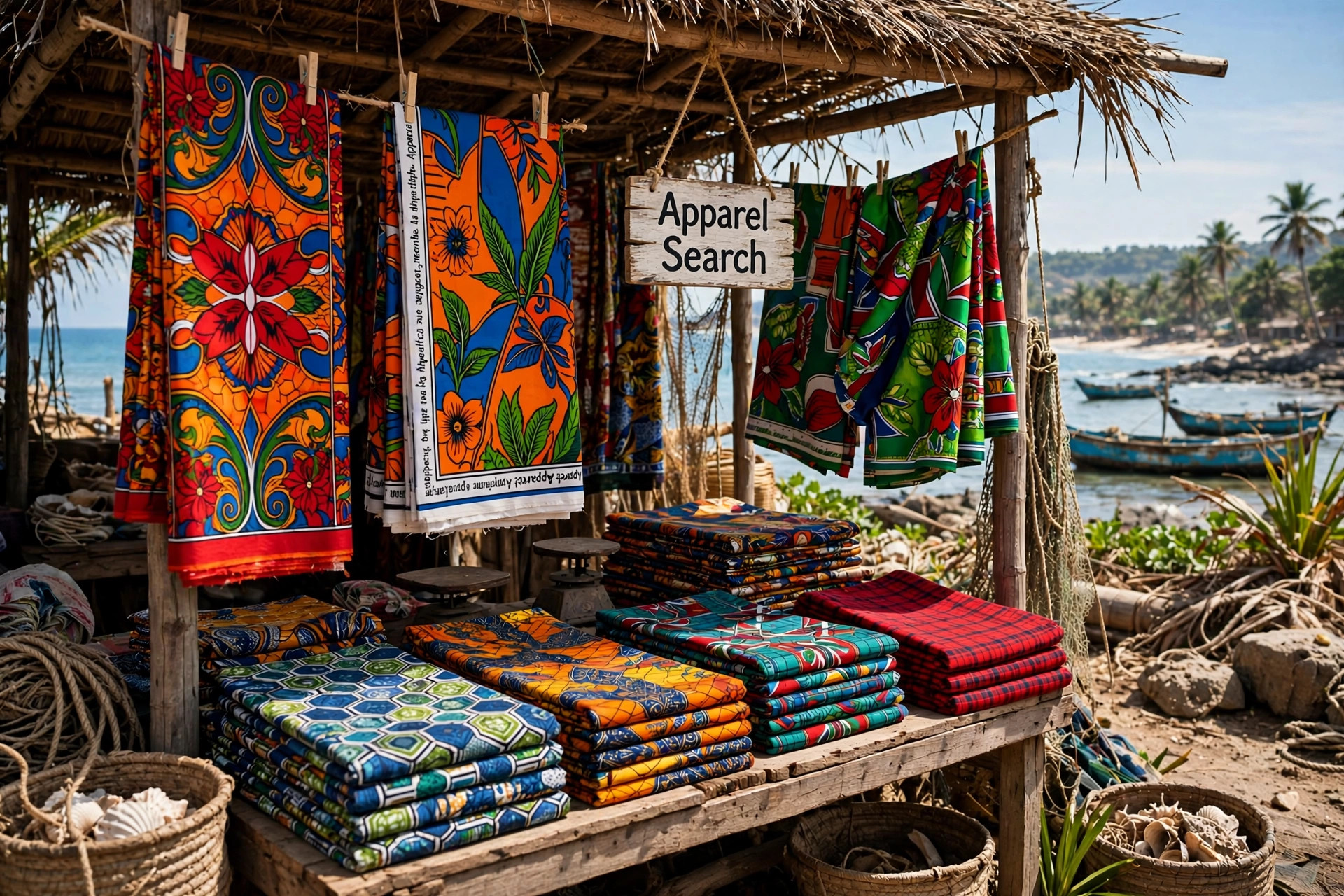
A kanga is a rectangle of printed cotton that talks. Each one carries a bold central motif, a patterned border — and, printed along one edge, a Swahili proverb or message, the jina, that the wearer chooses as carefully as the colours. Given at weddings, worn at home and at celebrations, traded along the whole Swahili coast, the kanga is Kenya's most democratic garment: one cloth, worn a dozen ways, saying something. This guide explains the kanga and its relatives — tailored kitenge, the Maasai shuka, coastal Swahili dress — and how to read, wear and buy them.
The Garment
What a Kanga Is
The kanga — leso in some usage, the words overlapping along the coast — is a printed cotton cloth of standard size, roughly a metre by a metre and a half, sold and worn in pairs and shared across Kenya, Tanzania and the wider Swahili coast. Its design follows a settled grammar: a central field with a bold motif, the mji; a wide patterned border, the pindo, running around all four sides; and a strip bearing a printed saying in Swahili, the jina — literally the cloth's 'name'. A kanga is therefore part garment, part greeting card, part newspaper: women have used the sayings to congratulate, console, tease, warn and make pointed remarks that politeness would never say aloud.
The cloth's history is coastal and commercial. In the nineteenth century, printed cottons arriving through the Indian Ocean trade were adapted in the port towns of the Swahili coast — local accounts often credit Mombasa's cloth merchants and the women who demanded ever bolder designs — and by the early twentieth century the classic format had settled: one design, one saying, sold as a matched pair. Early kanga were printed in India and later in Europe; today mills in Kenya and Tanzania produce them, and the designs turn over constantly, following seasons, politics, football, festivals and public events.
A single kanga is astonishingly versatile. Wrapped as a skirt or dress, tied as a headwrap, used as a baby carrier on the back, spread as a cloth, hung as a curtain or given folded as a gift, the same rectangle serves a household in half a dozen roles. That usefulness is the point: the kanga is not costume but equipment, beautiful equipment, and its designs assume it will be seen in public and read.
Because the kanga belongs to the coast's Swahili culture, it sits inside a wider dress world — the tailored fashions of kitenge cloth, the black buibui of coastal Muslim women, the embroidered kanzu worn by men, and inland, the famous red shuka of the Maasai. This guide treats them together, because a traveller in Kenya meets them together, often in the same market.
Anatomy
The Parts of the Cloth — and the Outfit
A kanga's anatomy is printed rather than sewn, but it is just as codified as any tailored garment:
- Mji — the central motif
- The bold design at the cloth's centre: fruit, flowers, birds, household objects, animals, geometric stars or topical scenes, drawn large enough to read across a market.
- Pindo — the border
- The patterned frame around all four edges. The border is what shows at the hem and the head when the kanga is worn, so experienced buyers judge a design by its border first.
- Jina — the saying
- The printed Swahili proverb, blessing, joke or message along one border. Choosing a kanga is choosing its words: for a new mother, a bride, a rival or a friend, there is a saying for the occasion.
- The pair
- Kanga are sold as two matching cloths. One wraps the lower body, the second covers the shoulders or head, or serves as the baby carrier — the pair is the outfit.
- Kitenge — the firmer cloth
- A heavier printed cotton, sold by the piece and taken to a tailor for dresses, skirts, shirts and suits. Kitenge holds a tailored shape where kanga drapes.
- Buibui and kanzu — coastal dress
- The buibui is the black covering worn by many Swahili Muslim women outside the home; the kanzu is men's long white robe, worn with an embroidered cap (kofia) — the formal dress of the coast.
Variations
Kanga, Kitenge, Shuka: Kenya's Cloth Family
Three cloths dominate a Kenyan market, and confusing them is the beginner's classic mistake:
| Cloth | Character | Typical use |
|---|---|---|
| Kanga | Light printed cotton, standard size, border + saying, sold in pairs | Wrap dress and skirt, headwrap, baby carrier, gifts |
| Kitenge | Firmer printed cotton, sold in longer pieces, no saying | Tailored dresses, skirts, shirts, matching family outfits |
| Maasai shuka | Checked and striped cloth, classically red, also blue and purple | Maasai wraps and blankets; widely sold as blankets and throws |
| Kikoi | Woven cotton with striped ends and fringes, coastal in origin | Men's wraps, beach wraps, scarves and household cloths |
The Maasai shuka deserves its own paragraph. The Maasai of southern Kenya and northern Tanzania are among the most recognisable dressers on earth: shuka cloths in red — the colour associated with courage and the earth — checked and striped, wrapped around the body, with beadwork collars, earrings and staffs completing the picture for men and women. The cloth itself is now usually a manufactured acrylic-cotton blend rather than a handwoven textile, a reminder that traditional dress everywhere is a living negotiation between old meanings and available materials. Visitors should also know that Maasai imagery is used commercially everywhere in Kenya; buying beadwork and shuka from Maasai makers and cooperatives directly is the respectful route.
Coastal Swahili dress has its own elegance. In Mombasa, Lamu and Malindi, the kanga is daily dress, and Lamu's old town — a UNESCO-listed Swahili settlement — shows the cloth in its home setting, alongside buibui, henna artistry for celebrations, and the embroidered kofia caps worn by men to Friday prayers and weddings.
Cloth and Pattern
Print, Proverbs and Wax-Print Cousins
Kanga printing is industrial screen or roller printing, and its design culture is fast and topical in a way handweaving never can be: new designs appear for elections, religious festivals, football tournaments and public campaigns, and health and civic messages have long been printed on kanga as a way of reaching households. The sayings themselves — drawn from Swahili proverb tradition, poetry, religious blessing and everyday wit — are the cloth's soul. A well-chosen jina congratulates a bride, thanks a hostess, comforts the bereaved, or delivers a beautifully deniable message to a co-wife or a gossiping neighbour. Sellers know the sayings stock by heart and will translate and advise; asking is part of the pleasure of buying.
The kanga's bolder cousin is the wax-print family that dominates West African fashion and appears across Kenya as kitenge-style prints. Our World Textiles guide to African wax prints explains how that cloth is made — the resin-resist crackle, the two-sided printing, and how genuine wax differs from the many imitations — and it is the essential background for anyone building a collection of African printed cottons.
For the collector, kanga designs are dated documents. Because sayings and motifs respond to events, a kanga can often be placed within a few years, and museums in Kenya and abroad hold kanga collections precisely as social history. Everyday buyers needn't go so deep — but it is worth knowing that the cloth on a market stall may be next decade's archive piece, and that the proverb you choose will be read by everyone who sees you wear it.
Living Dress
When Kanga Are Worn Today
On the coast, constantly: the kanga is working dress, home dress and visiting dress in one, and a woman may change kanga as the day changes register. Inland, kanga and kitenge come forward for celebrations, church, funerals and family occasions, and matching kitenge outfits — the whole family tailored from one cloth — are a beloved Kenyan celebration custom, instantly signalling unity in photographs. Kanga are given at weddings and baby showers, presented to honoured guests, and used to wrap gifts; a folded pair of good kanga is a present that is never wrong.
Kenya's tailors are the other half of the story. The fundi who turns kitenge into a fitted dress in a market workshop, often in a day, practises a design culture of real sophistication, and Nairobi's fashion scene regularly returns to kanga and kitenge prints for contemporary collections. That living industry — mills, printers, market traders and tailors — is part of the wider sector covered on our Africa clothing industry page. For readers ready to wear the tailored side of the family, our women's kitenge guide, linked in the explore cards below, covers styles and buying in depth.
Wearing
Wearing Basics
The classic wrap is learned in a minute and refined for a lifetime: the kanga is wrapped around the body under the arms or at the waist, its ends tucked firmly at the front or side so the border falls level at the hem, and the second cloth of the pair goes over the shoulders or is tied as a headwrap, knotted or folded to show the border and, if the wearer wishes, the saying. As a baby carrier, the cloth goes around the mother's back and is knotted at the chest or shoulder — a technique to learn from an experienced wearer in person, not from a paragraph. Tailored kitenge needs no instruction beyond a good fundi: take the cloth, a photograph of the style you want, and time for two fittings.
Whatever the wrap, show the border. A kanga worn with its pindo hidden is a design half-worn, and Kenyan eyes will notice. Colours are worn boldly and mixed with confidence — clashing prints that would alarm a minimalist are, in this dress culture, simply dressing properly.
Keeping
Care and Storage
Kanga cotton is made for real life: machine washable in cool or warm water, quick to dry, and improved in softness by use. Wash new cloth separately once or twice, since strong dyes can release colour, and dry printed cottons out of prolonged harsh sun to keep the colours true. Kitenge garments follow the tailor's advice — firmer cloth holds its finish longer if washed gently and ironed on the reverse. Shuka blankets wash like any sturdy cotton-acrylic cloth; beadwork should be sponged rather than soaked, and stored flat or rolled so the bead threads are not strained.
A kanga collection stores easily — folded flat, by colour or by saying, in a dry drawer. Collectors who keep topical or vintage designs add a note of the saying's translation and where the cloth was bought; in twenty years that note is the difference between a pretty cloth and a documented piece of Kenyan social history.
Acquiring
Buying and Collecting
Buy kanga where Kenyans buy them: the cloth stalls of markets in Mombasa and Nairobi, and reputable fabric shops, where the stock turns over fast and the sayings are current. Handle the cloth — a good kanga is smooth, evenly printed, with the design registered cleanly and the border straight — and ask for the translation of every saying you consider, in writing if your Swahili is new. Prices vary with cloth quality and origin; mill-printed Kenyan and Tanzanian kanga sit at the honest middle of the market, and a suspiciously cheap pair usually announces itself in thin cloth and blurred print.
For kitenge tailoring, budget for the cloth and the fundi separately, and agree the style, lining and deadline before the scissors come out. For shuka and beadwork, buy from Maasai markets and cooperatives where the makers sell their own work. And when a kanga is bought as a gift, choose the saying as carefully as you would choose the words in a card — because that is exactly what it is.
Common Questions
Common Questions
What is a kanga?
A kanga is a printed cotton cloth of standard size, worn across Kenya and the Swahili coast. Each design has a central motif, a patterned border called the pindo, and a printed Swahili saying called the jina. Kanga are sold in matching pairs and worn as wrap dresses and skirts, headwraps and baby carriers, and given as gifts.
What do the sayings on kanga mean?
The jina is a Swahili proverb, blessing, joke or message printed along the cloth's border. Wearers choose kanga by their sayings — to congratulate, thank, comfort or make a pointed remark — and sellers will happily translate the sayings in stock before you buy.
What is the difference between kanga and kitenge?
A kanga is a lighter cloth of fixed size with a border and a printed saying, sold in pairs and worn wrapped. Kitenge is a firmer printed cotton sold in longer pieces without a saying, bought to be tailored into dresses, skirts, shirts and matching family outfits.
What is a Maasai shuka?
The shuka is the checked and striped cloth — classically red, also blue and purple — wrapped around the body by the Maasai of southern Kenya and northern Tanzania, worn with beadwork jewellery. Shuka cloth is also widely sold as blankets and throws.
How is a kanga worn?
One cloth of the pair is wrapped around the body and tucked firmly so its border falls level at the hem; the second goes over the shoulders or is tied as a headwrap showing the border. Kanga are also used as baby carriers, a technique best learned in person from an experienced wearer.
Keep Exploring
More to Explore
In This Series
Traditional Dress by Country
The series hub — every country guide, from the hanbok of Korea to the kilt of Scotland, as each is published.
Visit the hub ↑Africa Clothing Industry
Apparel Search’s Africa clothing industry page — the wider apparel and textile sector across the continent that these traditional crafts sit within.
Explore ↑Go Deeper
Search Apparel Search