Traditional Dress by Country · South Africa
The Shweshwe Dress of South Africa
South Africa has eleven official languages and at least as many dress traditions, and this guide holds them carefully together. Its anchor is shweshwe — the stiff, indigo printed cotton whose dresses anchor Xhosa and Sotho celebration dress — but the full picture includes Xhosa umbhaco in ochre and white, Zulu beadwork and isidwaba skirts, the blanket dress of the Sotho, Ndebele colour geometry, and the printed Madiba shirt that carried South African style around the world. Here is how each is made, what it means, and when it is worn.
The Garment
Shweshwe: The Cloth That Became a Dress
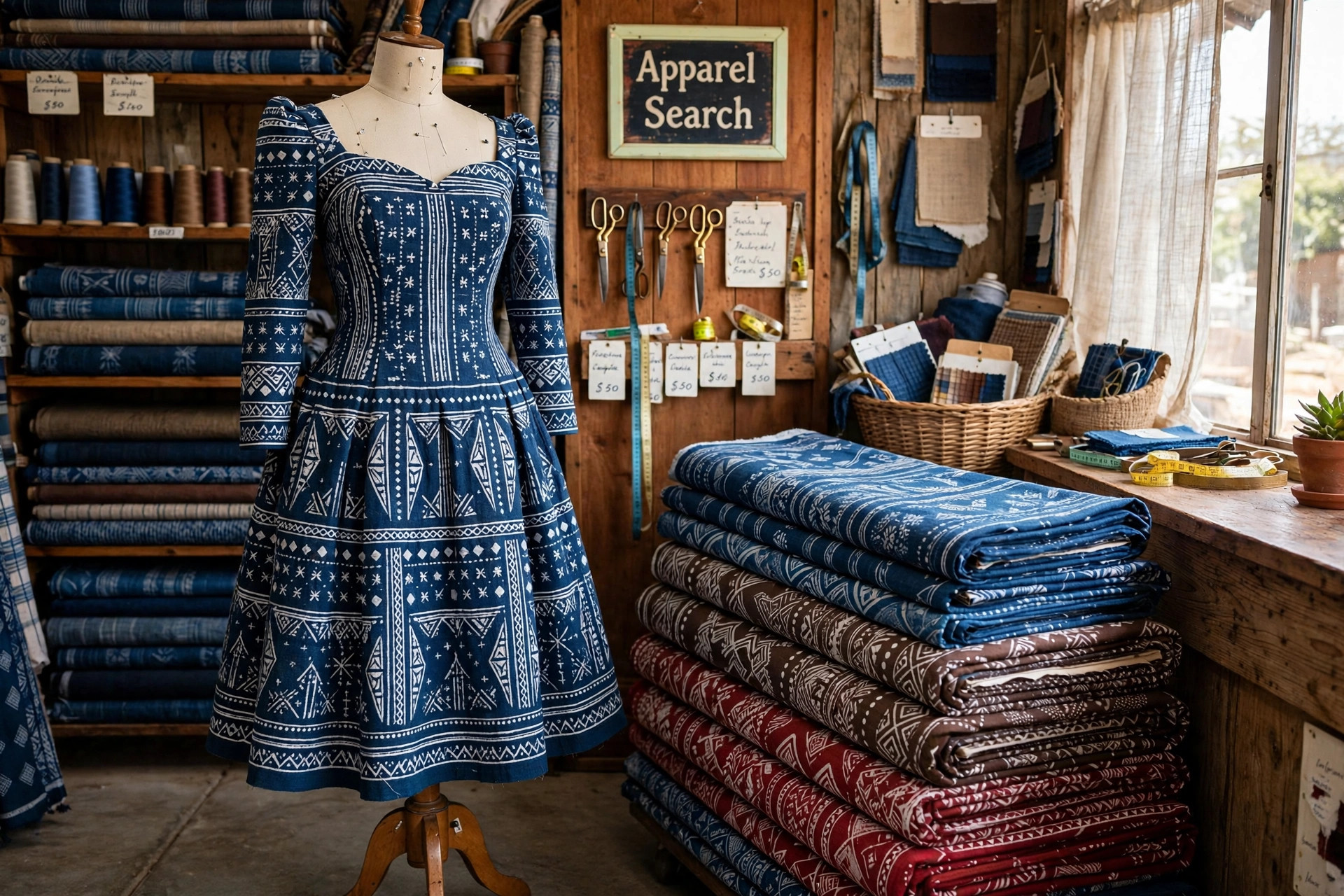
Shweshwe is a printed cotton with a personality you can feel before you see it: new shweshwe is famously stiff, almost board-like, with a distinctive smell from the starch of its manufacture, and it softens only with washing and wear into the comfortable cloth of a favourite dress. The prints are small, intricate and geometric — tiny stars, diamonds, circles and floral sprigs in dense all-over patterns — classically in indigo blue, and also in chocolate brown, red, green and other colourways. The designs are printed by discharge and roller methods that give the fine, sharp detail the cloth is known for.
The cloth's name is usually linked to King Moshoeshoe I of the Sotho, to whom French missionaries are said to have presented printed cloth in the nineteenth century — shweshwe echoes his name — while German and Swiss settlers brought similar indigo prints to the Eastern Cape, where Xhosa women adopted and transformed them. What matters more than the import story is the transformation: South African women took a trade cloth and made it the foundation of celebration dress so distinctive that a shweshwe dress now reads, instantly and worldwide, as South African.
A traditional shweshwe outfit is tailored, not wrapped: a fitted dress, often with puffed or structured sleeves and a full skirt, worn with a matching headwrap (doek) and sometimes an apron-like or layered overskirt for married women's dress. Tailors are central to the tradition — the same cloth becomes a grandmother's formal dress, a bride's celebration outfit and a young designer's fashion statement depending on the cutting. Modern South African fashion returns to shweshwe constantly, in everything from bridal gowns to sneakers.
This guide deliberately ranges wider than one cloth, because South African traditional dress is plural. The sections below give the Xhosa, Zulu, Sotho and Ndebele traditions their own space rather than blending them into a generic 'tribal' picture — a blending South Africans themselves do not accept.
Anatomy
The Parts of the Outfits
Each tradition assembles its own named pieces. The ones a reader will meet most often:
- Shweshwe dress and doek
- The tailored printed-cotton dress with its matching headwrap, worn by Xhosa and Sotho women especially for celebrations, church and traditional weddings, with the cloth's colour and print chosen for the occasion.
- Umbhaco — Xhosa dress cloth
- Heavy cotton cloth, classically white or cream with black braided edging (and ochre-dyed dress in older tradition), made into long skirts and wraps. Xhosa dress marks life stages carefully, with beadwork, head coverings and blankets changing as a woman marries and matures.
- Isidwaba and isigege — Zulu skirts
- The isidwaba is the pleated leather or cloth skirt of a married Zulu woman; unmarried girls traditionally wear the shorter isigege. Zulu women's dress is completed by married women's tall hats (isicholo) and extensive beadwork.
- Beadwork
- Across Zulu, Xhosa and Ndebele traditions, glass beadwork in coded colours forms collars, aprons, belts and panels. Ndebele beadwork and wall painting share the same bold geometry, and married Ndebele women wear beaded rings and blankets of great visual power.
- Sotho blankets
- The woollen blanket is Lesotho and Sotho dress at its most emblematic: patterned blankets worn over the shoulders by men and women, graded from everyday to the great ceremonial designs, with the corncob, crown and other motifs carrying their own histories.
- The Madiba shirt
- Nelson Mandela's loose, printed silk and cotton shirts — worn untucked, without a tie, to meet presidents and queens — became a national symbol of dignified informality and remain a staple of South African menswear.
Variations
Dress by People and Occasion
A careful map of who wears what — generalisations offered with respect for the variation inside every tradition:
| Tradition | Signature dress | Seen especially at |
|---|---|---|
| Xhosa | Umbhaco skirts and wraps, shweshwe dresses, beadwork, headwraps; men's blankets and beadwork for ceremony | Traditional weddings (umabo), initiation homecomings, church, funerals |
| Zulu | Isidwaba skirts, isicholo hats, rich beadwork; men's animal-skin and cloth ceremonial dress | Weddings, the reed dance, traditional ceremonies in KwaZulu-Natal |
| Sotho | Shweshwe dresses and doeks; patterned woollen blankets for all | Weddings, church, celebrations in the Free State and Lesotho |
| Ndebele | Beaded aprons, collars and blankets in bold geometric colour | Weddings and cultural celebrations in Mpumalanga and Gauteng |
| Modern national | Shweshwe and print tailoring, Madiba shirts | Heritage Day, weddings, graduations, formal-national occasions |
Two cautions belong in any honest guide. First, much of this dress is status dress: it communicates marital status, life stage and respect for elders, and some pieces — a married woman's hat or apron, an initiate's dress — are earned or given, not simply bought. Visitors admire best by asking rather than assuming, and by buying beadwork and cloth from the makers' own cooperatives and markets. Second, everyday South Africa dresses globally; traditional dress is celebration and identity dress, worn with intention, which is precisely why it carries such force when it appears.
Cloth and Pattern
Indigo Prints, Beads and Blankets
Shweshwe's print quality is its signature. Genuine shweshwe — produced for generations in the Eastern Cape, where the Da Gama textile mill became the cloth's famous home — is printed so the pattern shows clearly on both sides of the cloth, with fine detail and the characteristic stiffness and scent of the real article. Imitations are everywhere and are usually betrayed by one-sided, blurry print and limp cloth. The classic palette runs from deep indigo through chocolate to red, and designs mix European-derived floral sprigs with the geometric stars and diamonds that South African wearers made their own.
Beadwork is the second great textile art here, though its medium is glass rather than thread. Zulu beadwork historically used colour combinations that scholars and makers describe as a language of messages — love letters, in the famous account, woven as bead panels — while Ndebele beadwork speaks in bold geometric blocks whose palette brightened dramatically as new bead colours arrived in the twentieth century. In both cases the work is slow, skilled and increasingly collected as art.
The Sotho blanket completes the trio: a heavy patterned wool blanket, worn as a garment, graded by design from the everyday to blankets made for royalty and great occasions. Together — print, bead and blanket — these three crafts give South African dress a range that few countries match, and all three are living industries, not museum survivals.
Living Dress
When Traditional Dress Is Worn Today
Weddings are the great stage, and South African weddings often run in two acts: a 'white wedding' in Western dress and a traditional ceremony — umabo in Zulu and Xhosa usage — where both families appear in full traditional dress and the couple may change outfits more than once. Guests take the dress code seriously; a shweshwe dress or a Madiba shirt is correct, joyful wedding wear. Funerals, too, call for respectful traditional dress in many communities, and church dress across the country blends tailored print outfits with Sunday formality.
Heritage Day, on 24 September, has become a national dressing-up day when workplaces and schools fill with shweshwe, beadwork, blankets and prints from every tradition — a deliberate, cheerful assertion that the country's plurality is its wealth. Graduations, traditional leadership events and cultural festivals complete the calendar. The industries behind the cloth — Eastern Cape mills, township and rural tailors, beadwork cooperatives — form part of the continental picture on our Africa clothing industry page, and South African designers who cut shweshwe for international runways are its most visible ambassadors.
Wearing
Wearing Basics
A shweshwe dress is tailored clothing: it is worn like a good dress, with the doek tied to match — folded and wrapped around the head in styles that vary from the neat everyday turban to tall celebration forms. New shweshwe should be washed before tailoring or first wearing, both to soften it and because the cloth can shrink and release dye; experienced buyers wash the fabric before it ever meets the tailor's scissors, and buy a little extra length in consequence.
Blankets are worn over the shoulders and fastened or held at the chest, their patterns displayed flat across the back — a blanket worn carelessly, dragging or inside-out, draws gentle correction. Beadwork is worn as it is given or bought, in sets whose pieces belong together. For a visitor invited to a traditional ceremony, the appreciated move is to ask the host what to wear; a shweshwe dress or skirt bought locally and worn with evident pleasure is almost always a welcome answer.
Keeping
Care and Storage
Shweshwe improves with washing: cool or warm machine washing softens the cloth progressively, and colours hold well in genuine print. Wash dark indigo separately at first. Umbhaco's heavy cotton washes similarly, with its braided trim checked for loose ends. Beadwork should never be machine washed — sponge it, dry it flat, and store it flat or rolled with tissue, since bead threads weaken if pieces are folded sharply or hung by their own weight for months.
Wool blankets want airing, protection from moths, and occasional professional cleaning rather than frequent washing. Store all of it dry and out of strong light; indigo and red prints fade gracefully but they do fade. A well-kept shweshwe dress is regularly worn for a decade, and beadwork and blankets pass between generations — care here is not fussiness but inheritance management.
Acquiring
Buying and Collecting
Test shweshwe with your fingers and eyes: genuine cloth is stiff when new, smells faintly of its starch, and shows its fine pattern clearly on both sides. Buy from fabric shops and market stalls that stock the real Eastern Cape cloth and can name it, and be wary of very cheap 'shweshwe' that is limp and one-sided — it will sew up adequately but will not wear or soften like the original. For tailoring, South Africa's local tailors and dressmakers are the tradition's engine; take a photograph of the style, allow time for fittings, and order well ahead of the wedding season.
Beadwork and blankets reward buying from makers: craft markets, museum shops and cooperatives in KwaZulu-Natal, the Eastern Cape and Mpumalanga sell work whose makers are named and paid. Vintage umbhaco, older beadwork and royal-grade blankets form a serious collecting field — buy those with provenance where you can, and remember that some pieces carry family and ceremonial significance that a respectful collector acknowledges rather than strips away.
Common Questions
Common Questions
What is shweshwe?
Shweshwe is a printed cotton cloth — classically indigo, also brown, red and green — with small, intricate geometric and floral patterns. New shweshwe is stiff and distinctively scented from its manufacture, softening with washing. Tailored into dresses with matching headwraps, it is signature celebration dress for Xhosa and Sotho women and a national fashion fabric.
Is shweshwe the traditional dress of all South Africa?
No — South Africa's dress traditions are plural. Shweshwe is central to Xhosa and Sotho celebration dress. Zulu dress is known for beadwork, isidwaba skirts and isicholo hats; Ndebele dress for bold geometric beadwork; Sotho dress also for patterned woollen blankets. This guide covers them as distinct traditions.
What is umbhaco?
Umbhaco is the heavy cotton cloth of Xhosa women's traditional dress, classically white or cream with black braided edging, made into long skirts and wraps. Worn with beadwork, head coverings and blankets, its details mark life stages such as marriage.
What is a Madiba shirt?
The loose, printed, untucked shirt — worn without a tie — that Nelson Mandela, known by his clan name Madiba, made famous at state occasions around the world. It became a symbol of dignified South African informality and remains a menswear staple.
How can I tell genuine shweshwe from imitations?
Genuine shweshwe is stiff when new with a characteristic scent, and its fine pattern prints clearly on both sides of the cloth. Imitations are usually limp, with blurry one-sided printing. Buy from fabric shops that stock the Eastern Cape cloth and wash new shweshwe before tailoring, as it can shrink.
Keep Exploring
More to Explore
In This Series
Traditional Dress by Country
The series hub — every country guide, from the hanbok of Korea to the kilt of Scotland, as each is published.
Visit the hub ↑Africa Clothing Industry
Apparel Search’s Africa clothing industry page — the wider apparel and textile sector across the continent that these traditional crafts sit within.
Explore ↑Search Apparel Search