Traditional Dress by Country · Ethiopia
The Habesha Kemis of Ethiopia
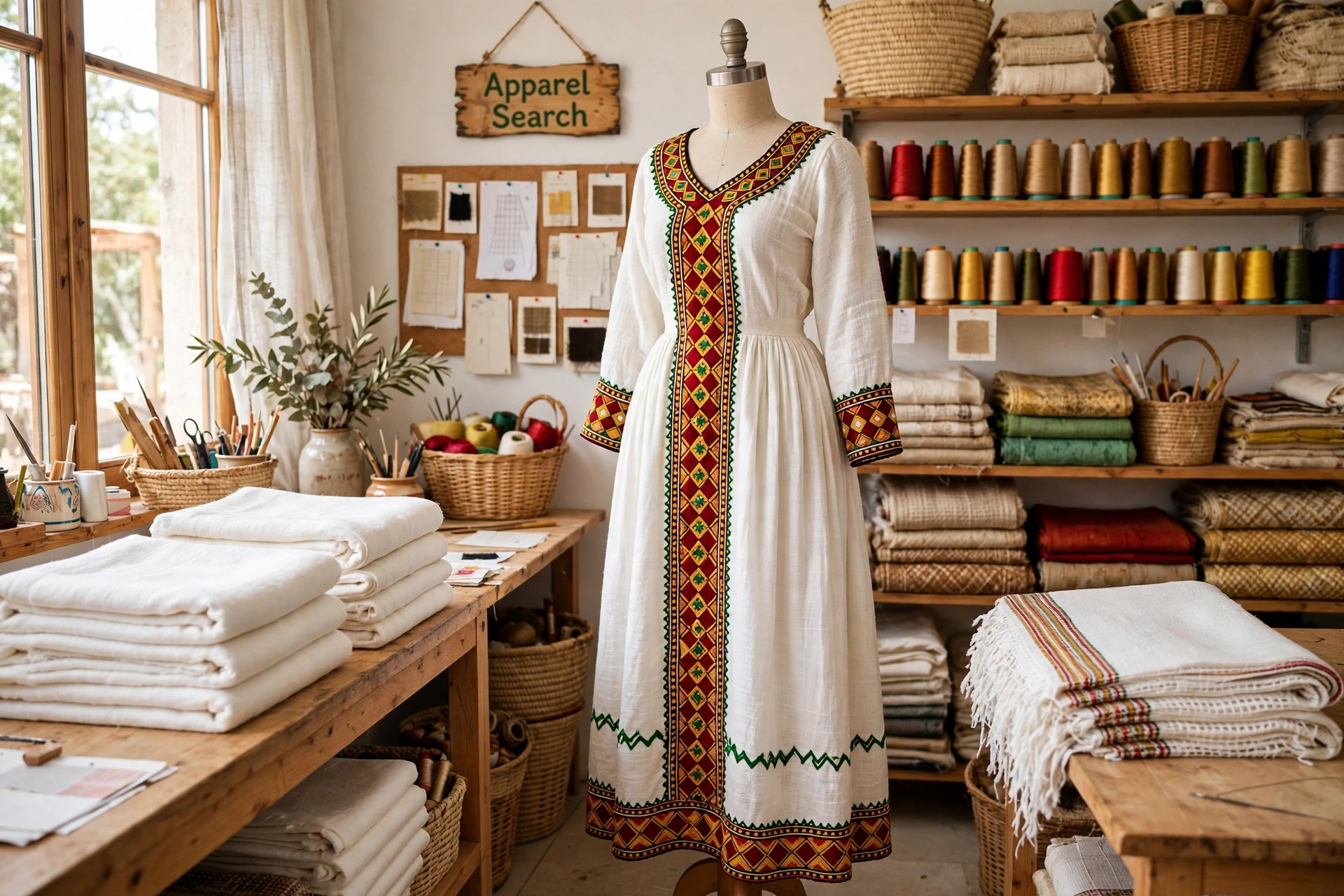
White on white, until the border catches the light. The habesha kemis is Ethiopia's classic dress for women — a long, loose gown of handwoven white cotton whose hems and cuffs carry tibeb, narrow bands of woven pattern in gold, red, green and silver thread. Worn for church, for holidays, for weddings and for the slow ritual of the coffee ceremony, it is at once everyday finery and national dress. This guide explains the garment and its companions, the gabi and netela wraps worn by women and men, how the cloth is woven, when each piece is worn today, and how to choose and care for one.
The Garment
What the Habesha Kemis Is
The habesha kemis is the traditional dress of Ethiopia's highland peoples, most closely associated with the Amhara and Tigray regions, and its name joins two ideas: habesha, the word Ethiopians and Eritreans use for themselves and their shared highland culture, and kemis, simply a dress. In its classic form it is a long, generously cut gown of white cotton, reaching the ankles, with wide sleeves, a round or modest neckline, and — the feature everyone remembers — bands of woven decoration called tibeb set into the hem, the cuffs and sometimes a panel down the front. Without the tibeb it would be a plain white shift; with it, the dress becomes a small woven gallery.
The cloth itself is part of the meaning. Ethiopian cotton weaving is an old, highly skilled craft, historically centred on handlooms in weavers' workshops and family compounds. The base fabric, called shemma, is woven soft and slightly open, light enough for highland sun yet warm in the cool evenings of Addis Ababa's altitude. Because the tibeb is woven directly into the cloth on the loom — not embroidered or printed afterwards — a good kemis carries its decoration in its structure. The weaver plans the bands as the cloth is made, working coloured and metallic threads into the warp and weft at exactly the right points.
White is the ground colour for a reason. In Ethiopian Orthodox Christian tradition, which shapes so much of highland dress, white signifies purity and celebration, and a congregation in white kemis, netela and gabi is one of the defining sights of an Ethiopian festival morning. The dress is worn across generations: grandmothers, mothers and daughters appear in matching or near-matching white at Timket, at Ethiopian Christmas (Genna) and Easter (Fasika), and at family celebrations, with the richness of the tibeb quietly marking the occasion's importance and the wearer's means.
It is important to understand the kemis as one element of a white-cloth system rather than a standalone frock. The same woven cotton, with the same tibeb borders, produces the wraps and shawls that complete both women's and men's dress, so a family buying cloth from a weaver is really buying a coordinated wardrobe. That shared cloth is why Ethiopian traditional dress reads as a unified national costume even though each piece is simple in cut.
Anatomy
The Parts of the Outfit
Highland dress is assembled from a small set of named pieces, mixed by occasion, weather and formality:
- Habesha kemis — the dress
- The long white cotton gown itself, its formality carried almost entirely by the width, complexity and materials of its tibeb bands. Festive dresses may add a tibeb panel at the chest and fuller sleeves.
- Tibeb — the woven border
- Patterned bands woven into the cloth on the loom, traditionally in geometric and symbolic motifs. Gold and silver metallic thread mark the most festive pieces; everyday dresses use coloured cotton thread in red, green, yellow and black.
- Netela — the light wrap
- A thin, gauze-like white cotton shawl with tibeb ends, worn by women over the head and shoulders for church and by men draped over the shoulders. It is the single most widely worn piece of Ethiopian traditional dress.
- Gabi — the heavy wrap
- A thicker, blanket-weight woven wrap, worn over the shoulders and body for warmth at ceremonies and in cold highland weather. Men's gabi are substantial garments in their own right, folded and draped with practised ease.
- Kaba — the ceremonial cape
- For the most formal occasions, historically worn by nobility and clergy and now seen at weddings and state occasions: a richly decorated, often velvet, cape worn over the white dress.
- Men's dress
- Men pair white trousers and a white shirt or tunic with the netela or gabi over the shoulders. The effect is deliberately plain — the white cloth and its borders do the talking — with a woven or embroidered cap completing some regional outfits.
Variations
Dress by Occasion and Region
The kemis changes less in cut than in weight, border and company. The main forms a buyer or observer will meet:
| Form | Character | Worn for |
|---|---|---|
| Church and festival kemis | Full white dress with tibeb, netela over the head | Orthodox services, Timket, Genna, Fasika |
| Wedding kemis | The richest tibeb, often gold thread, sometimes with a kaba cape | Brides, family and guests at weddings |
| Coffee-ceremony dress | A good kemis or a simpler dress with a netela | Hosting and attending the traditional coffee ceremony |
| Everyday traditional dress | Plainer borders, sturdier cotton, netela for errands and visits | Markets, family visits, regional towns |
| Modern interpretations | Tibeb bands applied to contemporary dresses, tops and jackets | Urban fashion, diaspora celebrations, cultural events |
Ethiopia is a country of many peoples, and this guide's subject is specifically the habesha dress of the northern and central highlands. Other regions have their own celebrated dress — the colourful woven and embroidered clothing of the south, Oromo dress with its leather and beadwork traditions, the light cotton of the eastern cities — and Ethiopians are quick to distinguish them. The white kemis is best described as the national festive dress, the outfit that represents Ethiopia abroad, rather than the only traditional dress Ethiopians wear.
Cloth and Pattern
Shemma Cloth and the Art of Tibeb
Everything begins with cotton and a loom. Ethiopian handweaving traditionally uses a pit or frame loom, and the weaver produces long strips and panels of shemma cloth whose softness improves with washing — a good kemis grows more comfortable for years. The work is slow and skilled, and weaving communities, including the Dorze weavers famous around Arba Minch and in Addis Ababa's Shiro Meda market district, have supplied the country's festive cloth for generations. Shiro Meda, at the foot of the Entoto hills, remains the great marketplace for kemis, netela and gabi, its stalls stacked with white cloth in every grade.
Tibeb patterns are geometric at heart — diamonds, zigzags, stepped lines and small symbolic figures built from the grid of warp and weft — but within that discipline weavers exercise real invention, and experienced eyes can read a border's origin and quality at a glance. The finest festive tibeb uses metallic gold and silver thread that flashes as the wearer moves; mid-range work uses bright synthetic or cotton yarns; the simplest netela may carry only a single coloured line at each end. Because the pattern is structural, it cannot peel, crack or fade the way a print does — tibeb ages exactly as the cloth ages.
Colour in the borders carries the national palette with it: green, gold and red, the colours of the Ethiopian flag and of the country's long imperial history, appear again and again, joined by black and by purple and silver in modern work. A diaspora fashion industry has grown up around the cloth, with designers in Addis Ababa and abroad cutting tibeb-bordered cloth into modern silhouettes — but the test of any innovation remains the same: the quality of the weaving itself.
Living Dress
When Habesha Dress Is Worn Today
Holiday mornings are the kemis's great stage. At Timket, the January festival of Epiphany and one of Ethiopia's largest public celebrations, processions fill the streets with white dress, embroidered umbrellas and church regalia. Genna and Fasika bring families to church before dawn in their best white, and weddings — often large, joyful, multi-day affairs — dress whole guest lists in kemis and gabi. Our companion guide to Ethiopian wedding attire follows the dress through the wedding celebrations in detail.
The coffee ceremony is the dress's intimate setting. Ethiopia is coffee's homeland, and the ceremony — green beans roasted over charcoal, ground, brewed in a jebena pot and served in three rounds — is hosted by a woman who is very often wearing a kemis or a good dress with a netela. To be received in traditional dress is part of the honour of the occasion, and visitors who attend a ceremony will understand the kemis faster in that room than in any museum.
In daily life the full outfit is now festive rather than everyday wear in the cities, though netela and gabi remain common, and in regional towns traditional dress is worn far more routinely. A large global diaspora keeps the dress in active use from Washington, D.C. to Tel Aviv, ordering cloth from home and wearing it for holidays and community celebrations. Behind the ceremonies stands the weaving trade itself, part of the wider sector profiled on our Africa clothing industry page.
Wearing
Wearing Basics
The kemis itself is simple to wear — it slips on as a dress — and the skill lies in the wraps. The netela is worn by women over the head for church, arranged so its tibeb ends frame the face and fall over the shoulders, and more loosely over the shoulders alone for social occasions. The gabi is folded lengthwise, thrown over one shoulder and wrapped around the body, with the free end often carried over the forearm; men adjust it constantly and unconsciously, the way other men adjust a jacket. Under the kemis, modern wearers add a slip for opacity, since fine shemma is light, and choose closed shoes or sandals by the occasion.
Fit is generous by design. The dress should fall straight from the shoulder without clinging, its hem near the ankle, and the tibeb at the hem should sit level — a tailor adjusts length from the shoulder or waist, never by cutting through the woven border.
Keeping
Care and Storage
Handwoven cotton rewards gentle handling. Wash a kemis by hand or on a delicate machine cycle in cool water with mild detergent, separately at first, since border threads — especially deep reds — can release a little colour. Avoid bleach, which yellows white cotton over time and attacks metallic thread; if brightness needs restoring, a traditional airing in strong sun does much of the work, as it has for generations of Ethiopian households. Iron while slightly damp, on the reverse side over the tibeb, to protect the raised woven pattern.
Store the dress folded with acid-free tissue at the folds if it will rest for months, and keep netela and gabi with it so the set stays together. Metallic-thread tibeb should not be folded sharply through the same crease every time. Moths are less a threat to cotton than to wool, but cedar or a lavender sachet in the drawer is cheap insurance, and any stain from coffee or the spiced butter of a feast should be treated before storage, not after a season in the dark.
Acquiring
Buying and Collecting
The honest measures of a kemis are the cloth and the border: hold the shemma to the light and look for even, dense weaving without slubs or thin patches, then turn the tibeb over — true woven tibeb reads clearly on the reverse, while cheaper imitations rely on surface embroidery or print that sits on one side only. Machine-made dresses with printed borders are widely sold and perfectly serviceable as festive wear, but they should be priced as what they are; handwoven cloth with loom-woven tibeb costs more because it represents days of work.
In Addis Ababa, Shiro Meda market is the classic destination, with tailors nearby who will make a dress to measure from chosen cloth; in the diaspora, Ethiopian shops and online weavers' cooperatives sell ready-made and custom pieces. For a wedding or a major holiday, order early — weavers' order books fill before Timket and the wedding season. Buy the best netela you can afford: it is the piece you will wear most.
Common Questions
Common Questions
What is a habesha kemis?
A habesha kemis is Ethiopia's traditional festive dress for women: a long, loose gown of handwoven white cotton with tibeb — patterned bands woven into the cloth on the loom — at the hem, cuffs and sometimes the front. It is worn with a netela shawl for church, holidays, weddings and the coffee ceremony.
What is tibeb?
Tibeb is the decorative border woven directly into Ethiopian shemma cloth as it is made on the loom. Its geometric patterns use coloured and, for festive pieces, metallic gold or silver thread. Because it is structural rather than printed or embroidered on afterwards, it lasts as long as the cloth itself.
What is the difference between a netela and a gabi?
Both are white woven cotton wraps with tibeb ends. The netela is thin and gauze-like, worn by women over the head and shoulders for church and by men over the shoulders. The gabi is much thicker and heavier, a blanket-weight wrap worn over the body for warmth and ceremony.
When do Ethiopian women wear the habesha kemis?
For occasions that call for traditional dress: Orthodox church festivals such as Timket, Genna and Fasika, weddings, family celebrations, and hosting the traditional coffee ceremony. In cities it is festive dress rather than daily wear; in regional towns it is worn more routinely.
How should a habesha kemis be washed?
By hand or on a delicate cycle in cool water with mild detergent, washed separately at first in case border threads release colour. Avoid bleach, dry out of harsh prolonged sun, and iron while slightly damp on the reverse side over the tibeb to protect the woven pattern.
Keep Exploring
More to Explore
In This Series
Traditional Dress by Country
The series hub — every country guide, from the hanbok of Korea to the kilt of Scotland, as each is published.
Visit the hub ↑Africa Clothing Industry
Apparel Search’s Africa clothing industry page — the wider apparel and textile sector across the continent that these traditional crafts sit within.
Explore ↑Ethiopian Wedding Attire
The wedding layer of this story — habesha kemis and traditional dress for Ethiopian wedding celebrations and the melsi that follows.
Read ↑Search Apparel Search