Traditional Dress by Country · Poland
The Kontusz of Poland
Polish traditional dress speaks in two registers. Above is the kontusz — the sweeping silk outer robe of the nobility, worn over the żupan and bound with a woven sash wide as a banner. Below, and just as proud, are the folk costumes of the regions: Kraków’s peacock-feathered cap, Łowicz’s rainbow stripes, the embroidered white wool of the Podhale highlanders. This guide explains both worlds: the garments part by part, the regions, the cloth and embroidery, and how Polish dress is worn and kept today.
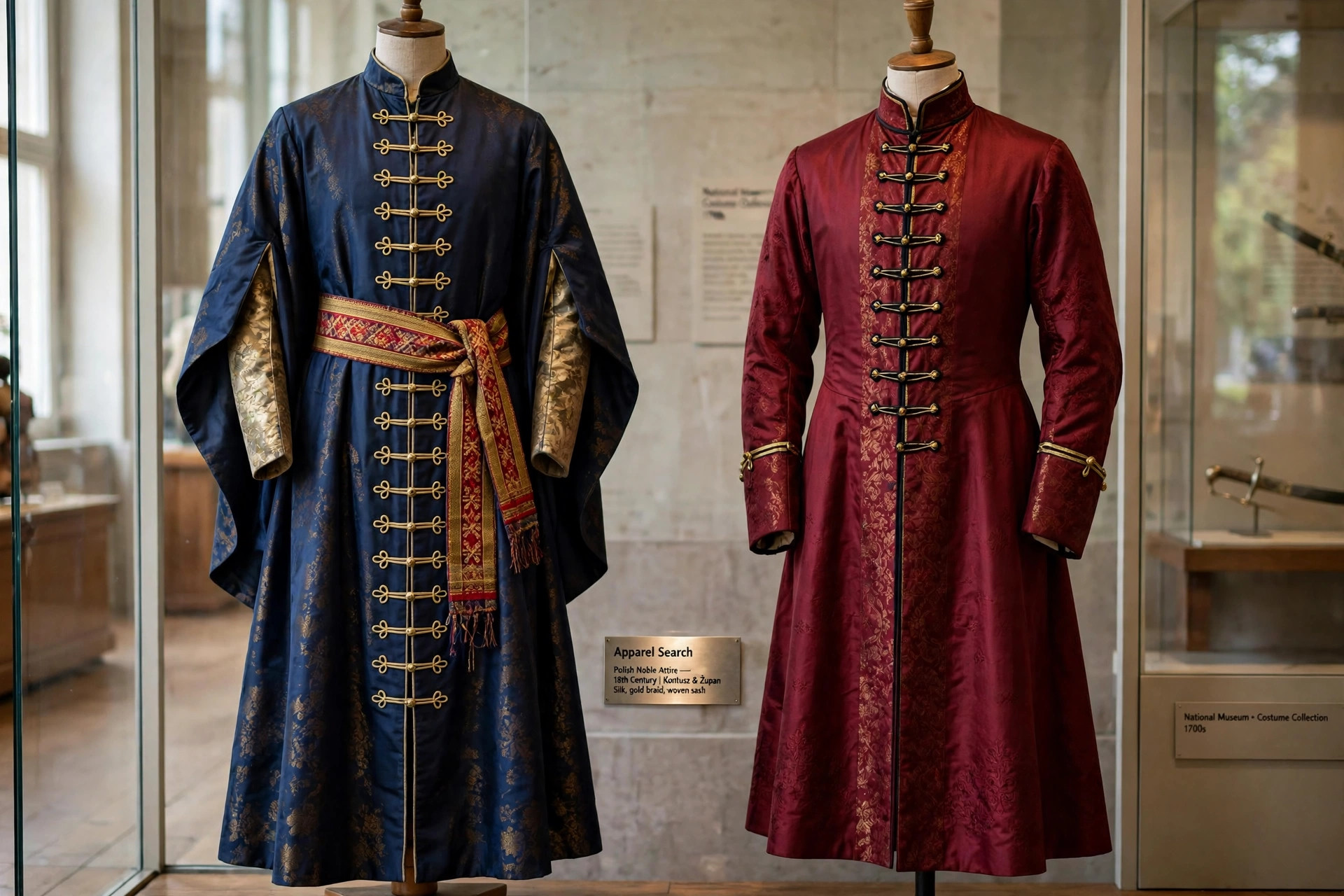
The Garment
The Robe of the Nobility
For three centuries the Polish-Lithuanian Commonwealth was one of Europe’s great states, and its nobility — the szlachta, unusually numerous and fiercely proud — dressed to be recognised across a continent. Their costume looked east as much as west: long robes, sashes and sabres drawn from Hungarian, Ottoman and Persian exchange, cut in silk and worn with shaved heads and long moustaches as a deliberate national style, the dress of “Sarmatian” Poland.
Its centrepiece is the kontusz, a long outer robe with the most theatrical sleeves in European dress: slashed at the front so the arm can pass through, leaving the sleeve to hang as a decorative panel, or thrown back over the shoulder in wear. Beneath it the żupan, a fitted long robe of silk or brocade, provides the colour field the kontusz frames. A wide woven sash binds the waist, a fur-trimmed cap or confederate rogatywka crowns the outfit, and the curved karabela sabre completes the silhouette that fills Polish history painting.
When the Commonwealth was partitioned in the late 18th century, the kontusz turned from fashion into statement: to wear it under foreign rule was to declare Poland still existed. It survives in museums, on ceremonial occasions and in the national imagination — while the folk costumes of Poland’s regions, worn by everyone else all along, carry the living tradition onto today’s festival stages.
Anatomy
The Parts of the Outfit
- Żupan — the inner robe
- A long, fitted robe of silk, satin or brocade with a stand collar and decorative fastenings, worn as the kontusz’s ground layer and, with the sash alone, as indoor and summer dress.
- Kontusz — the outer robe
- The long over-robe with slashed, hanging sleeves, frogged or buttoned at the chest, often lined in a contrasting colour that flashes as the sleeves move.
- Pas kontuszowy — the sash
- The wide silk sash woven with metallic thread and floral pattern, folded lengthwise to display one of several colour grounds, wound round the waist and knotted at the side — the outfit’s greatest luxury.
- Headwear and sabre
- Fur-trimmed caps, the four-cornered rogatywka, and the karabela sabre on its belt; boots of coloured leather complete the noble dress.
- Women’s noble and town dress
- Gowns in the kontusz spirit — kontusik jackets with similar frogging and sleeves worn by noblewomen — alongside the silk and brocade fashions of the Commonwealth’s towns.
The folk costume has its own anatomy, told region by region below: embroidered waistcoats and coral beads in Kraków, striped pasiak wool in Łowicz, white wool and parzenica embroidery in the mountains.
Regions
Folk Poland, Region by Region
| Region | Character |
|---|---|
| Kraków (Małopolska) | Embroidered corset bodices and flowered skirts for women; peacock-feathered caps, tasselled belts and coral-red details for men; Poland’s emblematic folk dress |
| Łowicz (Mazovia) | Rainbow pasiak stripes in wool for skirts, aprons and trousers, with bold floral shawls and embroidery |
| Podhale (Tatra highlands) | White woollen trousers with parzenica embroidery in red and navy, wide leather belts, feathered hats and embroidered capes for górale highlanders |
| Kujawy and Wielkopolska | Rich embroidery on white linen, elaborate women’s caps and bonnets, sober wools in Poland’s west |
| Kashubia | Golden-yellow embroidery of Kashubian flowers on black velvet caps and bodices in the north |
| Silesia and the south | Fine lace bonnets, silk aprons and jacquard weaves reflecting the region’s textile industry |
Folk-dance ensembles — Poland’s famous state and amateur companies — tour these costumes worldwide, and their stage versions, sewn true to regional documentation, keep the patterns in production.
Cloth and Pattern
Silk Sashes, Stripes and Embroidery
The kontusz wardrobe ran on silk: żupans of brocade and damask, kontusze of silk and fine wool, and above all the kontusz sashes, woven at Słuck and other manufactories with Persian looms and patterns naturalised into Polish flowers. A great sash was metres of silk shot with gold — reversible, multi-faced, and priced like jewellery.
Folk Poland worked in wool, linen and homespun. Łowicz wove its identity on the loom in pasiak stripes whose colour sequences name villages; Kraków embroidered roses and leaves in wool and sequins on bodices and waistcoats and strung necklaces of real coral; Podhale cut its dress from thick white highland wool, embroidering the parzenica — the looped heart-shaped motif worked in red and navy on men’s trousers — and tooling wide leather belts with brass. Kashubian embroidery keeps its own seven-colour floral school, taught and certified to this day. Across all of it runs the Polish genius for pattern at full strength: nothing tentative, everything saturated.
Living Dress
Polish Dress Today
Folk costume in Poland lives on the stage, at church and harvest festivals (dożynki), at Corpus Christi processions — where Łowicz’s stripes famously fill the streets — and at weddings, where highland families in Podhale dress in full górale costume as a matter of course. Folk ensembles rehearse weekly in every Polish town, and their wardrobes are working collections of documented regional dress.
The kontusz itself appears at historical re-enactments, in museum displays, on ceremonial occasions and whenever Polish history is pictured; original sashes and robes are among the treasures of Kraków’s and Warsaw’s museums. The living crafts — sash-weaving revived, Kashubian and Łowicz embroidery taught, highland tailoring still commissioned — sit within the modern industry profiled on our Poland clothing industry page.
Wearing
Wearing Basics
Folk costumes are worn complete and region-true: Kraków beads with a Kraków bodice, Łowicz stripes unmixed with highland white. Dance dress adds practical rules — secure fastenings, hems clear of the heel, caps pinned for turning figures. The kontusz, on the rare modern occasions it is worn, demands its full grammar: żupan beneath, sash folded to the chosen face and wound firm, sleeves worn as the moment dictates — arms through for action, hanging for ceremony. Half-measures read as fancy dress; the real garments, worn whole, read as history.
Keeping
Care and Storage
Silk kontusze and sashes are museum-grade textiles: they rest in the dark, in acid-free tissue, handled with clean hands, cleaned never at home and conserved only by textile specialists — metallic threads tarnish and shatter if bent or washed. Folk costumes work harder and are kept accordingly: wools aired and brushed, embroidery washed only by knowledgeable hands, coral and metal cleaned dry, striped wools stored flat so their folds do not set. Dance wardrobes mend as a matter of routine — a costume’s working life is measured in decades of festivals, and every repair keeps the documented pattern in service.
Acquiring
Buying and Collecting
Antique kontusz sashes are serious collectibles, traded through auctions and valued by manufactory, condition and the survival of their woven signatures and fringes; original robes rarely leave museums. Folk costumes are bought from regional makers and folk-art cooperatives — a true Łowicz pasiak is loom-woven wool, a true parzenica hand-embroidered — and prices follow the handwork honestly. Stage and souvenir versions serve dancers and visitors well at lower cost, provided they are sold as what they are. The collector’s rule in Poland is documentation: a costume with its region, maker and pattern named is worth more, in every sense, than a prettier anonymous one.
In Detail
The Sash in Detail, and Dress at Weddings
To see a kontusz sash properly, imagine a silk banner four metres long and a hand’s breadth wide, woven so densely with gold and silver thread that it folds like soft metal. Woven faces alternate along its length — one ground colour for solemn days, another for feasts — and the wearer chose his face as a modern man chooses a tie, folding the sash so the chosen colours showed and the fringed ends fell at the side. Słuck sashes, the most famous, carry their manufactory’s woven mark, and collectors read those marks the way others read hallmarks on silver. At the other end of Polish society, weddings remain the folk costume’s great showcase: in Podhale the bride and groom dress as their grandparents did, in Kraków the wedding party wears embroidered waistcoats and coral, and in Łowicz the procession to church is a river of stripes. Photographs from such weddings, taken across a century, show the same garments changing hands down the generations — the surest proof that Polish dress was preserved not by museums but by families who kept marrying in it.
Common Questions
Common Questions
What is a kontusz?
A kontusz is the long outer robe worn by Polish noblemen from the 17th to the 19th century, over a fitted inner robe called a żupan. It has distinctive slashed sleeves — often worn with the arms free and the sleeves hanging or thrown back — and is bound at the waist with a wide, richly woven silk sash. With the karabela sabre it forms the classic image of the Polish szlachta nobility.
What is a żupan?
The żupan is the long inner robe worn beneath the kontusz, of silk, brocade or fine cloth, fastened with decorative buttons and frogging. On its own, with the sash, it served as less formal dress; under the kontusz it shows at the chest, cuffs and hem, so the two garments were colour-planned together.
What are kontusz sashes?
Kontusz sashes (pasy kontuszowe) are wide silk sashes woven with gold and silver thread and Persian-inspired floral patterns, folded to show different colour grounds — a single sash could present four faces. Woven at manufactories such as Słuck, they became one of Poland’s famous luxury crafts and are now museum treasures.
What is the Kraków costume?
The strój krakowski, from the villages around Kraków, is Poland’s best-known folk costume: for men, a white linen shirt, embroidered waistcoat, striped trousers and the rogatywka cap or peacock-feathered krakuska; for women, a floral-embroidered corset bodice, flowered skirt, coral beads and a wreath or scarf. It is closely tied to the Lajkonik and harvest festivals.
What are Łowicz stripes?
The Łowicz region, west of Warsaw, dresses in bold rainbow stripes — pasiak wools woven in bands of orange, red, green and violet for skirts, aprons, trousers and waistcoats, paired with vivid floral embroidery and shawls. The Łowicz costume is one of the most colourful in Europe and a star of Polish folk-dance stages.
Keep Exploring
More to Explore
In This Series
Traditional Dress by Country
The series hub — every country guide, from the hanbok of Korea to the kilt of Scotland, as each is published.
Visit the hub ↑Poland Clothing Industry
Poland’s apparel and textile industry directory — the modern industry behind the traditional craft.
Explore ↑Go Deeper
Search Apparel Search