Traditional Dress by Country · Hungary
Matyó Embroidery and the Folk Dress of Hungary
No European folk art blooms like Matyó embroidery. Across the blouses, aprons and table linen of Mezőkövesd, roses, tulips and peonies crowd in scarlet, cobalt, green and gold until the black or white ground nearly disappears — embroidery so loved that UNESCO lists it as world heritage. This guide covers the Matyó world and its neighbours: Kalocsa’s bright needlework, the hussar dolman that conquered Europe’s armies, Hungary’s regional costumes, and how the dress is worn, kept and bought today.
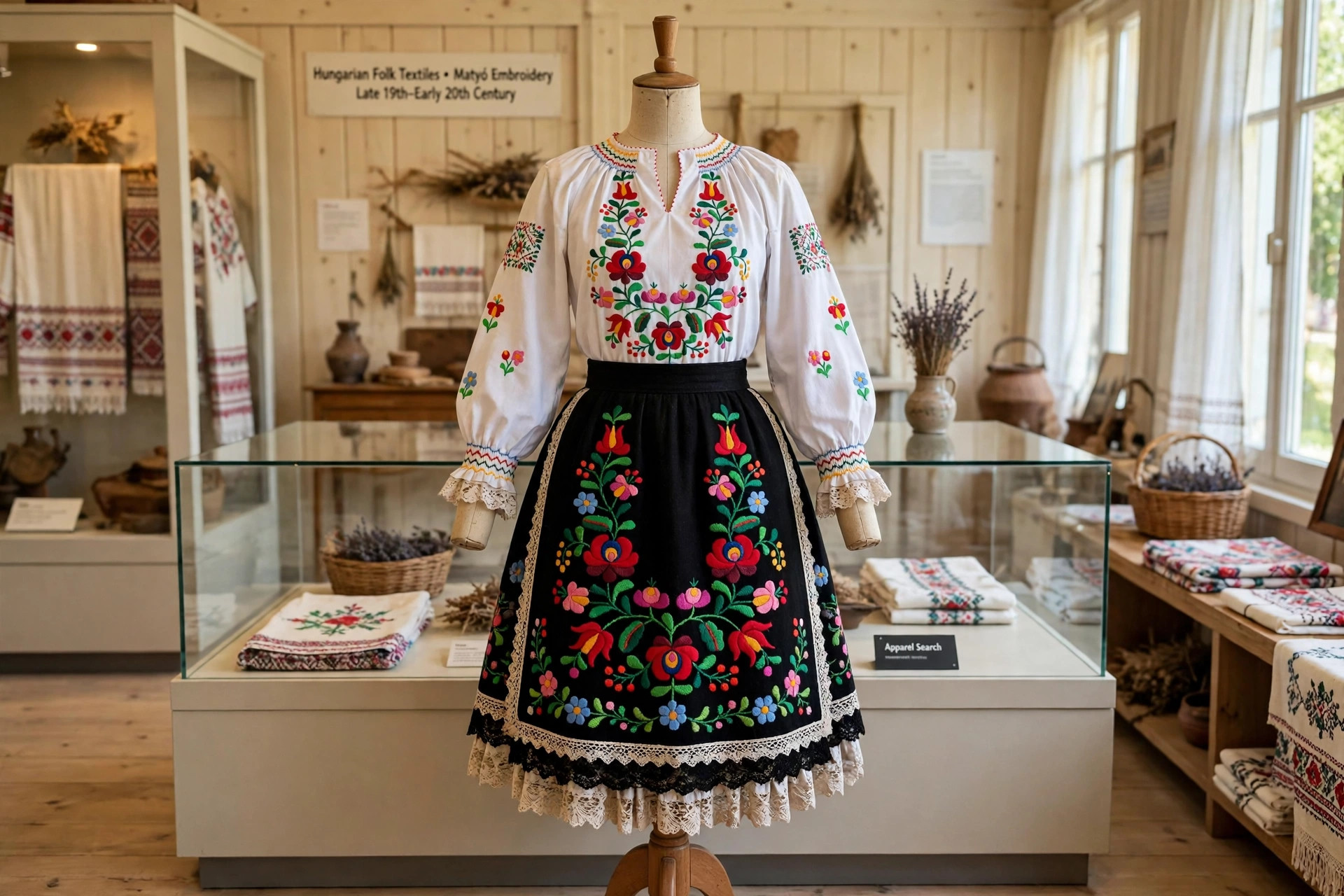
The Garment
The Matyó World
The Matyó are the people of Mezőkövesd and its neighbouring villages in northeastern Hungary, Catholic farming folk whose name — tradition says a king’s gift of the town to a “Matyó” bride’s people — became a byword for embroidery. In the 19th century, as their drawn-thread and white work grew into full colour, Matyó women developed a style of unmatched density: great stylised roses, tulips, peonies and pomegranates, worked in glossy satin stitch, flower crowding flower until a blouse front becomes a garden wall of colour.
The embroidery dressed the Matyó themselves first — festive blouses, aprons, men’s shirts and trousers, bridal wear — and the household second: bed linen, table cloths and church textiles. When Hungarian folk art won prizes at national exhibitions, Matyó work became the country’s emblem, sold across Europe and collected by museums. Its inscription by UNESCO in 2012 recognised what the stitchers always knew: this is art, practised by named masters, taught mother to daughter, and still the economic and emotional centre of its town.
Hungary’s dress story is wider than one town. Kalocsa embroiders as brilliantly in the south; the mente and dolman of the hussars gave Hungarian tailoring a European career; and every region — the Hortobágy shepherds with their great fringed cloaks, the palóc villages of the north, Transdanubia’s lace-capped costumes — keeps a documented dress of its own. This guide moves between the embroidery frame and the wardrobe they all share.
Anatomy
The Parts of the Outfit
- Embroidered blouse and shirt
- The canvas of Matyó and Kalocsa art: women’s blouses with embroidered fronts, sleeves and cuffs; men’s festive shirts with embroidered chest panels and wide sleeves in the older Matyó style.
- Apron (kötény)
- The Matyó apron is a masterpiece in itself — black ground, a full bouquet worked across it, fringed and worn over the skirt as the costume’s showpiece.
- Skirt and petticoats
- Full skirts, often of printed floral cotton or wool, worn over starched petticoats that bell the silhouette; regional weaves and colours vary by village.
- Vest, jacket and dolman braiding
- Embroidered or braided vests for women; for men and for ceremonial dress, the frogged dolman jacket and the fur-trimmed mente cloak of hussar descent, looped with cord and olive toggles.
- Headwear
- Embroidered caps, beaded bridal headdresses and scarves for women; wide-brimmed hats and hussar-style caps for men, by region.
- Shepherd’s cloak (szűr)
- The great felted-wool cloak of the plains shepherds, appliquéd and embroidered at collar and edges — Hungary’s most sculptural garment, worn slung from the shoulders.
Regions
Embroidery Schools and Regional Dress
| Region | Character |
|---|---|
| Mezőkövesd (Matyó) | Densest floral satin-stitch in saturated colour on black or white; roses and tulips; UNESCO-listed folk art |
| Kalocsa | Bright spaced florals with cutwork and drawn thread; famous painted-and-embroidered style of the southern plain |
| Palóc country (north) | Richly layered skirts, lace and beadwork, elaborate bridal crowns in the villages around Hollókő |
| Hortobágy (the puszta) | Shepherd dress: szűr cloaks with appliqué, wide trousers, embroidered shirts of the horse-herdsmen |
| Transdanubia (west) | Fine white embroidery, lace caps and woven sashes in the villages toward Austria |
| Sárköz | Silk-rich costumes and woven ribbon work of the Danube villages, among Hungary’s most luxurious folk dress |
Cloth and Pattern
Stitch, Colour and the Hussar Line
Matyó embroidery is worked mainly in satin stitch, its threads laid like paint, with stem stitch, appliqué and drawn-thread work in support. The classic palette burns against its ground: scarlet, crimson, cobalt, emerald, violet and gold-yellow on black for the richest festive work, the same flowers in slightly softer register on white for blouses and linen. Motifs descend from Ottoman-era floral art naturalised over centuries — the rose (matyó rózsa) above all, with tulip, peony, forget-me-not and the pomegranate — composed in bouquets and borders whose arrangements master embroiderers still sign by style.
Kalocsa adds cutwork: patterns cut and buttonholed into Richelieu lace-like openings among the flowers. And cutting across all regions is the hussar line — the braided frogging of the dolman and mente, Hungary’s gift to European uniform and fashion alike. Cord, toggle and braid turn a plain jacket into architecture; folk tailors used the same grammar on waistcoats and ceremonial coats, so that even a village wedding jacket carries a whisper of the cavalry.
Living Dress
Hungarian Dress Today
Folk dance is the great stage: Hungary’s dance-house (táncház) movement — itself UNESCO-recognised — fills halls with couples learning village dances in ordinary clothes by week and performing in documented regional costume at festivals. Weddings in embroidery country still dress brides in local costume or crown modern dress with embroidered pieces, and Mezőkövesd’s Matyó festival draws its diaspora home.
Embroidery itself is the living industry: Matyó and Kalocsa blouses sell as festive fashion far beyond costume wearers, table linen carries the flowers into homes worldwide, and master embroiderers teach in both towns. The modern Hungarian fashion and textile sector that surrounds the craft is profiled on our Hungary clothing industry page.
Wearing
Wearing Basics
Regional costume is worn complete and unmixed — Matyó apron with Matyó blouse, Kalocsa with Kalocsa — with starched petticoats giving the skirt its bell and headwear finishing the silhouette. An embroidered blouse worn as modern festive dress pairs best simply, with plain skirt or trousers letting the needlework speak. Braided jackets want upright posture and plain companions; the frogging is the ornament. In all cases the embroidery goes on last and comes off first: it is the treasure of the outfit, and Hungarians handle a grandmother’s apron the way other families handle christening silver.
Keeping
Care and Storage
Dense satin stitch survives gentle handling and suffers from everything else. Embroidered pieces are washed rarely, by hand in cool water or by specialists, never wrung, dried flat away from sun — the famous reds fade first — and stored flat or rolled in acid-free tissue, never folded through a bouquet. Petticoats are re-starched for wear; wool skirts aired and brushed; braided jackets hung on padded hangers so the frogging keeps its line. Museums store Matyó work in the dark, and family chests have always done the same: light is embroidery’s slow enemy, and darkness its oldest friend.
Acquiring
Buying and Collecting
Buy in the source towns when you can: Mezőkövesd and Kalocsa sell their embroiderers’ work directly, and the difference between hand satin stitch — plump, glossy, alive on the cloth’s reverse — and machine or printed imitation is visible across a room. Antique Matyó pieces, especially bridal aprons and early coloured work, are collected seriously; check stitch density, ground cloth and colour fastness, and value named makers. The szűr cloak and fine dolman-braided jackets appear through folk-art auctions. A genuine piece, kept in the dark and handled gently, will out-bloom its century.
In Detail
Learning the Stitch, and Dress at the Dance-House
A Matyó embroiderer begins young, tracing flowers drawn freehand by a master — traditionally the patterns were drawn, not printed, each designer’s hand recognisable in the sweep of her roses — and she learns satin stitch the slow way, laying thread beside thread until the petal shines like enamel. A single rich apron can hold weeks of evenings; a bridal set, months. That economy of time explains both the price of genuine work and the fierce local pride in it: to wear Matyó embroidery is to wear a neighbour’s season of skill. The dance-house is where the dress proves itself. In the táncház the costumes turn, stamp and spin for hours, petticoats belling and braided jackets holding their line under real use — folk dress tested the way it was always meant to be, in motion, to music. Visitors who see Hungarian costume only behind museum glass have seen the flowers; the dance-house shows them alive, and Mezőkövesd’s and Kalocsa’s festivals exist to make exactly that introduction.
One more distinction helps buyers and wearers alike. Festive Matyó dress was never everyday clothing: the embroidered aprons and blouses came out for Sundays, feasts and courtship, were put away in chests between wearings, and grew more valuable with every careful year. That rhythm — splendour kept for the great days, and kept well — is still the rhythm of Hungarian costume life, from village feast to national festival stage.
Common Questions
Common Questions
What is Matyó embroidery?
Matyó embroidery is the richly coloured floral needlework of the Matyó people of Mezőkövesd in northeastern Hungary. Roses, tulips, peonies and leaves are worked in satin stitch in vivid reds, blues, greens and yellows on black or white grounds, covering blouses, aprons, caps and household linen. UNESCO inscribed the folk art of the Matyó in its Representative List of Intangible Cultural Heritage in 2012.
How is Kalocsa embroidery different from Matyó?
Kalocsa, in southern Hungary, embroiders in a brighter, more open style: first in white-on-white, then from the early 20th century in bold colours — the famous Kalocsa reds, blues and greens — on blouses, dresses and table linen, often combined with drawn-thread and Richelieu cutwork. Matyó work is denser and more sculptural, its flowers crowding the ground; Kalocsa patterns breathe, with flowers spaced along stems and borders.
What is a dolman?
A dolman is the braided, frogged jacket of the Hungarian hussar — short, close-fitting, looped with cord and toggles across the chest. Hussar regiments across Europe copied it, and the dolman passed into fashion as a women’s jacket and cloak style in the 19th century. In Hungarian folk and ceremonial dress, braided jackets and mente over-coats keep the hussar line alive.
When do Hungarians wear folk costume today?
At folk-dance performances and festivals, village celebrations, weddings, church feasts and heritage days — and in Mezőkövesd and Kalocsa, where embroidered dress remains a living local industry as well as a costume. Dance ensembles wear documented regional costumes; embroidered blouses are also worn as festive dress in their own right.
Can I buy genuine Matyó embroidery?
Yes — in Mezőkövesd itself, from embroiderers and the Matyó museum and folk-art shops, and from Hungarian folk-art cooperatives. Genuine work is hand-embroidered, dense and priced for the weeks it takes; printed imitations are flat and cheap by comparison. Look for even satin stitch, rich colour on both faces of the cloth, and a maker or cooperative label.
Keep Exploring
More to Explore
In This Series
Traditional Dress by Country
The series hub — every country guide, from the hanbok of Korea to the kilt of Scotland, as each is published.
Visit the hub ↑Hungary Clothing Industry
Hungary’s apparel and textile industry directory — the modern industry behind the traditional craft.
Explore ↑Go Deeper
Search Apparel Search