Traditional Dress by Country · Portugal
The Traje of Portugal
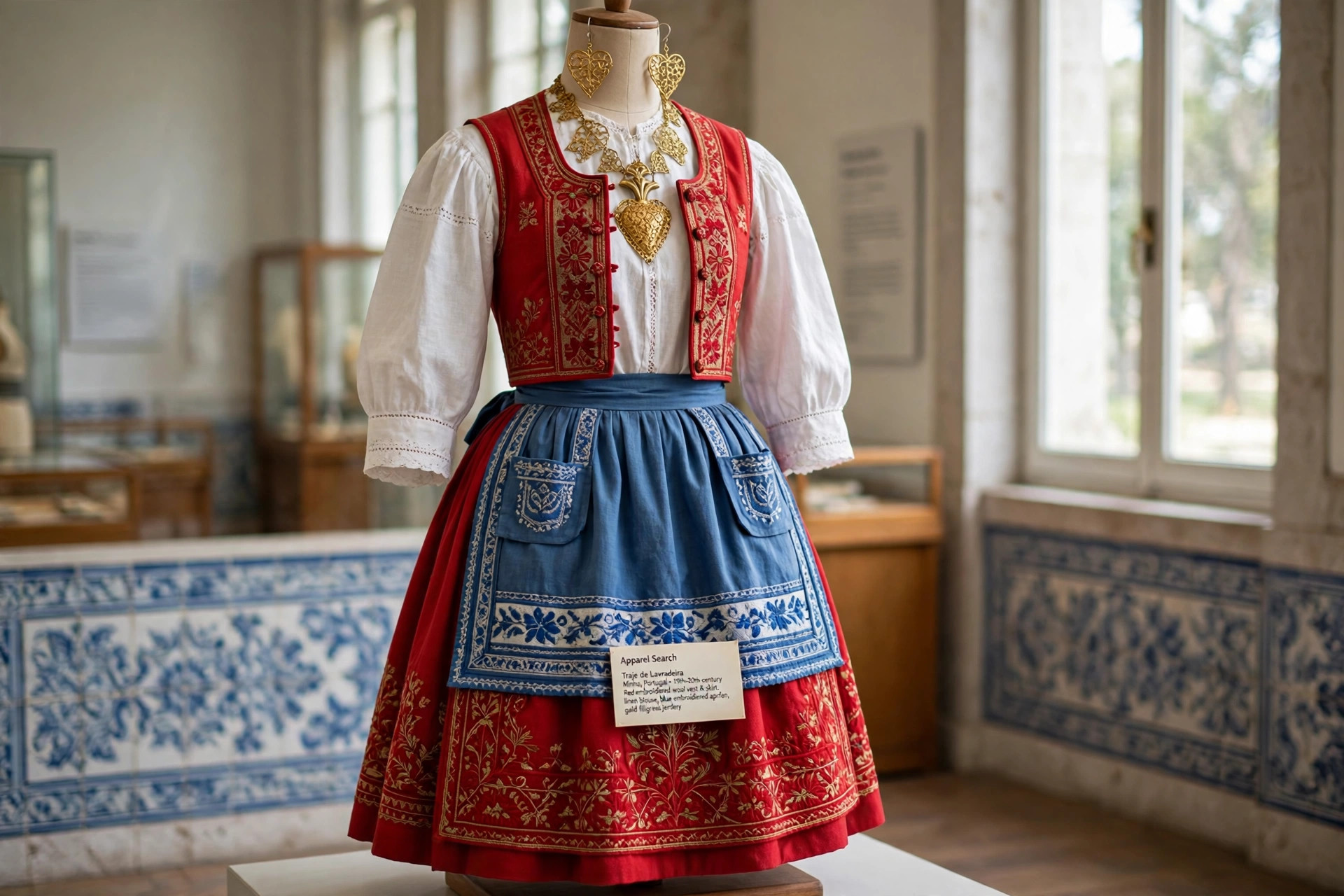
Portugal’s traje is a wardrobe of working coasts and farming valleys, crowned with gold. In the Minho, the traje de lavradeira blazes red and blue under necklaces of filigree gold heavy enough to need both hands. In Nazaré the fisherwomen still count their seven skirts; in Miranda do Douro men dance with sticks in embroidered linen; in the Alentejo the plain sings under shepherds’ capes. This guide explains the costumes region by region, the gold that completes them, and how they are worn and kept today.
The Garment
A Wardrobe of Coasts and Valleys
Traje means dress or costume, and Portugal — a long country of Atlantic coast, river valleys and dry southern plains — keeps not one traje but a wardrobe of them, each valley and port with its own. What unites them is work: these are the festive clothes of farming and fishing people, built from the cloth they wove and the wealth they could carry. In the Minho that wealth became gold, worn on the body at festival time in quantities that astonish visitors; elsewhere it became embroidery, layered skirts, or a dancer’s white linen.
The costumes survived because Portugal’s festivals survived. The romarias — pilgrimage feasts for the Virgin and the saints — never stopped asking whole towns to dress their best, and the folklore groups (ranchos folclóricos) that formed in the 20th century documented village dress parish by parish, rather as Scandinavia’s heritage societies did. The result is a living archive that still processes through Viana, Nazaré and a hundred villages every summer.
Two costumes lead this guide: the traje de lavradeira of the Minho, Portugal’s national image of folk dress, and the seven skirts of Nazaré, still working clothes within living memory. Around them stand the pauliteiros’ dancing linen, the Alentejo’s shepherd dress, and the gold-filigree craft that ornaments them all.
Anatomy
The Parts of the Minho Outfit
- Blouse (camisa)
- White linen or cotton, embroidered in red or blue at the collar, chest and cuffs — the needlework ground of the costume.
- Vest and skirt
- A fitted vest and a full gathered skirt in strong colour — the classic Viana red, with blue and green variants by village and occasion — in wool or heavy cotton with woven or embroidered borders.
- Apron (avental) and scarf
- A patterned or embroidered apron and the headscarf or shawl, colour-matched to the village dress; married and mourning dress sober the palette by rule.
- Gold filigree jewellery
- Strands of filigree bead necklaces (cordões), crosses, the flaming coração de Viana heart pendant, and great filigree earrings — family wealth in gold, inherited and added to across generations.
- Shoes and stockings
- Embroidered slippers or black shoes with white stockings complete the festive dress.
- Men’s Minho dress
- White shirt, waistcoat, sash, trousers and the embroidered or plain jacket of the farming north, with hat by village custom.
Regions
Portugal Region by Region
| Region | Character |
|---|---|
| Minho (Viana do Castelo) | Traje de lavradeira: red festive dress, rich embroidery, the heaviest gold filigree in Portugal |
| Nazaré | Fisherwomen’s seven skirts with checked shawls and headscarves; men’s checked shirts and woollen caps of the fishing shore |
| Miranda do Douro | Pauliteiros: white embroidered linen skirts and waistcoats, flowered hats, stick dances of the Mirandese northeast |
| Alentejo | Shepherds’ and farmworkers’ dress of the southern plains: capes, sheepskin and felt in winter, white cotton in the harvest heat |
| Madeira | Island dress with embroidered linen — Madeira embroidery is a famous export craft — and striped woollen skirts |
| Azores | Atlantic island costumes: hooded capes of the islands, dark wools and festival whites |
Cloth and Pattern
Embroidery, Linen and Gold
The Minho blouse carries Portugal’s festival embroidery: hearts, flowers and birds in cross-stitch and satin stitch, red on white above all. Linen — grown and woven in the north for centuries — grounds blouses, pauliteiros’ skirts and Madeira’s famous export embroidery alike, while skirts and cloaks use local wool, woven in stripes and checks along the coast.
But the traje’s signature craft is metal, not thread. Filigree goldsmiths twist fine gold wire into beads, hearts and crosses of lace-like lightness, so that even a great necklace weighs less than it gleams — though a full Minho set, strand upon strand, is wealth by any measure. The coração de Viana, a heart crowned with flames, distils the style into one emblem, now Portugal’s jewellery symbol worldwide. Silver filigree serves the same patterns at humbler cost, and the craft towns of the north still train apprentices in wire and solder.
Living Dress
The Traje Today
August in Viana do Castelo settles any doubt that the traje lives: at the Romaria de Nossa Senhora d’Agonia, hundreds of women process in lavradeira dress, gold at their throats, in the Mordomia parade — many wearing family gold older than the republic. Through the summer, every region’s festas and folklore festivals put their ranchos on stage and street, and the diaspora — in France, Canada, the United States and beyond — dresses its festivals the same way, an ocean away.
Nazaré keeps the rarer sight of costume as daily dress, and Miranda’s pauliteiros dance at feasts through the year. The goldsmiths, embroiderers and weavers behind the dress work within the modern industry profiled on our Portugal clothing industry page — a country whose textile and footwear exports give its folk crafts an unusually professional home.
Wearing
Wearing Basics
The traje is worn complete, by village rule: blouse, vest, skirt, apron, scarf and gold in the Minho manner, skirts counted and shawl squared in Nazaré. Gold goes on last, over everything, and its arrangement — strands graduated, heart centred — is done before a mirror or by the family hands that have always done it. Colours carry meaning: festival red is not mourning dress, and wearers respect the difference. As everywhere in this series, the complete costume honours its makers; a single souvenir piece worn as fancy dress does not.
Keeping
Care and Storage
Embroidery is washed gently and rarely, wool skirts aired and brushed, linen ironed to its festival crispness. The gold asks different care: filigree is cleaned only with a soft brush and mild solution or by a jeweller — its wires bend and its soldered lace crushes under rough handling — and stored strand by strand in soft pouches so pieces cannot tangle or abrade. Families keep traje and gold together as one inheritance, recorded and insured as the treasure it plainly is, and brought out, polished and complete, for the feasts that justify it.
Acquiring
Buying and Collecting
Genuine filigree is bought from the goldsmith towns and reputable jewellers, hallmarked, its wirework even and its weight honest; plated imitations of the Viana heart fill souvenir shops at souvenir prices and should be enjoyed as such. Costumes are made by regional makers and folklore suppliers — a true lavradeira outfit is measured, embroidered and finished by hand — and antique pieces, especially early embroidered blouses and old filigree, collect a growing following. Buy with provenance where you can: village, maker and feast are part of a traje’s value, in Portugal above all countries, because the traje was always an address as much as an outfit.
In Detail
The Gold in Detail, and a Festival Day
Look closely at Minho filigree and the technique explains the splendour: two hair-fine gold wires are twisted into a cord, the cord is coiled and soldered into hearts, beads and crosses, and hundreds of such elements build a necklace that is mostly air and light. That is why a bride could wear her family’s whole fortune without stooping under it — and why the gold was fortune indeed, pawnable in a bad year and redeemed in a good one, dowry and bank account in one shining strand. A festival day shows the system whole. Before the Agonia procession, Viana’s streets fill before noon: grandmothers arranging granddaughters’ strands, scarves squared, aprons smoothed, the heart centred exactly; then the mordomias step out in their hundreds, red and gold in the Atlantic sun, bands playing, and the town’s argument is made without a word — that beauty, gold and belonging are the same thing, worn where everyone can see it.
It is worth adding that Portuguese costume rewards close looking at its smallest pieces: the embroidered slipper, the woven sash, the silver cross small enough to miss among the gold. Makers lavished the same care on a christening cap as on a bride’s necklace, because in the village world that made the traje, every feast-day piece testified to a household’s skill. Museums in Viana and Lisbon now collect those small pieces as seriously as the great gold sets, and modern makers copy them stitch for stitch.
Common Questions
Common Questions
What is the traje de lavradeira?
It is the festive costume of farming women (lavradeiras) of the Minho, centred on Viana do Castelo in northern Portugal: a white embroidered blouse, a brightly coloured vest and full skirt — classically red — a patterned apron, a headscarf, and above all heavy gold filigree jewellery: necklaces, the heart-shaped coração pendant and large earrings. It is Portugal’s most famous folk costume.
Why do Nazaré women wear seven skirts?
Nazaré’s fisherwomen traditionally wear seven layered skirts or petticoats. Local explanations say the seven stand for the days of the week, the waves, or the colours of the rainbow — the honest answer is that the layers were practical warmth and modesty for women who worked the shore waiting for the boats, and the number seven became the beloved tradition. The costume is still worn daily by some older women in Nazaré.
What is Portuguese filigree gold?
Filigree (filigrana) is jewellery made of fine twisted gold wires soldered into lace-like forms — hearts, crosses, beads and the great crescent earrings of the Minho costume. Centred on Gondomar and the north, it is one of Portugal’s signature crafts; the coração de Viana heart, with its flames and crown, has become a national symbol worn far beyond folk costume.
Who are the pauliteiros?
The pauliteiros de Miranda are the stick dancers of Miranda do Douro in the northeast: men and boys in white embroidered linen skirts, waistcoats and flowered hats who perform dances clashing pairs of sticks (paulitos). Their dress and dance, tied to the Mirandese language and culture, are among Portugal’s most distinctive traditions.
When is the traje worn today?
At the great festas — above all Viana do Castelo’s Romaria de Nossa Senhora d’Agonia in August, where hundreds parade in Minho costume with their gold — at village saints’ festivals, folklore festivals and ranchos folclóricos performances across Portugal and in the Portuguese diaspora worldwide.
Keep Exploring
More to Explore
In This Series
Traditional Dress by Country
The series hub — every country guide, from the hanbok of Korea to the kilt of Scotland, as each is published.
Visit the hub ↑Portugal Clothing Industry
Portugal’s apparel and textile industry directory — the modern industry behind the traditional craft.
Explore ↑Go Deeper
Search Apparel Search