Wedding Attire Around the World · Scotland
Wedding Attire in Scotland
A Scottish wedding is framed in white and filled in tartan. The bride usually wears the Western white dress; the groom wears the most complete surviving ceremonial outfit in British dress — eight yards of pleated tartan, a Prince Charlie coatee, a fur sporran, a small knife in his sock — an outfit with a named part for everything. Between the two, the old customs are worn and carried rather than spoken: a silver brooch of intertwined hearts, hands bound with cord or tartan, a two-handled cup shared in both hands. This guide takes the groom's outfit piece by piece, answers the tartan question honestly, and explains the objects. For the kilt as a garment, begin with our kilt of Scotland guide; this page is about what happens to it at a wedding.
The Shape of It
White Dress, Tartan Groom, and a Long Evening
A Scottish wedding follows the broad Western shape — ceremony by day, celebration into the night — with Scotland's own legal and cultural furniture. Couples marry in church, in a civil ceremony, or in a humanist or other belief ceremony, which Scotland recognises in law; the setting is as likely to be a castle, a barn, a hotel on a loch or a family garden as a church. A piper commonly plays the guests in and the couple out. And the day has a second half with a dress life of its own: the evening reception, very often a ceilidh, where the dancing is called, communal and vigorous enough that the groom's jacket comes off, the bride's shoes change, and the kilt — pleated wool built for movement — comes into its own. Nobody at a ceilidh regrets the groom's outfit choice.
Within that frame, the distribution of tradition is strikingly uneven, and it is the subject of this guide. The bride's dress is the international white wedding dress, to which tartan is added in touches — a sash, a shawl, a ribbon, a brooch. The groom's dress is the opposite: a complete, codified national outfit in which every component has a name, a correct form and a correct place, worn today much as the Victorians fixed it. The customs that carry the marriage itself — handfasting, the quaich, the luckenbooth — are small, portable and personal, fitted into the ceremony the couple chooses. The mills and makers behind the cloth are part of the industry profiled on our United Kingdom clothing industry page.
The Ceremony
Bound Hands and a Shared Cup
Handfasting — the original tying of the knot
During the ceremony, the couple's joined hands are bound with cords, ribbons or cloth — each partner traditionally providing a piece, very often a strip of their own clan tartan, so that the two families' cloth is literally knotted together. As the couple draw their hands apart, the knot forms; it is kept afterwards as the physical record of the vows. Handfasting is presented as an ancient Celtic practice and is the commonly given origin of the phrase tying the knot; whatever its exact antiquity, it is now a standard, much-loved part of Scottish ceremonies, and in Scotland it can form part of the legal ceremony itself when an authorised celebrant performs it.
The quaich — a drink that needs both hands
The quaich is a shallow, two-handled cup — pewter, silver or wood — filled traditionally with whisky and shared by the couple as their first drink as newlyweds, often engraved with their names and the date and kept for life. Its meaning is trust: a quaich is held and offered with both hands, so neither party can hold a weapon while drinking with the other — a gesture born, tradition says, between clans that were not always friends. Each partner holds a handle as they drink, and the cup may then be passed among the families: two households, one cup.
The Bride
The White Dress, Answered in Tartan
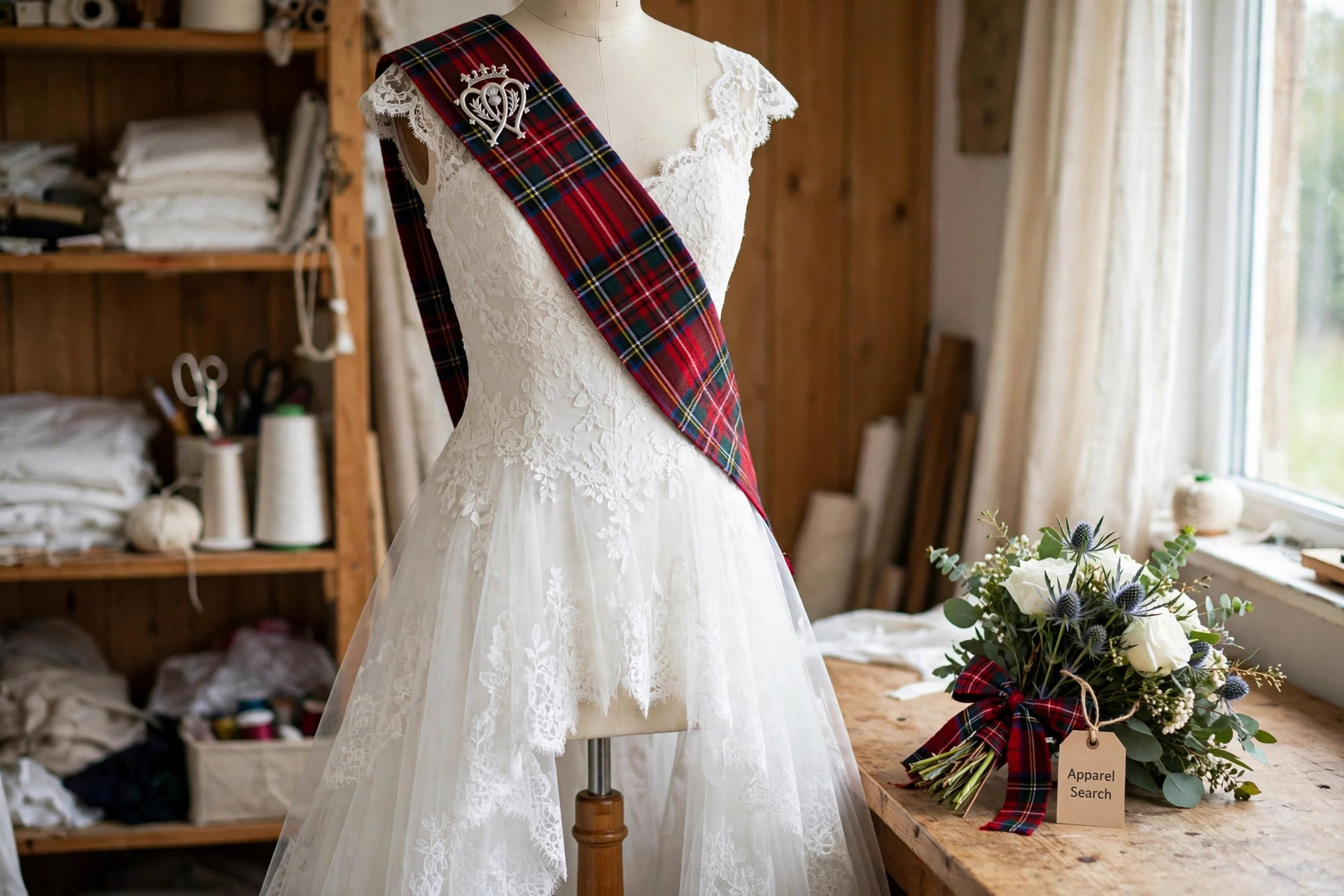
The Scottish bride's starting point is the Western one: a white or ivory dress, chosen as brides choose it everywhere. What makes the outfit Scottish is the layer of tartan and token added to that frame — usually the groom's tartan, so that the bride visibly takes up his family's cloth for the day, or her own family's tartan, or one chosen tartan that the whole wedding party shares. The additions are small, deliberate and photographed:
| Addition | How it is worn | Notes |
|---|---|---|
| Tartan sash | A long band of tartan over one shoulder, across the dress, pinned at the shoulder with a brooch | The classic bridal tartan gesture; conventions about which shoulder exist, but they are modern courtesies, not law |
| Tartan shawl or wrap | Draped over the shoulders for the evening or outdoor photographs | The descendant of the old Highland women's wrap, the earasaid, in modern form |
| The luckenbooth | The groom's brooch pinned to the sash or the dress | Two intertwined hearts under a crown — see the jewelry section below |
| Tartan in the bouquet | Stems bound in tartan ribbon; thistles and white heather among the flowers | White heather is traditionally lucky; the thistle is Scotland's emblem |
| A tartan garter | Worn unseen, sometimes with a small sixpence or charm | The private version of the same idea — tartan carried, not displayed |
Some brides go further — a tartan bodice, a full tartan skirt with a white blouse in the older Highland manner, or a dress tartan woven into the gown itself — and at weddings where the bride's family is the Scottish one, the direction reverses: she wears her own tartan at full strength and the groom's party hires to match the room rather than the reverse. A related custom you may see is the pinning of the tartan, in which, after the ceremony, a rosette or sash of the groom's tartan is pinned on the bride (or his on her family) as a sign of welcome into the family. The white dress remains the frame; tartan is the signature written across it.
The Groom
Full Highland Dress, Piece by Piece
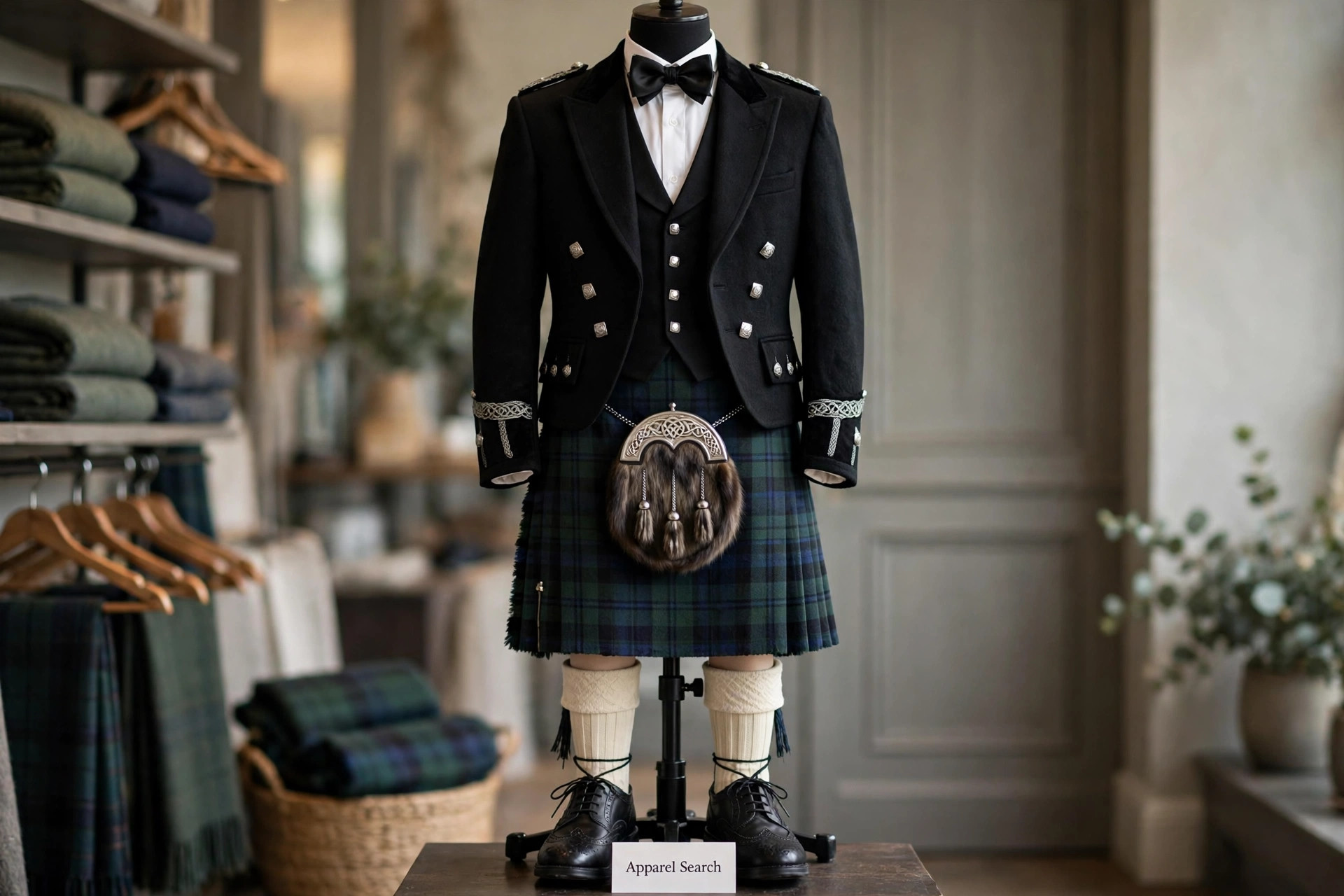
The groom's outfit is the centrepiece of the Scottish wedding, and it is an outfit, not a garment: nine or ten pieces that must agree in formality. The garment-by-garment account is in our Traditional Dress guide; here is the wedding version, in the order a kiltmaker would check it:
- The kilt
- About eight yards of woollen tartan, pleated deeply at the back and sides and flat across the front in two overlapping aprons, sitting high on the natural waist and falling to the middle of the kneecap. At a wedding it is worn in the family or clan tartan if the groom has one — the question of whose tartan, answered below — and its pleats, sett and cloth weight are where quality lives: a proper wedding kilt is heavy, hand-finished and made to measure. The short dictionary version is our definition of kilt.
- Prince Charlie coatee and waistcoat
- The evening jacket: a short black barathea coatee, cut away at the waist so the kilt shows, with tails behind, satin-faced lapels and silver buttons, worn with a matching low waistcoat. It is the Scottish equivalent of the dinner jacket, and it is what most wedding grooms wear — for the whole day, even when the ceremony is in daylight. The daytime alternative is an Argyll jacket, longer and plainer, or a tweed jacket, worn with a necktie rather than a bow tie.
- Shirt and bow tie
- A white dress shirt — wing or standard collar — with a black bow tie for the Prince Charlie. The shirt is deliberately plain: everything coloured in the outfit is tartan, everything shining is silver.
- Sporran
- The pouch worn at the front, because the kilt has no pockets. For a wedding with a Prince Charlie it is a dress sporran: fur, with a silver or pewter cantle (the ornamental top), hung on a chain. A plain leather sporran is day wear and looks wrong against the evening jacket — outfitters name it the most common mismatch they see.
- Kilt hose and flashes
- Long woollen hose, usually cream or white with evening dress, turned down below the knee and held by garter flashes — small tabs of tartan or plain colour that show beneath the turnover, on the outside of each leg.
- Ghillie brogues
- Black leather shoes without tongues, their long laces crossed, twisted and wrapped around the ankle — a design made for wet Highland ground, now the formal shoe of the outfit.
- Sgian-dubh
- The small knife — Gaelic for "black knife" — tucked into the top of the right hose (the left for the left-handed), with only its handle showing. Hire sgian-dubhs are blunt, deliberately, and many venues require it.
- Kilt pin
- A decorative pin through the outer apron only, at its lower corner — it weights the apron against the wind; it does not, and must not, fasten the two aprons together.
- Plaid
- For the most formal looks, a length of the same tartan worn over the shoulder: the fly plaid, gathered at one corner and pinned at the left shoulder with a brooch, hanging down the back. Optional, unmistakable, and the groom's alone.
Which tartan? The honest answer
Start with the fact that settles most anxiety: there is no law about who may wear which tartan, and there has not been for centuries. What exists is custom, and the custom runs like this. If you have a clan or family tartan — through your surname, a parent's or grandparent's name — that is the traditional and most meaningful choice, and it is what most Scottish grooms wear. If you do not, you are not excluded from tartan: universal tartans exist precisely to be worn by anyone, and the two you will see most at weddings are the dark blue-and-green Black Watch — the old government sett, sober and safe with everything — and the red Royal Stewart, technically the monarch's personal tartan but in practice, through two centuries of popularity, a universal one that anyone may wear. District tartans, tied to a place rather than a name, belong to anyone with a connection to that place. The one genuine exception is the Balmoral tartan, reserved to the Royal Family. The remaining courtesy is simple: wear another family's tartan by all means, but do not claim the family. At a wedding, of course, the practical answer overrides all of this — the groom chooses, the groomsmen hire to match him, and the tartan becomes the wedding's own for the day.
Jewelry and Tokens
The Luckenbooth: a Brooch That Is a Love Letter
The luckenbooth is Scotland's wedding jewel. It is a brooch — usually silver, sometimes set with stones — of two intertwined hearts surmounted by a crown: love, doubled and loyal. Its name comes from the luckenbooths, the locked booths or stalls around St Giles' in Edinburgh where goldsmiths and jewellers traded, and from the seventeenth century onward it was given as a betrothal and wedding token — the groom's gift to his bride alongside, or in earlier times instead of, a ring. On the wedding day it is pinned to the bride's dress or sash. Afterwards, tradition pinned it to the couple's first baby's blanket as a charm against harm: the love token of the wedding becoming the luck of the next generation.
Around it gather the outfit's smaller silver: the kilt pin, often clan-crested; the sgian-dubh's mounted handle; the sporran's cantle; cufflinks and, for the bride, the brooch that pins her sash — very often the luckenbooth itself doing double duty. Rings follow the wider Western pattern, covered in our wedding bands guide. But the luckenbooth is the piece with a story attached, and Scottish jewellers still make it for exactly the purpose it has served for three hundred years.
Acquiring
Hire Culture, and the Kilt You Keep
Scotland hires its wedding kilts the way other countries hire morning suits, and the hire trade is a national institution: outfitters in every town hold outfits in dozens of tartans, fit the whole wedding party in a session or two, and hand over the complete kit — kilt, jacket, waistcoat, shirt, neckwear, sporran, hose, flashes, sgian-dubh — for the days around the wedding. Typical prices, as quoted by Scottish outfitters and guides in 2026, run about £95 to £170 for a full outfit hire; hiring a kilt made in a tartan of your choice costs more, around £300, because the kilt is made for the booking. Hire is why a Scottish wedding party can be perfectly matched in a tartan none of them owns, and why guests from abroad can be fully dressed by Friday.
Against that stands the other Scottish tradition: the bought kilt. A hand-sewn, made-to-measure kilt in eight yards of woollen tartan runs roughly £570 to £900 for the kilt alone, and a complete made-to-measure outfit about £1,500 to £3,000; making takes weeks — six to twelve is the usual advice, longer at busy makers — so grooms order early. What the money buys is permanence. A good kilt, properly stored, lasts a lifetime of weddings, ceilidhs, graduations and Burns suppers, can be re-fitted as its owner changes, and is handed down — outfitters speak of wedding kilts as heirloom purchases in exactly those terms. The common groom's compromise tells the story of both cultures at once: hire for the groomsmen, buy for himself.
Today
The Modern Mix
Highland dress is a living uniform, and it moves. Contemporary grooms wear tweed and velvet jackets in colours the Victorians never offered, waistcoats in contrast cloth, tartans designed for the wedding itself — new setts are registered every year, for families, couples, companies and causes — and kilts, occasionally, in leather, denim or plain cloth from Edinburgh's modern kiltmakers. Brides answer with tartan bodices and full tartan gowns, or keep the white dress and let a sash carry the whole statement. The customs flex with the couples: handfasting cords in rainbow ribbon or in the colours of two football clubs, quaichs filled with something kinder than whisky, luckenbooths bought new from Scottish jewellers working in the old form. None of it displaces the structure underneath — the pleated tartan, the codified outfit, the bound hands and the shared cup. If you are attending rather than starring, our Wedding Guest Attire section covers what to wear from the other side — including to weddings exactly like this one.
Common Questions
Common Questions
What does a Scottish groom wear?
Full Highland dress: a kilt in his family or chosen tartan, a Prince Charlie coatee and matching waistcoat, a white dress shirt with a black bow tie, a dress sporran, cream or white kilt hose with flashes, black ghillie brogues, a kilt pin, and a sgian-dubh tucked into the top of his right hose. For a daytime wedding some grooms choose a tweed or Argyll jacket and a necktie instead — the kilt and its accessories stay the same.
Can I wear a tartan that is not my family's?
Yes. No law governs who may wear which tartan. By custom, a clan or family tartan is worn by people of that name or family connection, and it is the most meaningful choice if you have one. If you do not, universal tartans exist precisely for you: Black Watch and Royal Stewart are the best known and are worn by everyone, and district tartans belong to anyone connected with the place. The one widely respected exception is the Balmoral tartan, reserved to the Royal Family.
What is handfasting?
Handfasting is the binding of the couple's hands with cords, ribbons or a strip of tartan during the ceremony, symbolising their union — it is the commonly given origin of the phrase 'tying the knot'. Each partner often provides a cloth, traditionally in their own tartan, and as the couple draw their hands apart the knot forms and is kept. In Scotland handfasting can form part of a legal marriage ceremony when performed by an authorised celebrant.
What is a luckenbooth brooch?
A traditional Scottish love token: a brooch, usually silver, of two intertwined hearts surmounted by a crown. Grooms traditionally give one to their bride — in earlier centuries as a betrothal gift — and it is pinned to her dress on the wedding day. Afterwards it was traditionally pinned to the first baby's blanket as a protective charm, carrying the luck of the marriage into the next generation.
Should a groom hire or buy his kilt?
Most Scottish grooms and groomsmen hire: a full outfit hire typically runs about £95 to £170 for several days, with every piece matched and fitted by the outfitter. Buying makes sense when the kilt will be worn for years of weddings, ceilidhs and formal dinners: a hand-sewn made-to-measure kilt alone runs roughly £570 to £900, and a complete outfit £1,500 to £3,000 — but a good kilt lasts a lifetime and is handed down. Order a bought kilt months ahead; making one takes weeks.
Keep Exploring
More to Explore
In This Series
Wedding Attire Around the World
The series hub — wedding dress country by country, from China's qun kua to Scotland's tartan, as each guide is published.
Visit the hub ↑Scotland — Highland Dress
The base outfit behind this page: the eight-yard kilt, its pleating and sett, and the full Highland wardrobe in the Traditional Dress series.
Read ↑Go Deeper on Scotland
United Kingdom Clothing Industry
The UK apparel industry directory — the wider sector behind Scotland's mills and kiltmakers.
Explore ↑Definition of Kilt
The short Apparel Search definition of the kilt and its key terms.
Read ↑Definition of Tartan
What a tartan sett is, in the short Apparel Search fabric definition.
Read ↑Men's Kilts Guide
Kilts as menswear to buy and wear — cloth weights, fittings and outfit building.
Read ↑Attending a Wedding?
Search Apparel Search