Wedding Attire Around the World · Mexico
Wedding Attire in Mexico
A Mexican wedding holds two wardrobes at once. The common modern form is familiar — the bride in a white dress, the groom in a suit — but Mexico's own dress is never far away: the groom in the silver-buttoned charro suit of Jalisco, the bride in the sequined china poblana, or in the regional splendour of a Yucatán terno or an Oaxacan Tehuana dress. Over it all, the Catholic ceremony lays its own garments: a great rosary looped around the couple's shoulders, thirteen gold coins passed hand to hand, a bouquet carried not to be thrown but to be given away. This guide walks the whole wardrobe. For the charro suit as a garment, begin with our charro suit and china poblana of Mexico guide; this page is about what they do at a wedding.
The Shape of It
A Mass, a Lasso, and a Fiesta That Runs All Night
A Mexican wedding is built on the Catholic nuptial Mass — most weddings include one, an hour or more in church — and, alongside it, the civil ceremony that Mexican law has required since the nineteenth century, held before the religious service or at the reception venue. Around the couple stands the padrinos system: sponsors, usually married couples, each pair responsible for one element of the day — padrinos de lazo for the lasso, de arras for the coins, de anillos for the rings, del ramo for the bouquet offered to the Virgin, and more, at a large wedding a dozen couples deep. The padrinos are not honorary: they provide or carry the objects of the ceremony, share its costs, and stand as mentors to the marriage afterwards. Dress follows the structure — the couple in their finest, the padrinos formal, the objects themselves chosen, blessed and kept.
Then the wedding changes key. The reception — the fiesta — runs from the late afternoon into the small hours, with a long feast (mole poblano in Puebla country, cochinita pibil in Yucatán), mariachi musicians in charro dress appearing for the serenata, the recessional and the party, and set-piece dances including the víbora de la mar, in which guests stream in a snaking line under the couple's raised veil and tie. A Mexican wedding is therefore dressed twice over: for the church, where the lazo and arras are laid on the couple's clothes, and for a party built to outlast them. The industry behind the tailoring and embroidery is profiled on our Mexico clothing industry page.
The Ceremony
The Padrinos and Their Objects
The ceremony's dress story is told in full in the symbols section below — the lazo laid over the couple's shoulders, the arras poured from hand to hand, the ramo carried to the Virgin's altar. What the padrinos system adds is authorship: none of these objects is the couple's alone. Each is given, carried and placed by a chosen couple, whose own dress on the day is formal in honour of the role — the padrinos de lazo step forward in their wedding best to bind the couple, and are photographed doing it. A Mexican wedding's cast, like a Filipino one, dresses the couple during the rite; the wardrobe of the wedding includes the sponsors' hands.
The music dresses too. The mariachi — violins, trumpets, vihuela, guitarrón and guitar, an ensemble from Jalisco inscribed by UNESCO as Intangible Cultural Heritage in 2011 — performs in the charro suit described below, so that at a wedding with both a charro groom and a mariachi, the room holds the same suit in two roles: the horseman's dress worn by the man marrying, and by the men singing him out of the church.
The Bride
The White Dress, the China Poblana, and the Regions
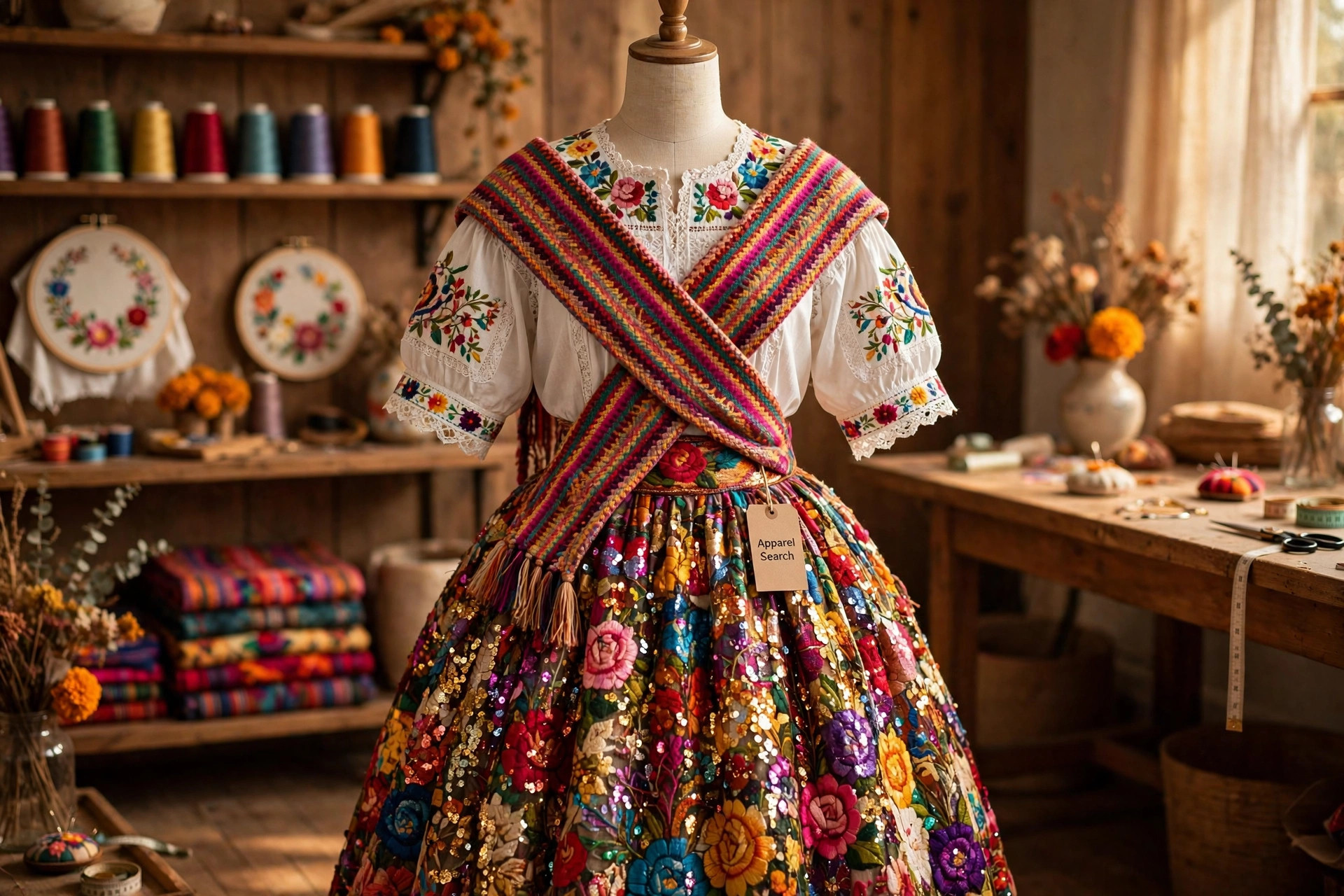
The common modern Mexican bride marries in a white dress — slim or A-line in the Spanish-influenced manner, often with hand-embroidered or lace detail that nods to Mexican needlework, and frequently with a mantilla, the lace veil worn over a high comb in the Spanish style. That is the national default, and most of this guide's ceremony fits over it unchanged. But Mexico also keeps a complete alternative bridal wardrobe, worn where a couple wants the wedding itself to be folkloric — above all the china poblana, Puebla's festive costume and, with the charro suit, half of the national dress pairing: a white blouse embroidered in silk and beads, a full skirt covered in sequins — flowers, and often the Mexican eagle, glittering across it — a sash, and a rebozo crossed over the shoulders, with the hair braided and ribboned. It is the dress of the Jarabe Tapatío, the courtship dance that ends with the charro's sombrero on the floor and the couple dancing around its brim; a bride in china poblana and a groom in charro dress are, together, the emblem of Mexico itself.
Beyond the national pairing, two regional dresses reach a splendour that rivals any bridal gown:
| Region | The bridal dress | Signature details |
|---|---|---|
| Yucatán | The terno — the festive three-piece dress of Maya Yucatán | White huipil, overskirt and underskirt in fine cotton or linen, each band embroidered with bright floral cross-stitch at neck and hem; gold jewelry completes the festive dress. Grooms and guests answer in the white guayabera |
| Oaxaca — the Isthmus | The Tehuana dress of the Zapotec women of Tehuantepec | A short huipil of velvet embroidered with large flowers, a long skirt finished with a starched white lace ruffle (the holán), gold jewelry, and for weddings and great festivals the huipil grande — a starched lace headdress framing the face. Frida Kahlo made the Tehuana world-famous by wearing it |
| Puebla | The china poblana | Sequined skirt, embroidered blouse, crossed rebozo — the folkloric bride, paired with the charro groom |
Underneath the variety runs one old folk rule worth knowing: a Mexican bride traditionally does not wear pearls, which folklore reads as tears — diamonds, gold, or the silverwork of places like Taxco take their place. Our general wedding dress guide covers the white-dress side of the wardrobe as clothing to buy and wear.
The Groom
The Charro Suit: Silver Buttons and a Horseman's Silhouette
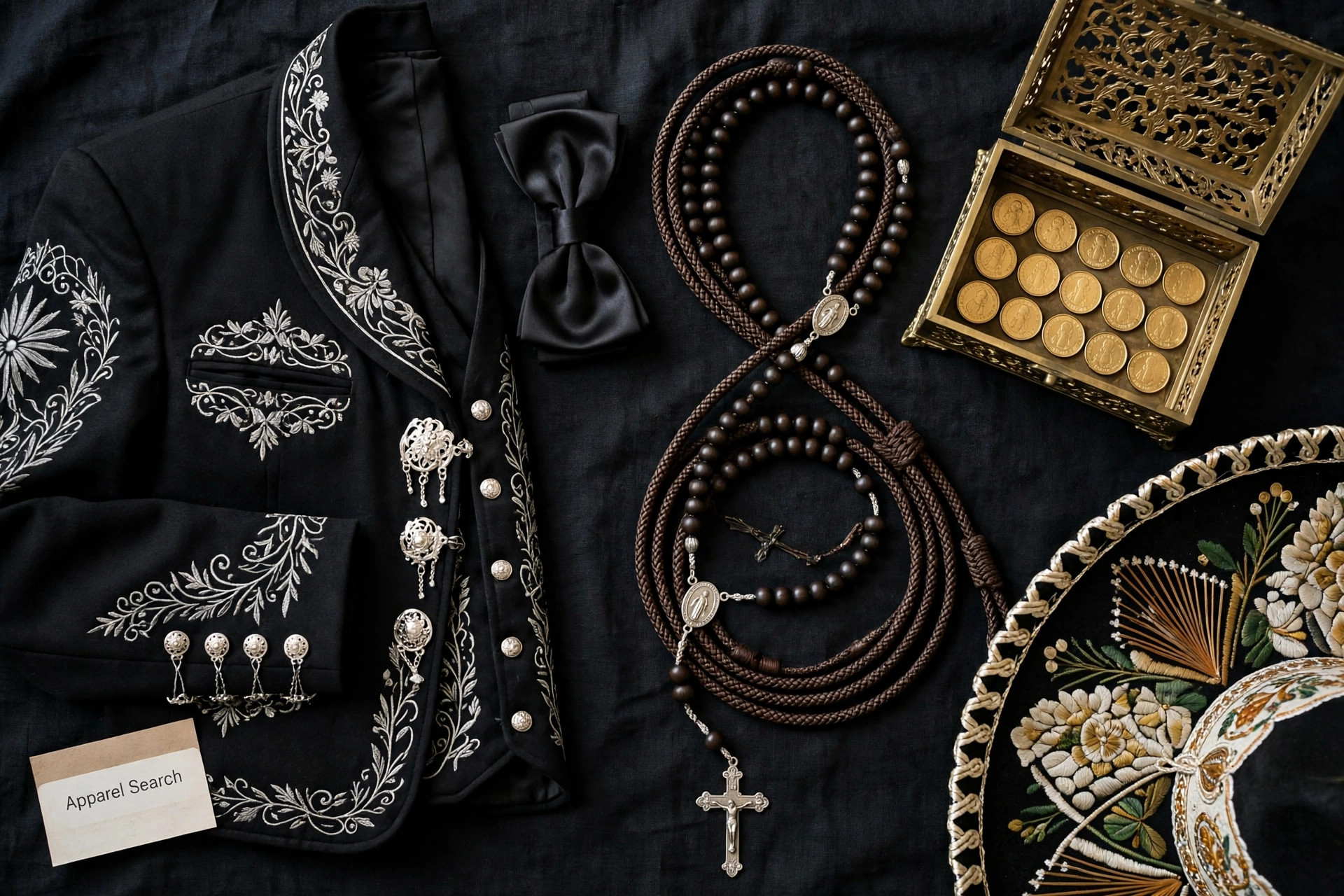
The groom who marries in Mexican dress wears the traje de charro — the suit of the charro, the horseman of the great cattle haciendas of Jalisco and central Mexico, whose skills became charrería, the national rodeo tradition recognised by UNESCO in 2016. It is a suit built for a saddle and finished like jewelry:
- Chaquetilla — the jacket
- A short, close-fitting jacket ending at the waist — nothing loose to catch on a horn or a rope — its fronts, cuffs and back worked with embroidery or appliquéd greca scrollwork, in thread, suede or, on gala suits, silver and gold. It is worn open or closed with ornamental brooches.
- Pantalón and botonadura
- Trousers cut tight to the leg, and down the outside seam the suit's signature: the botonadura, rows of silver buttons linked by chains — a full gala set runs the length of the leg. On plainer suits embroidery takes the silver's place. Either way, the leg is decorated along its whole line, which is why the charro silhouette reads as ornamented from shoulder to boot.
- Moño — the bow tie
- A wide, soft bow tie at the throat, in silk — the suit's one soft note, and the piece groomsmen most easily borrow (below).
- Sombrero
- The great wide-brimmed hat, felt or palm according to grade, itself embroidered on gala examples. It is carried as much as worn at a wedding — and it is the hat of the Jarabe Tapatío, laid on the floor for the dance's finale.
- Botines and belt
- Ankle boots with a riding heel, and a leather belt — on fine suits a piteado belt, embroidered with agave fibre — completing the horseman's kit.
The suit's second life explains its fame. Mariachi musicians adopted the traje de charro in the early twentieth century — by the 1930s it was their standard — and cinema and radio carried it worldwide as the uniform of Mexican music, so the groom in charro dress is quoting the mariachi even as the mariachi quotes the horseman. Grades run from working dress through media gala to the full gran gala with its complete silver botonadura, the version used for parades, formal occasions and church. A wedding groom wears gala or near it: black with silver is the classic, with white and deep colours regional and festive alternatives. And where the charro would cook — a beach or Yucatán wedding — the groom's formal answer is the guayabera, the pleated, four-pocketed linen shirt of the Gulf and Caribbean coasts, white with tailored trousers: formal, and built for the heat.
The Symbols
El Lazo, Las Arras, El Ramo
- El lazo — the lasso
- After the vows, the padrinos de lazo step forward with the lazo: a large rosary, a silk cord, or a garland of flowers, long enough to loop over two people. They drape it over the couple's shoulders in a figure-eight — one loop on the bride, one on the groom, infinity where they cross — and the couple wears it, joined, through the rest of the Mass. It is the wedding's unity made visible and physical: while the lazo is on, the two cannot move apart. When it comes off, it does not go back to a shop. Couples keep the lazo as an heirloom of the marriage, hung or stored with the family's devotional things.
- Las arras — the thirteen coins
- The padrinos de arras carry the coins — thirteen, gold or gilt, in a small chest or on a tray. Blessed by the priest, they pass from the groom's hands into the bride's cupped hands, and in the rite's full form she pours them back and he closes the chest over them: a pledge, made in metal, that he will provide for the household and that what they have will be shared and stewarded by both. The number is read as Christ and the twelve apostles. Engraved arras sets are kept and handed down like rings — the jewelry of the ceremony rather than of the body; our wedding bands guide covers the rings that accompany them.
- El ramo — the bouquet for the Virgin
- The bride carries two bouquets. One is hers. The other, el ramo, is carried for giving away: after the Mass the couple go to the image of the Virgin — in most of Mexico, the Virgin of Guadalupe — kneel, pray, and leave the bouquet at her altar, asking her blessing and protection on the marriage. It is the only wedding bouquet in the world whose purpose is to be surrendered, and it closes the church part of the day before the fiesta begins.
All three symbols share the Spanish Catholic root that Mexico shares with the Philippines — the same cord, the same thirteen coins, carried across the Pacific by the galleons — and all three have outgrown the strictly religious frame: couples marrying civilly in Mexico often keep the lazo and arras as cultural acts in their own right.
Acquiring
Buying the Wedding Wardrobe
A true charro suit is a tailor's commission. Master sastres in Jalisco and Mexico City cut the chaquetilla and pantalón to the man, and the price climbs with the work: greca embroidery by the panel, piteado belts, and above all the botonadura — a full gala set in real silver is silversmithing, priced as such, where plated sets serve the stage and the budget. Couples buy through the charro and mariachi outfitters of the great cities, and artisan work is safest bought from recognised makers and artisan channels such as those promoted by FONART, Mexico's national crafts fund. The suit, bought well, is not a costume: charros wear the same grades in the arena, and a groom's gala suit joins that wardrobe for life.
The bride's traditional wardrobe is bought regionally, from the regions themselves: a Yucatán terno from Mérida's embroiderers, its cross-stitch bands worked by hand; a Tehuana ensemble from the Isthmus, where the velvet huipiles and their great floral embroidery are a living trade; a china poblana from Puebla. White dresses come from bridal shops and designers as anywhere, increasingly with Mexican embroidery commissioned into them. And the ceremony's objects are bought as a set and kept as a set — lazo, arras in their chest, the Virgin's bouquet made fresh — the beginning of the new household's store of meaningful things, in a country where the arras of a grandparents' wedding still surface, engraved, at a grandchild's.
Today
The Modern Mix
The contemporary Mexican wedding mixes its wardrobes with intent. Destination weddings — on the Riviera Maya, in Los Cabos, in the colonial streets of San Miguel de Allende — pair the white dress with a lazo and arras in a garden ceremony, the groom in a suit or a linen guayabera, and a mariachi in full charro dress for the recessional: each tradition at the moment it does most. Grooms who marry in suits borrow the charro's touches for their party — the wide moño on the groomsmen, botonadura-style buttons, a sombrero reserved for the fiesta photographs — while folkloric couples go the whole way, charro and china poblana, and dance the Jarabe at their own reception. Bridal designers embroider white gowns with the floral work of Oaxaca and Puebla, and regional brides modernise the terno and the Tehuana rather than replacing them. The structure underneath — padrinos, lazo, arras, ramo, fiesta — has absorbed every fashion offered to it so far. If you are attending rather than starring, our Wedding Guest Attire section covers what to wear from the other side — including to weddings exactly like this one.
Common Questions
Common Questions
What does a Mexican groom wear?
Either a suit or tuxedo, or — for a wedding that wears its heritage openly — the traje de charro: a short, fitted jacket and tight trousers worked with embroidery and silver botonadura buttons, a wide bow tie (moño) and a broad embroidered sombrero, the dress of the Jalisco horseman and of the mariachi. On the hot coasts, above all in Yucatán, a white linen guayabera with tailored trousers is the groom's formal dress instead.
What is el lazo, the wedding lasso?
El lazo is a large rosary, silk cord or floral garland that the padrinos de lazo drape over the couple's shoulders during the Catholic ceremony, looped in a figure-eight for infinity. It joins the couple through the rest of the Mass — they cannot move apart while wearing it — and stands for their unbreakable, everlasting bond. Afterwards the couple keeps the lazo, often for life, as one of the heirlooms of the wedding.
What are las arras?
Las arras are thirteen gold or gilt coins, carried by the padrinos de arras in a small chest or on a tray, blessed by the priest, and given by the groom to the bride — poured into her cupped hands, and poured back, in the full form of the rite. The thirteen stand for Christ and the twelve apostles. The gesture pledges that the groom will provide for the household and that the couple will share and steward what they have; engraved arras sets pass down through families.
Why does a Mexican bride carry two bouquets?
One bouquet is hers; the other — el ramo — is an offering. After the ceremony, the couple kneel before the image of the Virgin, most often the Virgin of Guadalupe, and leave the second bouquet there, praying for her blessing and guidance on the marriage. Because the offering bouquet is given away, it is made separately from the bouquet the bride keeps and photographs with.
What is the china poblana?
The china poblana is Puebla's festive dress and one of Mexico's national costumes: a white blouse embroidered with silk and beads, a full skirt glittering with sequins — often worked with flowers or the Mexican eagle — a sash at the waist, and a rebozo over the shoulders, with braided hair tied with ribbons. Paired with the groom's charro suit, it is the dress of a folkloric wedding and of the Jarabe Tapatío, the hat dance in which the couple traditionally appears.
Keep Exploring
More to Explore
In This Series
Wedding Attire Around the World
The series hub — wedding dress country by country, from China's qun kua to Scotland's tartan, as each guide is published.
Visit the hub ↑Mexico — The Charro Suit
The base outfits behind this page: the charro suit's grades and silverwork and the china poblana's sequins and embroidery, in the Traditional Dress series.
Read ↑Go Deeper on Mexico
Mexico Clothing Industry
Mexico's apparel industry directory — the sector behind the country's tailoring and embroidery trades.
Explore ↑Mexico Clothing Customs
An overview of Mexican dress customs and regional clothing beyond the wedding day.
Read ↑Wedding Dress Guide
Wedding dresses as clothing to buy and wear — silhouettes, fabrics and shopping.
Read ↑Wedding Bands
Rings and wedding bands — the jewelry counterpoint to the arras coins.
Read ↑Attending a Wedding?
Search Apparel Search