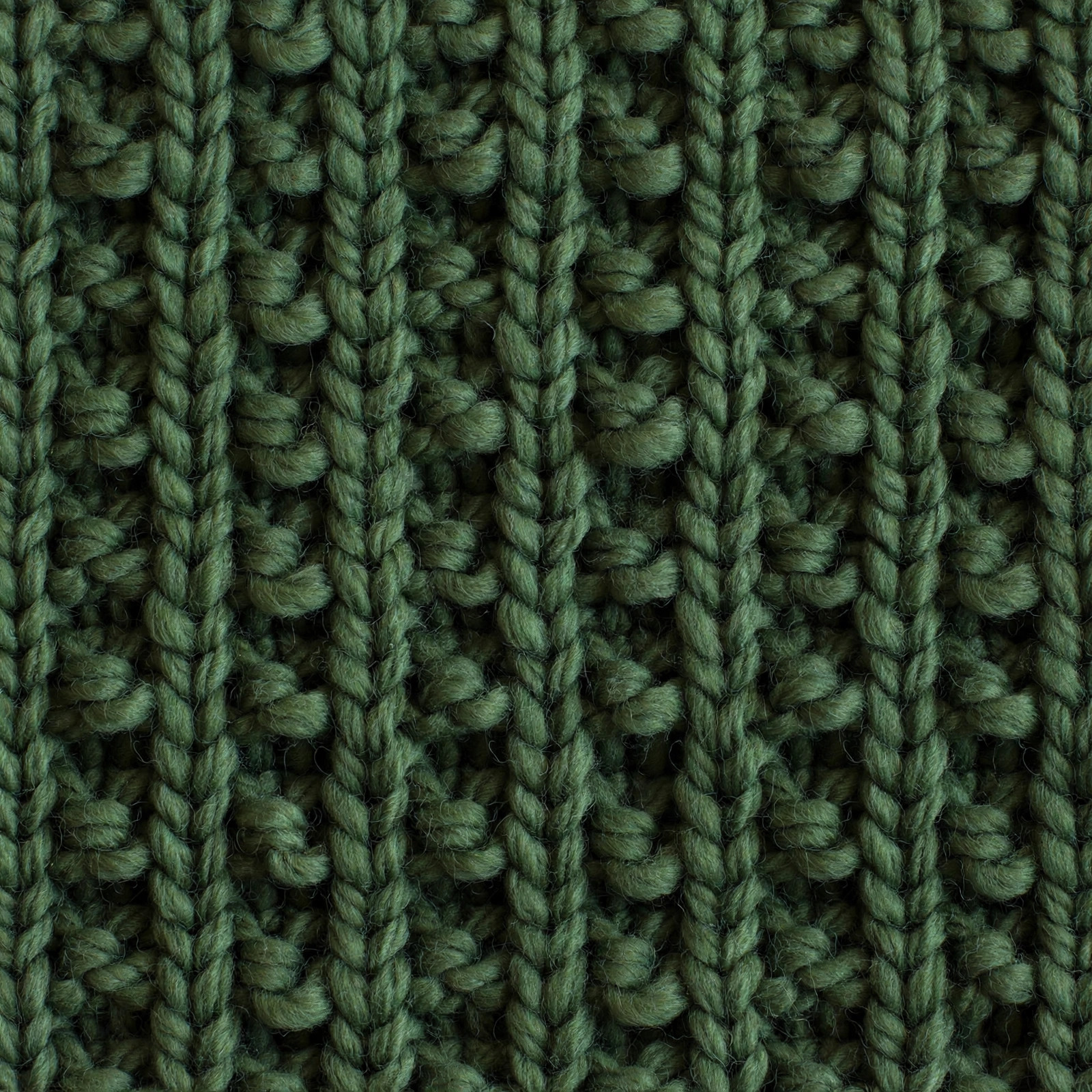
Take a 1×1 rib — the elastic, columned structure of cuffs and sweater bodies — and teach one of its needle beds to hesitate. On some courses a bed does not knit its stitches cleanly through; instead it tucks, gathering a new strand of yarn into the loop it is already holding. That single change, repeated across the fabric, turns plain rib into the cardigan structures — the softest, widest of the classic double-bed knits, and the structures cardigan jackets were traditionally knitted in.
A note on the name. “Cardigan” is first of all a garment — the open-front, buttoned sweater named for the Earl of Cardigan. These structures carry the name because half and full cardigan were the standard machine structures for knitting that garment: their spongy, body-holding hand suits a jacket-weight knit. The word names the garment first and the stitch plan second — a cardigan-structure fabric can become a sweater, dress or throw, and most cardigan garments today are knitted in other structures entirely.
Cardigan structures, defined. Both are derivatives of 1×1 rib knitted on two needle beds. In half cardigan, one bed knits every course while the other bed alternates knit courses with tuck courses. In full cardigan, the two beds take turns: each bed alternates knit and tuck courses, staggered between the beds. Everything else — the width, the softness, the bulk — follows from where the tucks fall.
The two structures behave differently, so each gets its own section: jump to Half Cardigan or Full Cardigan. Both grow from the rib and tuck stitches in Knit Stitches & Structures, within the weft-knit family of Weft Knitting vs Warp Knitting.
Half Cardigan: Tuck on One Bed
How it is knitted. The repeat is two courses. On the first course both beds knit a normal 1×1 rib course. On the second course the front bed knits again, but the back bed tucks: every back-bed needle takes the new yarn into its hook without knocking over the loop it already holds, so the new strand is gathered in as a tuck loop alongside the old one. On the next rib course that doubled loop is finally knitted through and cleared. The plan below draws each course as two rows — back bed above, front bed below — over four wales.
What the one-sided tuck does. Because only one bed accumulates yarn, the two faces of half cardigan are not alike. The always-knitting face keeps a fairly regular rib appearance; the tuck side shows the gathered loops as a softer, blurred texture that breaks up the rib columns. The fabric is noticeably wider and thicker than the same rib knitted plain — the held tuck loops push the wales apart and add a second strand of yarn to every second course on one side — and it keeps most of rib’s widthways stretch while feeling altogether more cushioned. It is not perfectly balanced — a large panel can bias gently toward the tuck side — so it is most often used where one face is the show face: sweater bodies, cardigan fronts and jacket knits.
Full Cardigan: Tuck on Both Beds
How it is knitted. The repeat is four courses. Courses one and three are plain rib courses with both beds knitting. On course two the back bed tucks while the front bed knits; on course four the front bed tucks while the back bed knits. Each bed therefore works the same rhythm — knit, knit, knit, tuck — but staggered by two courses, so the tuck courses alternate between the beds.
What the two-sided tuck does. With tucks gathered on both beds, full cardigan is the widest, thickest and spongiest of the rib family. Both faces look and feel essentially the same — a softened, rounded rib texture with no clear right or wrong side — and the fabric is balanced, lying flat without the one-sided bias of the half structure. It is also the costliest to produce: tuck courses consume extra yarn on both beds, accumulated loops slow the machine, and the fabric yields less area per kilo of yarn than rib or half cardigan. What the extra yarn buys is hand-feel — a lofty, cushioned softness that reads as quality the moment a garment is picked up.
Properties: Why Tuck-on-Rib Is Spongy, Wide and Soft
Three effects combine. First, yarn content: every tuck adds a strand that a plain knit course does not carry, so a cardigan structure simply contains more yarn — and more trapped air between its doubled loops — than rib at the same gauge. Second, geometry: a tuck loop is not drawn tight through the old loop, so it sits open and rounded, pushing its neighbouring wales apart; that is why cardigan fabrics knit up so much wider than the rib they are based on, and why their courses pack closer together lengthways. Third, recovery: the held loops act like small springs — squeeze the fabric and they compress, release it and they push back. That springiness, on top of rib’s natural widthways elasticity, is the sponge in the hand.
- Width and weight — markedly wider and heavier than plain rib from the same yarn and gauge; pattern calculations must allow for the extra width or the garment comes out oversized.
- Stretch and recovery — strong widthways stretch inherited from rib, with a softer, less snappy recovery; lengthways stretch is reduced by the packed courses.
- Warmth — the doubled loops trap still air, making cardigan structures among the warmest of the classic sweater knits at a given yarn size.
- Balance — full cardigan lies flat and even; half cardigan is slightly one-sided and best kept to garments with a defined face.
Uses
The structures earned their name in cardigans and knit jackets, and outerwear-weight knitwear is still their home: button-front cardigans, sweater jackets, coatigans and blazer-style knits that need body without stiffness. Full cardigan’s identical faces suit unlined jackets and reversible pieces; half cardigan serves where a single show face is enough, including dresses and skirts that want rib’s stretch with a softer snap. In chunkier gauges the same plans produce throws and cushion covers with a deeply cushioned hand. The tuck principle behind them — hold the yarn, gather it, knit it through later — is also the engine of the textures on Tuck-Stitch Textures, and of jacquard knits, where tucks are placed stitch by stitch rather than across a whole bed.
Recognising the Structures
Spread a suspect fabric flat and look at the columns. Plain rib shows crisp, separate wales that pull in tightly; a cardigan structure looks like rib that has relaxed and swollen — the columns rounder and less distinct. Check both faces: alike on both sides points to full cardigan; a clearer rib face against a softer, blurred face points to half. A gentle widthways pull is the final test — cardigan structures extend easily and spring back with a slow, cushioned recovery quite unlike the tight snap of plain rib.
Common Questions
- What is the difference between half cardigan and full cardigan?
- Both are 1x1 rib structures with tuck stitches. In half cardigan only one needle bed tucks, on alternate courses, so the two faces of the fabric differ. In full cardigan both beds tuck in turn, staggered over a four-course repeat, so the fabric is balanced and both faces look and feel the same — and it is wider, thicker and spongier still.
- Is a cardigan structure the same thing as a cardigan sweater?
- No. The cardigan sweater is a garment — an open-front, buttoned knit. Half and full cardigan are machine-knit stitch structures named after that garment because they were traditionally used to knit it. A cardigan-structure fabric can be made into many garments, and most cardigan sweaters today are knitted in other structures.
- Why do cardigan structures feel spongier than rib?
- A tuck stitch gathers an extra strand of yarn into a held loop instead of drawing it tight. Those open, doubled loops push the wales apart, trap air and compress and recover like small springs. Built into a rib base, that produces the width, bulk and cushioned softness the cardigan structures are known for.
- Which cardigan structure is warmer?
- Full cardigan, slightly. It tucks on both beds, so it holds more yarn and traps more air than half cardigan in the same yarn and gauge. Both are warmer than plain rib of the same yarn, because the tuck loops add thickness without adding stiffness.
- Are cardigan structures difficult to knit?
- They are standard work for a double-bed (rib) machine with tuck capability — a V-bed flat machine or a circular rib machine — but they knit more slowly than plain rib and use more yarn, because the tuck courses accumulate loops that must be cleared on a following course. They cannot be knitted on a single-bed machine.
More Knit Structures
- Knit Stitches & Structures — the parent guide: the four basic stitches and the main structures built from them
- Tuck-Stitch Textures — waffle and blister knits: the tuck stitch used for surface texture instead of bulk
- Milano Rib — another firm double-bed rib derivative, built from rib and jersey courses without tucks
- Ponte di Roma — a stable double-knit structure for structured garments, from the same two-bed family
- Purl Knit Structure — the links-links structure, alternating knit and purl courses on one bed set
- Weft Knitting vs Warp Knitting — the two machine families of knitting, and where rib-based weft structures sit
Back to Knit Stitches & Structures
This page is one part of Knit Stitches & Structures, Apparel Search’s deep guide to the structures inside the Knitwear Construction Guide series on how knitted fabric is made.
Search Apparel Search