Children's Flip Flops Guide
Children's flip flops are the simplest sandals a child can wear: a flat sole held on the foot by a thong strap that passes between the first two toes and anchors to the sole at three points. There is no upper, no fastening and almost no structure, and that simplicity is the whole point - a pair slips on in a second at the pool, the beach, the campsite shower or the back door, keeps bare feet off hot, rough or wet ground, and rinses clean under a tap. This guide explains what to look for, how soles and straps differ, how to size a pair that stays on, and where flip flops are the right footwear and where they are not.
Shop Children's Flip Flops Now
Shop Children's Flip Flops on Amazon Shop Children's Flip Flops on eBayThe Amazon and eBay links on this page are affiliate links. If you make a purchase through them, Apparel Search may earn a commission.
Children's flip flops are the simplest sandals a child can wear: a flat sole held on the foot by a thong strap that passes between the first two toes and anchors to the sole at three points. There is no upper, no fastening and almost no structure, and that simplicity is the whole point - a pair slips on in a second at the pool, the beach, the campsite shower or the back door, keeps bare feet off hot, rough or wet ground, and rinses clean under a tap. This guide explains what to look for, how soles and straps differ, how to size a pair that stays on, and where flip flops are the right footwear and where they are not.
Read more about flip flops as a style. This guide stays on the children's product: the sole compounds and strap materials below, the fit questions that decide whether a young child keeps a thong sandal on at all, and the practical limits - running, climbing, cycling, long walks - where an open, unsecured sandal stops being protection and a closed shoe takes over. Bought for the right jobs, flip flops are the hardest-working few ounces in a child's summer wardrobe.
Styles and Construction
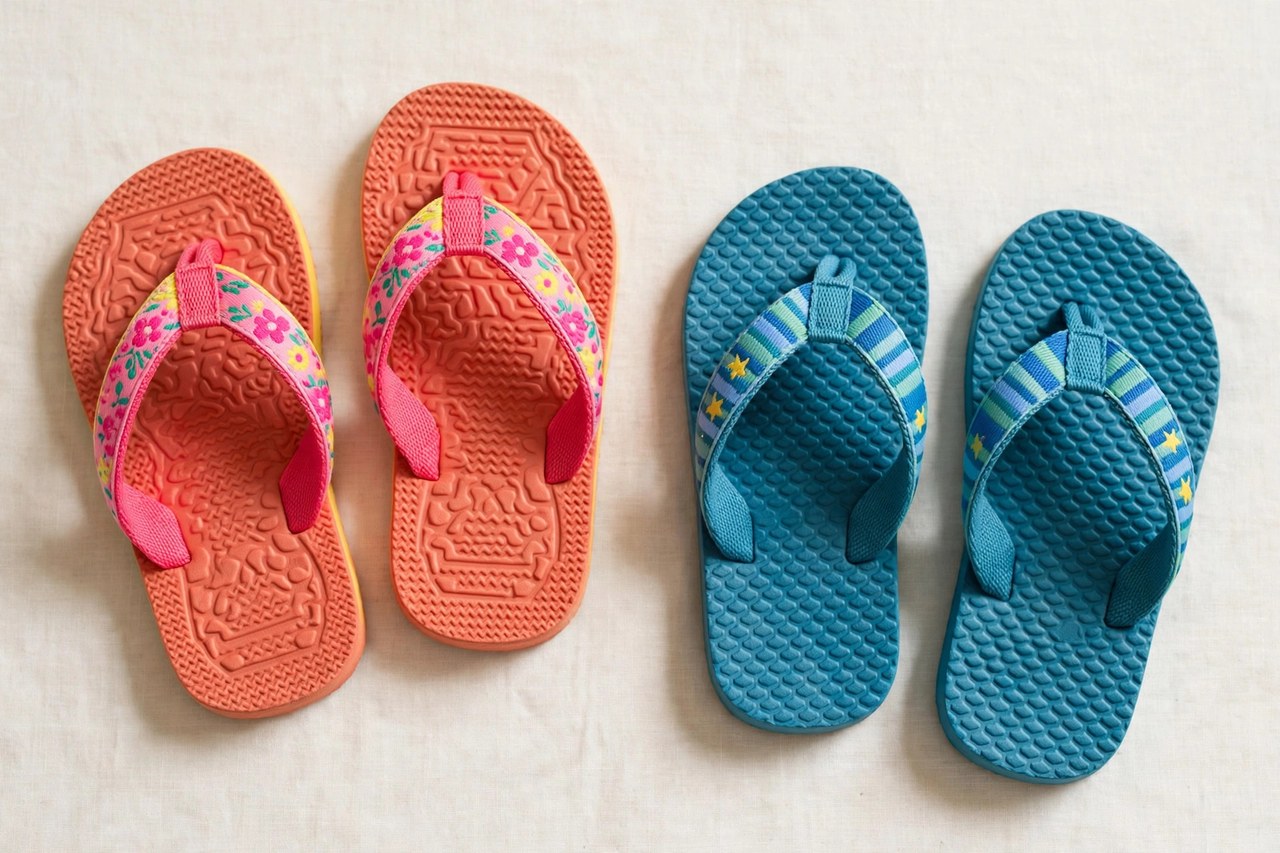
The sole decides comfort and lifespan. Basic foam soles - EVA and similar compounds - are light, cheap, float in the pool and compress flat within a season of regular wear. Denser rubber and moulded soles cost more, keep their cushioning, and carry tread patterns that grip wet tiles and pool decks instead of skating on them. A slight texture or arch moulding on the footbed helps a small foot stay centred on the sole; a completely smooth, flat footbed lets the foot slide forward until the toes hang over the front edge. Thickness matters too: a very thin sole transmits every pebble on a gravel path, while a chunkier sole handles rougher ground between the car and the water.
Straps divide into the plain rubber thong, softer fabric or padded straps that are kinder between the toes, and - the important variation for younger children - styles with an added back strap or heel elastic that holds the sandal on a toddler's foot. A pure thong stays on by toe grip alone, which children under about five often cannot sustain for long; a back-strap version is technically a sandal rather than a true flip flop, but it does the same poolside job without being left behind on the path every twenty steps. Decorated straps and printed footbeds are decoration only - judge the pair by sole density, tread and strap comfort first.
Fit and Sizing
Fit in flip flops is mostly length. The child's heel should sit fully on the sole with a small margin behind it, and the toes should end just short of the front edge - toes overhanging the front catch on steps and rough ground, while a sole far too long trips the wearer at the back. The thong should sit comfortably between the toes without pulling the foot sideways, and the straps should lie against the top of the foot without digging: a strap that only touches at one hard point will rub a sore spot within an afternoon. Have the child walk, turn and walk up a slope in the pair before keeping it, because flip flops fail in motion, not standing still.
Match the pair to the child's stage as honestly as to the size chart. Toddlers and new walkers are better served by closed sandals with heel support for everyday wear, with flip flops kept for very short, supervised stretches on flat ground. Confident walkers handle a thong pair for pool, beach and garden use well. Whatever the age, flip flops are not running shoes, playground shoes or cycling shoes: the unsecured sole comes off under exactly the forces those activities apply, and a child chasing a ball in flip flops is a fall waiting for a place to happen. Buy them as water-and-short-distance footwear and they are excellent; ask more of them and they are not.
Wearing and Care
Care could hardly be simpler, which is part of the appeal. Rinse sand, salt and pool water off after use, let the pair air-dry out of direct fierce sun - which perishes foam and fades straps - and scrub textured footbeds with an old toothbrush when grit builds up in the tread. Check the thong's anchor plug under the sole regularly: it is the single point of failure on every pair, and a plug that has pulled partway through or worn thin will let go under load, usually mid-stride. A pair with a compressed, paper-thin sole has also finished its job - the cushioning and tread are gone even if the straps survive.
Keep a spare pair where the main pair gets used - beach bag, swim kit, caravan or locker - because a lost or broken flip flop cannot be improvised and bare feet on hot tarmac end outings early. Name-label the footbed in permanent marker for school and camp pools, where identical pairs multiply. Bought with a dense, treaded sole, straps that do not rub, a back strap for the youngest wearers and a clear understanding of what they are for, children's flip flops do a small job completely - and ask almost nothing in care in return.
Common Questions
Are flip flops good for children to wear all day?
Not as everyday footwear. Flip flops have no heel support, no fastening and a flat, flexible sole, so feet work hard just keeping them on. They are excellent for pools, beaches, showers and short stretches on flat ground. For school days, long walks, playgrounds and sport, a secured sandal or shoe with a fitted heel counter protects the foot far better.
Do young children need a back strap on flip flops?
Usually, yes. A pure thong sandal stays on by toe grip alone, which most children under about five cannot sustain - the pair gets left behind every few steps. A back strap or heel elastic keeps the sandal on a small foot for the same poolside and beach jobs, and can be dropped once the child walks confidently in a plain thong pair.
How can you tell when children's flip flops are worn out?
Check two things: the sole and the thong anchor. A sole compressed thin, smooth where its tread used to be, no longer cushions or grips. The plug where the thong anchors under the sole is the pair's single failure point - if it has pulled partway through or worn thin, replace the pair before it lets go mid-stride.
More in Children's Clothes Guide F
The F letter hub and the guides closest to this one:
Looking for Children's Clothing Stores?
This guide helps you choose children's flip flops. To browse where to buy, visit our children's clothing store directory, where you can find retailers that carry them.