Children's Footwear Guide
Children's footwear is everything a child wears on their feet - everyday shoes, school shoes, sneakers, boots, sandals and dress shoes - and it is the most fit-critical clothing category in this entire guide. A child's foot is not a small adult foot: the bones are still forming, much of the structure is cartilage in the early years, and a shoe that fits badly does its harm quietly and continuously, every school day it is worn. This guide explains what to look for, how children's feet are measured and sized, how the main footwear families divide the work, and how to check fit at home between purchases.
Shop Children's Footwear Now
Shop Children's Footwear on Amazon Shop Children's Footwear on eBayThe Amazon and eBay links on this page are affiliate links. If you make a purchase through them, Apparel Search may earn a commission.
Children's footwear is everything a child wears on their feet - everyday shoes, school shoes, sneakers, boots, sandals and dress shoes - and it is the most fit-critical clothing category in this entire guide. A child's foot is not a small adult foot: the bones are still forming, much of the structure is cartilage in the early years, and a shoe that fits badly does its harm quietly and continuously, every school day it is worn. This guide explains what to look for, how children's feet are measured and sized, how the main footwear families divide the work, and how to check fit at home between purchases.
This letter also carries a dedicated flip flops guide, and the relationship between the two pages is deliberate: this guide is the system - measuring, sizing, construction and care across every kind of children's footwear - while the flip flops guide goes deep on the one open summer style. Read this page first for how feet and sizes work, then use the individual style guides for the specifics of a single purchase. Almost every footwear mistake families make is a system mistake - measuring rarely, sizing by age, keeping shoes past their fit - rather than a style mistake.
Measuring and Sizing
Measure feet in the afternoon, standing, in the socks the shoes will be worn with: feet spread and lengthen under weight and across the day, and a morning, sitting measurement understates both. Measure both feet - most children have one foot measurably longer - and size to the longer one. A well-fitted shoe leaves roughly a thumb's width, about a centimetre, of growing room beyond the longest toe, with the widest part of the foot sitting at the widest part of the shoe and the heel held without slipping. More room than that is not a saving; an oversized shoe lets the foot slide, trips the wearer and wears unevenly.
Children's shoe sizes are not standardised between brands - a size in one make is a different length in another - so treat sizes as starting points and the measured foot length, which better brands print alongside, as the real guide. Expect to re-measure often: feet grow fastest exactly when children are least able to report a tight shoe, roughly every few months for toddlers and at least twice a year through primary school. The home check is simple - the child stands, you press the toe box: if the longest toe is against the end, the shoes are done, whatever the calendar says and however good they still look.
The Main Footwear Families
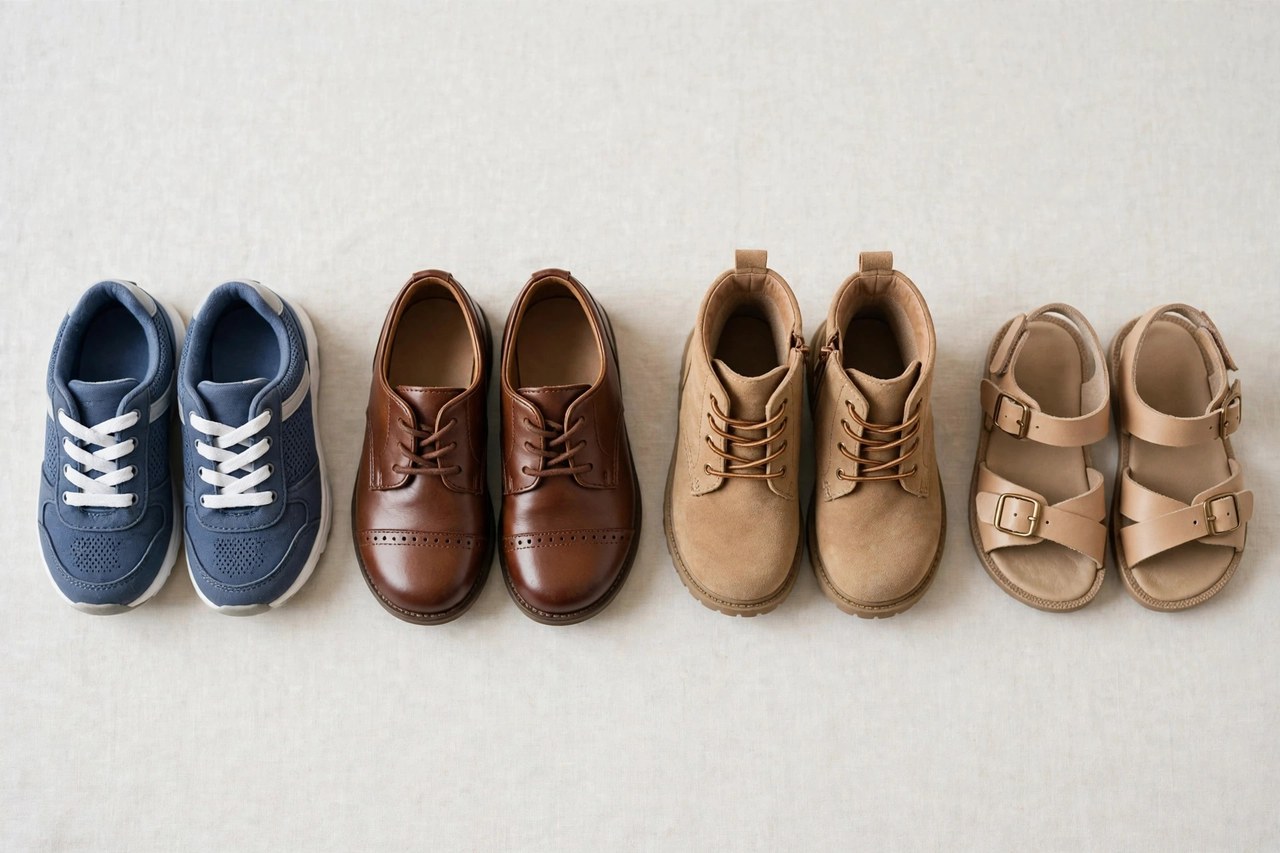
Everyday and school shoes carry the heaviest duty: a supportive heel counter, a sole that flexes at the ball of the foot rather than in the middle, a fastening - laces, straps or touch-fastening - that holds the heel in place, and a breathable upper. Sneakers divide into fashion pairs, fine for ordinary days, and true sports shoes built for running and court movement, which a child doing serious sport should actually have. Boots trade the shoe's neatness for coverage: ankle support and weather protection in winter and rain styles, with waterproof membranes and tread doing the real work. Sandals range from secured, closed-toe styles fit for everyday summer wear down to this letter's flip flops, which sit at the minimal end of the range.
Dress shoes, covered in more depth by the formal clothes guide's occasion wardrobe, are the family most often bought in a hurry and worn least - which makes fit checks more important, not less, because a child cannot break in a stiff pair across a single wedding or recital. Across all families the construction checks are the same: stitching or bonding sound at the sole, no rough seams inside where toes and heels rub, an insole that can be removed to check size against the foot, and a sole neither so stiff the foot cannot roll nor so soft it offers no protection on rough ground.
Care, Rotation and Replacement
Two pairs in rotation outlast two pairs worn in sequence: a day's rest lets cushioning recover and damp insides dry, which is why a school pair plus a second everyday pair is the practical minimum wardrobe for most children. Clean according to the upper - brush and polish leather, wipe synthetics, wash fabric sneakers only if the maker allows it - and dry wet shoes at room temperature with paper inside, never on a radiator, which cracks leather and warps soles. Check heels and soles for uneven wear; a shoe consistently worn down on one edge is information about how the child walks, worth mentioning at the next health check if it persists.
Replace on fit first and condition second: outgrown shoes go, however new they look, and shoes with a collapsed heel counter, a sole worn smooth, or uppers splitting at the flex point have finished structurally even if the size still serves. Handing shoes down needs honesty - a lightly worn, still-supportive pair in the right size is a reasonable economy, a pair moulded and worn down by another child's feet is not. Measured regularly, bought by length rather than label, rotated where possible and retired on fit, children's footwear does the quiet, essential job underneath every other guide in this letter.
Common Questions
How often should children's feet be measured?
Roughly every few months for toddlers and at least twice a year through primary school - feet grow fastest when children are least able to report tightness. Measure standing, in the afternoon, in wearing socks, and measure both feet: size to the longer one. At home, press the toe box while the child stands; a longest toe against the end means the shoes are done.
How much growing room should children's shoes have?
About a thumb's width - roughly a centimetre - beyond the longest toe, with the heel held without slipping and the widest part of the foot at the widest part of the shoe. More room is not a saving: an oversized shoe lets the foot slide forward, trips the wearer, rubs and wears unevenly, so buy for fit now plus that centimetre, not for next year.
Can children's shoes be handed down?
Sometimes. A lightly worn pair that still has a firm heel counter, an unworn tread pattern and the correct measured size can be a reasonable economy. A pair moulded to another child's feet, worn down on one edge, or with a collapsed structure should not be passed on - and fit, checked by measurement, always outranks condition: outgrown shoes go however new they look.
More in Children's Clothes Guide F
The F letter hub and the guides closest to this one:
Looking for Children's Clothing Stores?
This guide helps you choose children's footwear. To browse where to buy, visit our children's clothing store directory, where you can find retailers that carry them.