Children's Infant & Toddler Socks Guide
Socks are the smallest garments in the wardrobe and the most frequently purchased, lost, and argued about - the argument being between the parent, who puts them on, and the baby, who regards removing them as a developmental milestone. Start with the wearer's sense of humour: infants and toddlers might have a sense of humor but can do little more than giggle, and it is very possible you would get a giggle from them if you considered novelty socks. It is a sound buying principle - at this age, socks are one of the few garments whose wearer genuinely notices the design.
Shop Children's Infant & Toddler Socks Now
Shop Children's Infant & Toddler Socks on Amazon Shop Children's Infant & Toddler Socks on eBayThe Amazon and eBay links on this page are affiliate links. If you make a purchase through them, Apparel Search may earn a commission.
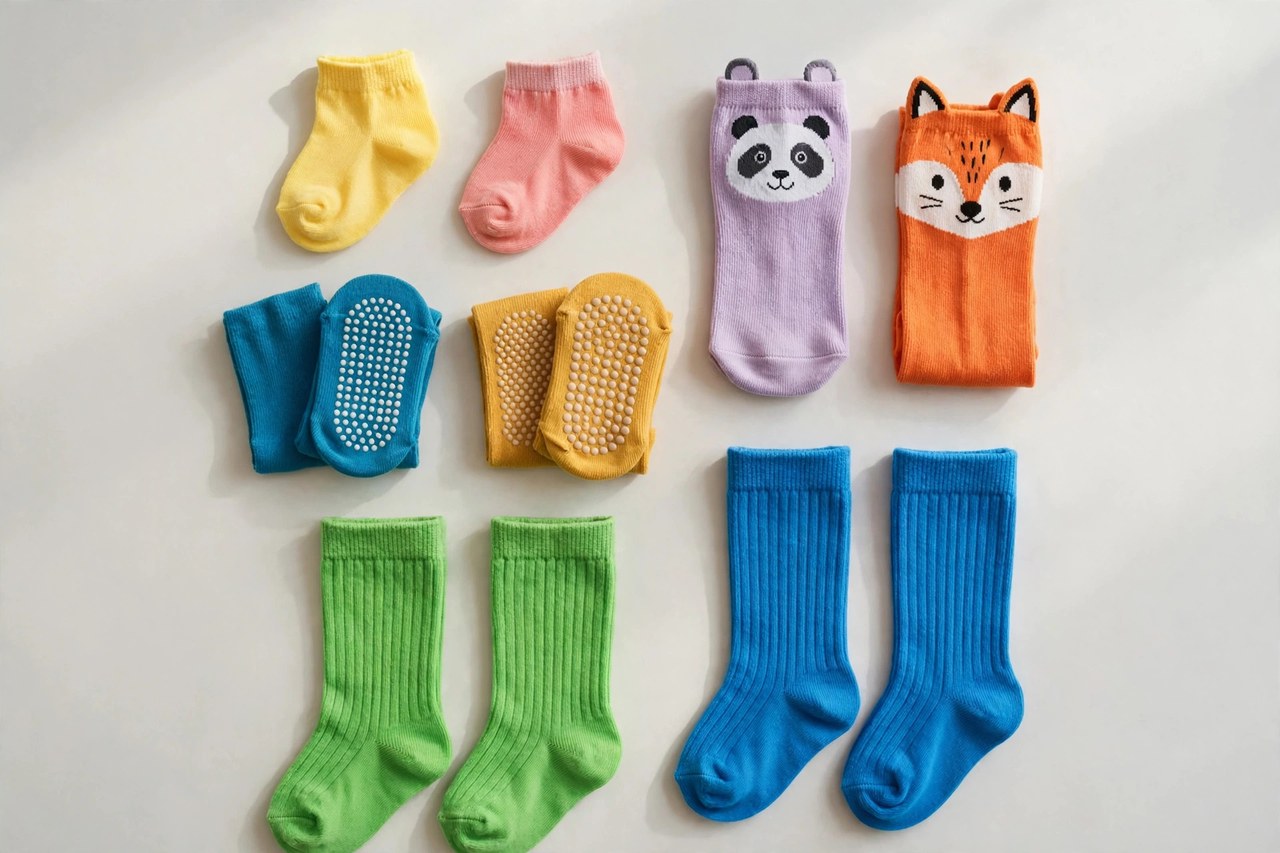
Socks are the smallest garments in the wardrobe and the most frequently purchased, lost, and argued about - the argument being between the parent, who puts them on, and the baby, who regards removing them as a developmental milestone. Start with the wearer's sense of humour: infants and toddlers might have a sense of humor but can do little more than giggle, and it is very possible you would get a giggle from them if you considered novelty socks. It is a sound buying principle - at this age, socks are one of the few garments whose wearer genuinely notices the design.
Beneath the novelty, socks do real work: warmth for feet that cannot be blanketed safely in every setting, grip for new walkers on hard floors, a barrier inside shoes, and the layer that decides whether a shoe fits well or rubs. The category divides into stay-on engineering for babies, grip technology for toddlers, and the eternal logistics of pairs.
Staying On: The Baby Sock Problem
Baby feet are tapered, active and sock-hostile: the classic baby sock departs within minutes. The designs that stay use a combination of a shaped heel pocket, gentle ribbing at the ankle and enough length up the leg to fold or grip - and even the best are rated in hours, not days. Socks built into pants and footed garments exist because the problem is, at root, unsolved, and experienced parents carry a spare pair in every bag as the pragmatic answer.
Fit helps: a sock sized to the foot stays better than a generous one, and the toe seam should be flat and placed over, not at the ends of, the toes. Check the inside elastic thread ends, which can wrap a tiny toe - any loose loop inside a baby sock is trimmed or the sock is retired, no debate.
Grip Socks and the Walking Year
When a baby begins standing and cruising, the sock acquires a sole: grip dots or patterns in silicone or rubber across the ball and heel. On hard floors these are safety equipment, turning the household's most treacherous surfaces back into practice space, and they are the reason many first steps happen in socks rather than shoes. Grip wears smooth with washing and time; a grip sock that has gone slick is just a sock, and should be demoted before the floor delivers the news.
Shoe socks for toddlers are thinner, cushioned at the sole, and cut in ankle, crew and knee lengths for different shoes and seasons. The sock is part of every shoe fitting - a thick sock in a fitted shoe is a size error wearing a disguise - and the blister rule applies from the first walks: any redness at heel or toe is a sock-or-shoe problem to solve that day.
Novelty, Pairs and the Laundry Treaty
Novelty socks - animal faces at the toes, rattles in the infant versions, characters and joke designs for toddlers - earn their premium honestly: they are played with, noticed, and (in the rattle sock's case) developmental toys that encourage a baby to find her feet. Buy the novelty for the top of the drawer and the plain multi-packs for the base of it.
Logistics close the subject: buy socks in identical multi-packs so that any two survivors make a pair, wash them in a mesh bag, and accept the category's entropy with good grace. Socks are the wardrobe's consumable - priced like it, lost like it, and replaced like it - and the families at peace with baby socks are the ones who stopped expecting pairs to be a permanent condition.
Common Questions
How do you keep socks on a baby?
Choose a shaped heel pocket, gentle ankle ribbing and the correct size - and carry spares. Even the best baby socks are measured in hours; footed garments exist because the problem is never fully solved.
When does a baby need grip socks?
From standing and cruising onward, on hard floors. The grip pattern gives traction for first steps; when it wears smooth, demote the pair before it causes a slide.
How do you stop baby socks disappearing in the wash?
Buy identical multi-packs so any two socks pair up, and wash them in a mesh laundry bag. Treat socks as a consumable rather than a kept wardrobe item.
More in Children's Clothes Guide I
The I letter hub and the guides closest to this one:
Looking for Children's Clothing Stores?
This guide helps you choose children's infant & toddler socks. To browse where to buy, visit our children's clothing store directory, where you can find retailers that carry them.