Women's Petite Blouses Guide
A petite blouse fits a shorter torso and narrower shoulders — sleeves end at the wrist, darts sit at the bust and prints are scaled down, so nothing needs tucking, rolling or pinning to look right.
Shop Women's Petite Blouses Now
Shop Women's Petite Blouses on Amazon Shop Women's Petite Blouses on eBayThe Amazon and eBay links on this page are affiliate links. If you make a purchase through them, Apparel Search may earn a commission.
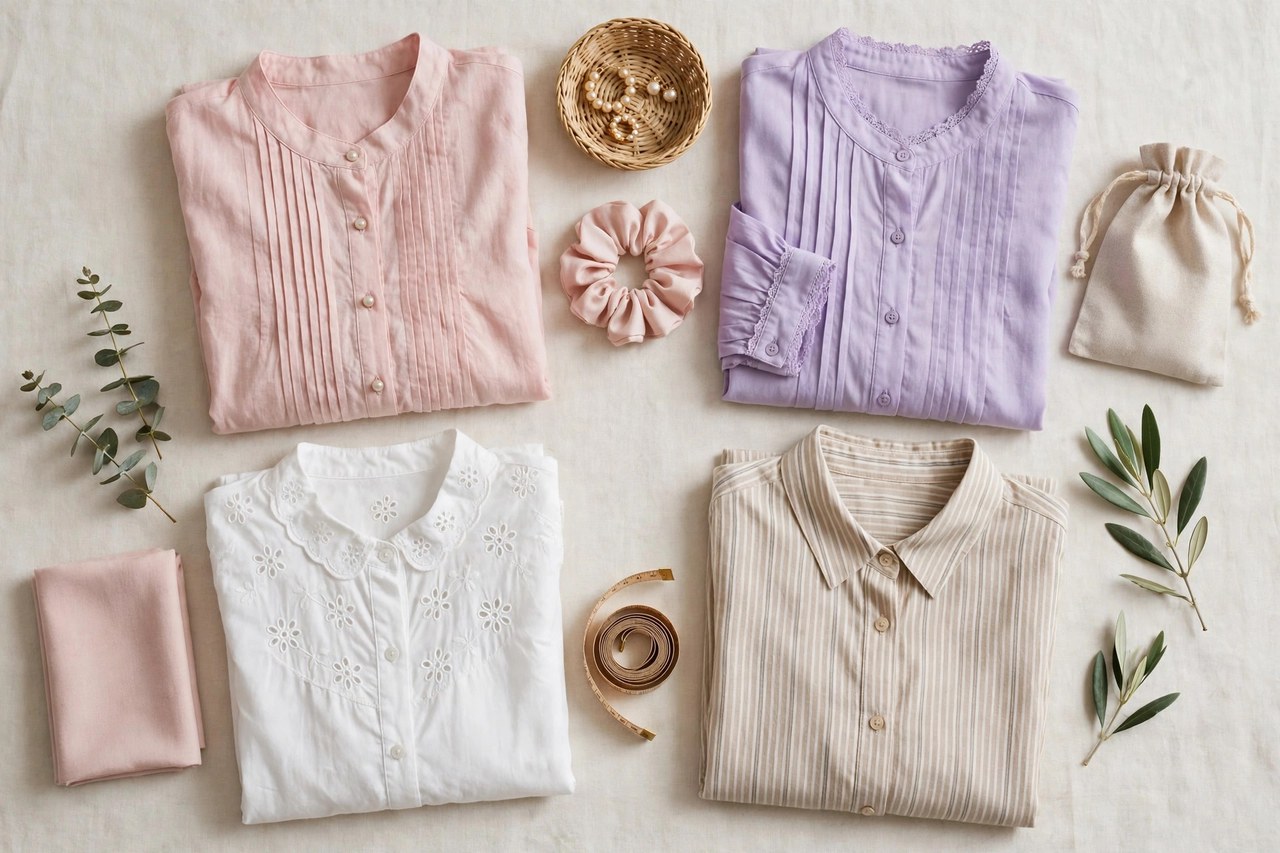
A blouse is a soft, usually dressier top, and in a petite cut it is re-proportioned for women 5'4" and under in the places where regular blouses most visibly fail. The shoulder seam sits on the shoulder instead of sliding down the arm, the sleeve ends at the wrist bone instead of the knuckles, bust darts point at the bust, button plackets do not gape from misplaced spacing, and the hem ends at the hip bone rather than mid-thigh. Each fix is small; together they are the difference between polished and borrowed.
This guide covers the main petite blouse styles, from tailored shirts to wrap and peasant blouses, how petite pattern adjustments work, which fabrics and print scales flatter a smaller frame, and the tucking and fit rules that make a blouse work with petite trousers, skirts and jeans. If you have ever pushed your sleeves up out of necessity rather than style, this is the category where petite buying pays for itself fastest.
What Changes in a Petite Blouse Pattern
Manufacturers shorten a petite blouse by roughly an inch in body length and sleeve length, narrow the shoulder by about half an inch, raise the armhole and reduce its circumference, and move bust darts and waist shaping up to match a shorter torso. Necklines are shallowed slightly so a V or scoop lands at the intended point rather than plunging, and collars, cuffs, pockets and button sizes are scaled down so the details match the garment instead of overwhelming it.
Print and stripe scale is part of the pattern, too. Petite ranges reduce motif size and stripe width, because a large-scale floral or a wide stripe engineered for a taller frame can occupy the entire front of a petite blouse with a single repeat. When you shop regular blouses, the warning signs are consistent: shoulder seams beyond the shoulder bone, sleeves covering the thumb, a waist seam or peplum landing at the hip, and pockets sitting at the stomach. A petite cut corrects all four at once.
Styles: Shirts, Wraps, Shells and Soft Blouses
The petite tailored shirt-blouse is the workhorse: a scaled collar, a placket with closer button spacing that resists gaping at the bust, and cuffs that button at the wrist. The wrap and faux-wrap blouse is especially kind to petites because the tie defines the waist wherever it truly is and adjusts through the day; in petite sizing the wrap point and tie length are shortened so the ends do not hang to the knee. Shells and sleeveless blouses need petite armholes most of all — cut higher and smaller so they neither gape nor show underpinnings.
Peasant, smocked and tie-neck blouses carry volume and detail that must be moderated at petite scale: less gathering, smaller ruffles, shorter ties and elbow or three-quarter sleeves that end at a slim point of the arm. Tunic blouses are the riskiest style for petites; choose petite tunics that end just below the hip bone and pair them with slim bottoms, since a regular tunic on a short torso reads as a dress that lost its way. Three-quarter sleeves, offered widely in petite ranges, are a natural ally, ending at the forearm's narrowest point.
Fabrics and Print Scale
Silk, silk blends and fluid polyester crepes drape close and add no bulk to a small frame, making them the default dressy choice; petite silk blouses also place their smaller buttons and finer plackets in keeping with the fabric. Cotton poplin and lawn give crisper shirts that hold a collar, while rayon and viscose offer fluidity at lower cost but crease readily and can shrink — check petite length after washing before committing to a size. Knit blouses in fine jersey follow the body and forgive small fit differences, but need the petite armhole and length to avoid a sloppy hem.
For prints, favor small to medium motifs, narrow stripes and compact checks at petite scale, and place one statement print per outfit. Vertical details lengthen: a placket line, pin-tucks, a narrow tie neck falling straight, or fine vertical striping. Avoid a single huge placement print centered on a short torso, wide horizontal bands at the hem, and heavy embellishment at the shoulder, all of which widen or shorten the read of the body. Solid colors with texture — crepe, seersucker, dobby — are the safest petite investment.
Fit Checks, Tucking and Care
Check a petite blouse in this order: shoulder seam on the bone, armhole high enough to lift your arm without the whole blouse rising, buttons closed at the bust without pulling, sleeve at the wrist bone, and hem at or above the hip bone so it tucks without bulk. A blouse that will be tucked into petite trousers or a skirt should be long enough to stay tucked when you sit — petite lengths are designed for exactly this balance against a shorter rise, which regular blouses overshoot with excess fabric bunching at the waistband.
Care follows fabric: silk and viscose prefer gentle or hand washing and low heat, cotton tolerates more, and all blouses last longer hung on narrow or petite hangers that support the shoulder at its true width. Button before washing to protect plackets, and iron or steam collars and cuffs first, since scaled details wrinkle visibly. Buy your first petite blouses in white, a soft neutral and one scaled print that works with your existing bottoms; the fit difference will make them the most reached-for tops you own.
Related Women's Guides
Looking for Women's Clothing Stores?
This guide helps you choose women's petite blouses. To browse where to buy, visit our women's clothing store directory, where you can find retailers that carry them.