Pattern Making & Fitting · Darts
Dart Manipulation
The pattern maker's central trick: the bust dart's shaping power can be moved anywhere around the bodice — shoulder, side seam, armhole, neckline — or turned into seams and gathers, without changing the fit at all.
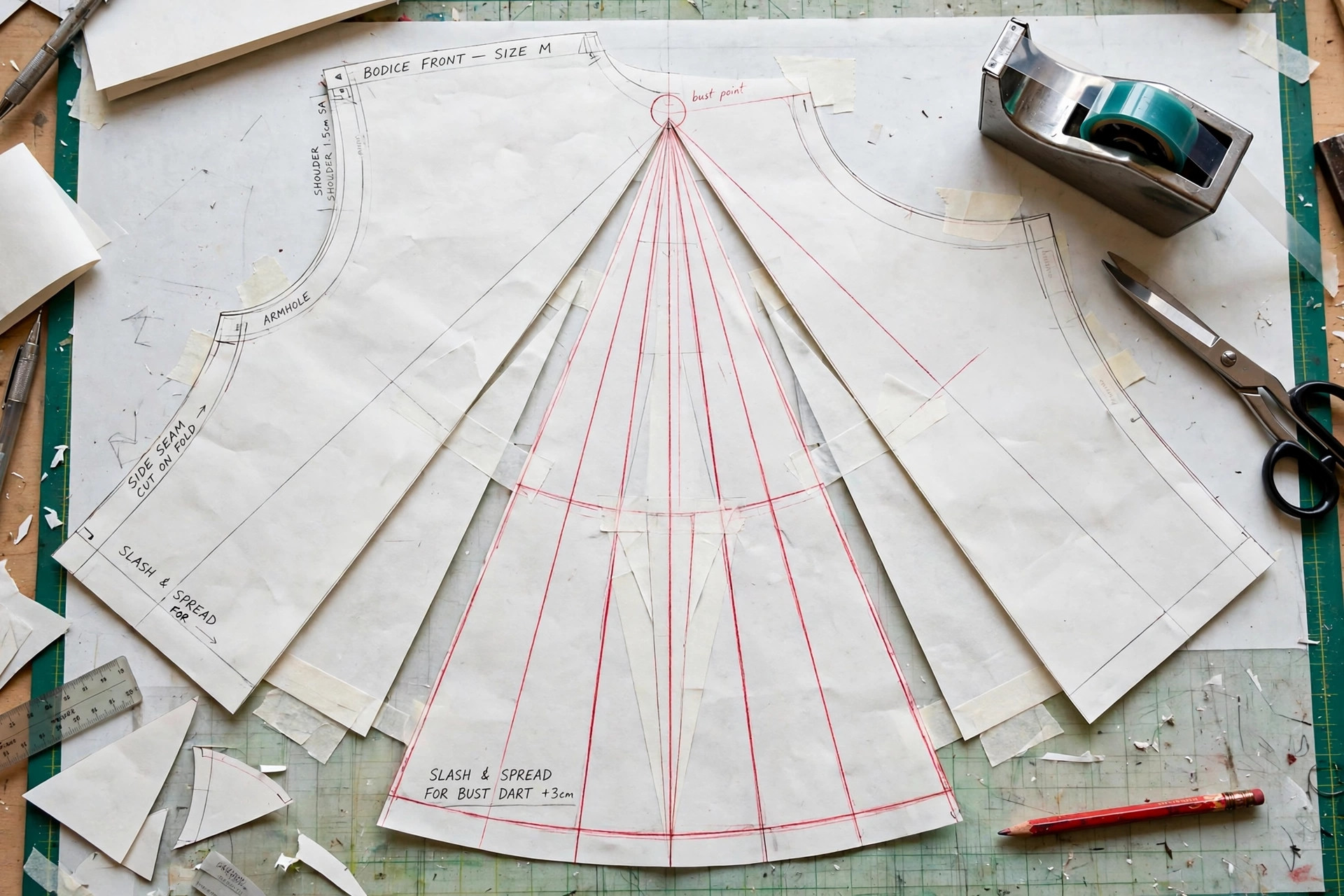
Of all the techniques in the Pattern Making, Draping & Fitting guide, dart manipulation is the one that turns a pattern maker into a designer. It rests on the conservation rule introduced in Flat Pattern Drafting: for a given fit, the total wedge of fabric removed around the bust is fixed by the body's measurements — but where that wedge is removed is entirely up to you. Every dart radiates toward the same pivot point, the bust apex. Swing the wedge around that pivot and the identical fit reappears wearing a completely different style: a classic waist dart becomes an elegant shoulder dart, a chic French dart low at the side seam, a pair of neckline darts, or no visible dart at all once the wedge is absorbed into a princess seam.
Method One: Slash-and-Spread
The cut-paper method is the clearest way to learn, because the transfer of fullness is physically visible.
Mark the New Dart Position
On a copy of the bodice block (never the master block), draw a line from the chosen new dart location on the pattern's edge — say, the midpoint of the shoulder seam — straight to the bust point.
Slash to the Bust Point
Cut along the new line from the edge to the bust point, stopping a hair short so a paper hinge remains. Also cut along one leg of the existing dart to the same point, leaving the same small hinge.
Close the Old Dart
Fold the old dart shut, bringing its two legs together, and tape it closed. As it closes, the slash along the new line spreads open — by exactly the angle of the old dart. Conservation is not a theory here; you can watch it happen.
Draw the New Dart
Tape paper behind the spread wedge. The new dart's point is marked on the center line of the wedge, backed off from the bust point — typically half an inch to an inch for a bust dart — and its legs are drawn from that point to the spread edges. Fold the new dart closed in the direction it will be pressed and re-draw the seam line across it so the edge is smooth, then true the whole piece.
Method Two: The Pivot Method
The pivot method achieves the same transfer without cutting. The block is placed on fresh paper and pinned through the bust point. Starting from one side of the existing dart, the outline is traced until the tracing reaches the first dart leg; then the block is rotated — pivoted on the pin — until the second dart leg meets the traced line, which closes the old dart and opens the new space by the same amount. Tracing continues section by section, pivoting at each marked point, until the whole outline, with the dart relocated, is on the paper. Pivoting is quicker for a single straightforward move and keeps the block intact, but slash-and-spread handles divided darts, added fullness and seam conversions more transparently — which is why it remains the teaching standard.
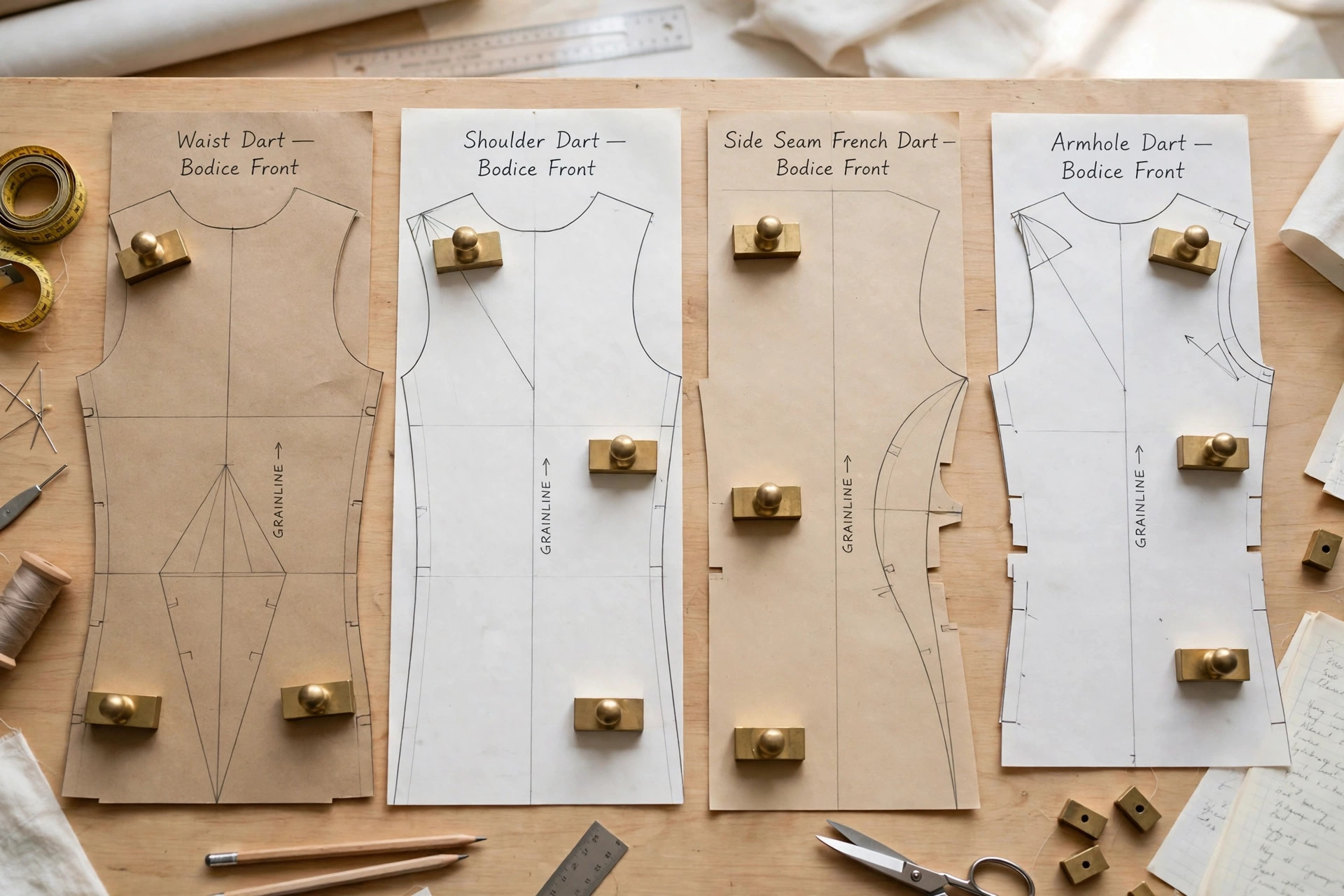
The Classic Moves
Waist to shoulder moves the dart into the shoulder seam, where it can be sewn as a dart, eased, or converted to soft gathers — a staple of blouses. Waist to side seam, placed low and angled up toward the apex, gives the French dart, which shapes and slims in one diagonal line. Waist to armhole hides the shaping in the armscye, common in sleeveless styles. Waist to neckline splits naturally into small twin darts or gathers at the neck. The intake can also be divided — half left at the waist, half moved — whenever one very large dart would be bulky or hard to press, and it can be combined: many fitted bodices carry the whole intake in a single waist dart for a clean, uninterrupted front.
From Darts to Seams: The Princess Conversion
The most useful manipulation is the one that deletes the dart as a dart. Draw a style line through the bust point from shoulder (or armhole) to hem, slash the pattern apart along that line, and close both the waist and side darts: their intake becomes the shaping built into the curved seam itself. The result is the princess line — two pattern pieces whose seam does the fitting work of the darts invisibly. The same trick converts darts into yokes, panels and any seam that passes near the apex, which is why so many pattern developments begin with the question: where can a seam pass?
When the Wedge Becomes Fullness
Manipulation can also change dart intake into added fullness, a different operation that must not be confused with a simple move. If the pattern is slashed and spread without closing an existing dart, the wedge that opens is new fabric — gathers, flare or pleats — and the garment gets bigger at that point. Designers combine both operations constantly: close the waist dart into the shoulder (a move), then slash the hem and spread further (an addition) for a blouse that is fitted at the shoulder and full at the hem. Keeping the two operations conceptually separate — moves conserve, additions create — prevents the classic beginner's error of a "moved" dart that mysteriously changed the fit. Any change of intake is a fitting change, and belongs with the adjustments in Pattern Fitting Adjustments.
More in Pattern Making, Draping & Fitting
Common Questions
Does moving a dart change the fit of the garment?
No — that is the point of dart manipulation. The total dart intake (the wedge of fabric removed to shape the bust) stays exactly the same; only its position changes. A bodice whose waist dart is moved to the shoulder fits the same body in the same places, because both darts remove the same amount of fabric and both point at the bust apex. Fit changes only when intake is added, removed, or redistributed between front and back.
What is the difference between slash-and-spread and the pivot method?
Slash-and-spread physically cuts the paper pattern: the old dart is slashed closed and the pattern is cut open to the bust point along the new dart line, spreading a wedge of exactly the old dart's size at the new position. The pivot method keeps the paper whole: the block is pinned at the bust point and rotated on paper, tracing section by section, so the old dart closes as the new one opens by the same amount. Both give identical results; slash-and-spread is easier to learn and to use for dividing darts, while pivoting is faster for simple moves once mastered.
Why does the finished dart point stop short of the bust apex?
A dart stitched all the way to the apex creates a sharp, pointed cone — a 1950s bullet silhouette — because the fabric runs out exactly at the fullest point. Real busts are rounded, so the dart point is backed off, typically by about half an inch to an inch for the bust (less on small darts), letting the fabric curve softly over the apex instead of peaking at it. The manipulation itself is always done to the apex; only the final drawn dart is shortened.
Can darts be removed completely for a loose style?
The dart intake cannot vanish, but it can change form. In loose styles the waist dart is often dropped and its intake becomes wearing and design ease — the bodice simply hangs straighter and looser. Bust shaping can likewise be eased into a seam or gathered rather than darted. What you cannot do is remove the intake and keep the same close fit: something — a dart, a seam, gathers or looseness — must account for the difference between bust and waist.
Back to Pattern Making, Draping & Fitting
The Pattern Making, Draping & Fitting hub maps the whole craft — drafting, draping, darts, fitting, muslins and finishes — with links to every guide in this cluster.