Pattern Making & Fitting · Drafting
Flat Pattern Drafting
How foundation patterns — blocks and slopers — are plotted on paper from body measurements, how darts give flat fabric its shape, and how a fitted block becomes the starting point for every style that follows.
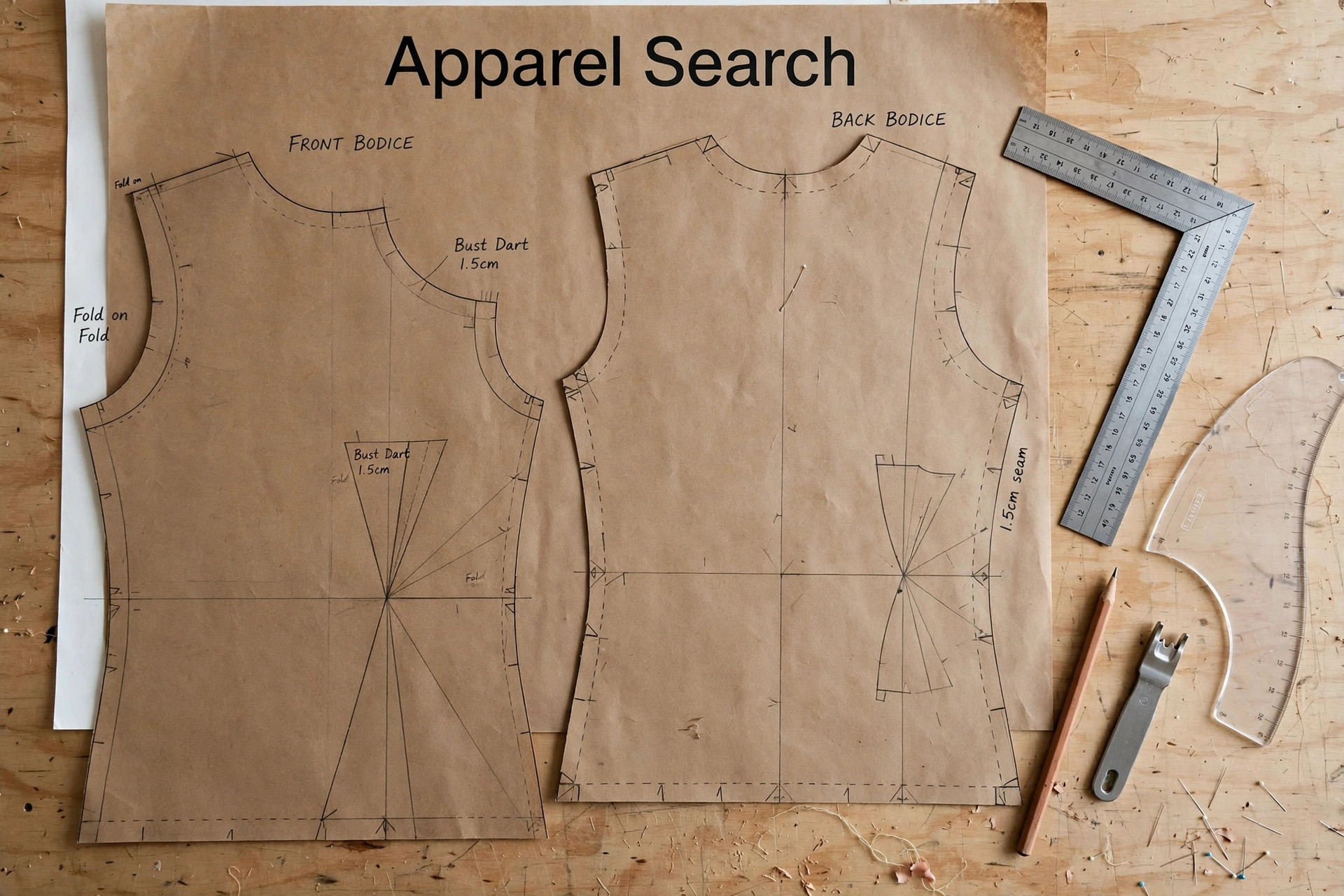
Flat pattern drafting is the systematic half of the Pattern Making, Draping & Fitting craft: instead of shaping cloth on a body, the pattern maker shapes paper on a table, plotting the garment as a geometry problem whose inputs are body measurements. Done well, drafting is fast, repeatable and endlessly adaptable — one well-fitted set of blocks can generate a whole wardrobe of styles. Done carelessly, it produces patterns that are mathematically plausible and unwearable. The difference is understanding what each line on the draft actually represents.
The Block: A Pattern With the Style Removed
A block — called a sloper in much of the American trade — is a garment stripped to its fitting skeleton. The bodice block is a close-fitting, sleeveless torso with darts at bust and waist and nothing else: no collar, no pockets, no closure styling. The skirt block is a straight tube shaped by waist darts; the trouser block adds the crotch curve; the sleeve block is a plain tube with a shaped cap. Each is drafted to a specific set of measurements, sewn in muslin, fitted once, and corrected. From then on, the block is trusted: style is added to it by the methods in the dart manipulation guide, never by re-drafting from scratch. The terminology of blocks, slopers and their parts is defined in the pattern-making glossary.
Drafting the Bodice Block, in Outline
Every drafting system — metric, imperial, or the proprietary systems of the big pattern houses — follows the same logic, even when the arithmetic differs.
Set Up the Frame
A rectangle is drawn from the key circumferences: its width comes from the bust measure (divided between front and back, with the front usually taking the larger share), its length from the nape-to-waist and waist-to-hip measures. Bust, waist and hip lines are ruled across as the reference grid every later point hangs from.
Plot the Fixed Points
Neck width and depth, shoulder length and slope, and armhole depth are plotted from their measurements. These are the body's bony landmarks, and they change least between figures — which is why a block can be wrong in the soft places and still be rescued, but rarely the reverse.
Shape the Curves
Neckline, armhole and (on the skirt and trouser) hip and crotch curves are drawn with French curves and hip curves, blending the plotted points into smooth, sewable lines. A curve that looks elegant but kinks at a join will sew into a pucker.
Place the Darts
The difference between the bust and waist circumferences must go somewhere, and in a block it goes into darts: a waist dart front and back, and a bust dart that aims at the bust point. The dart intake — the total wedge removed — is fixed by the measurements; only its position is a design choice, which is the whole subject of dart manipulation.
True the Draft
Seams that will be sewn together are walked against each other to confirm equal length; curves are smoothed across joins; dart legs are folded and the seam line re-drawn over the folded dart so the edge is continuous. Trueing is unglamorous and non-negotiable.
Dart Theory in One Paragraph
A dart is a triangular wedge taken out of flat fabric so the fabric can bend around a projection of the body — bust, shoulder blade, hip, elbow. The wider the wedge (the greater the intake), the sharper the resulting cone of shape. All the fitting darts of a bodice radiate toward one point, the bust apex, and their total intake is determined by the difference between bust and waist measure. You can move that intake around the body, split it between several darts, or convert it into seams, gathers or ease — but for the same fit, you cannot create or destroy it. That conservation rule is the single most useful idea in pattern making.
The Tools of the Drafting Table
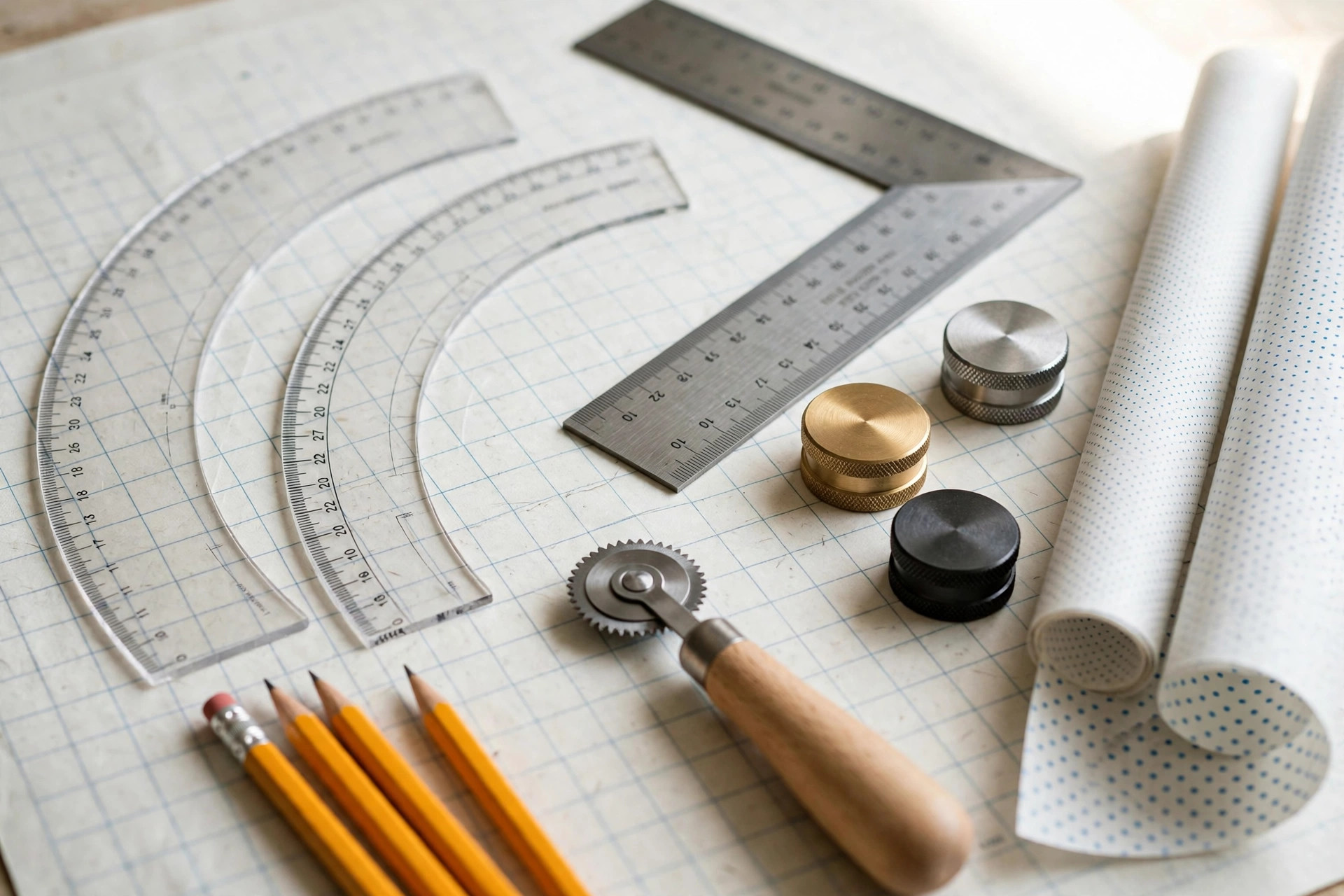
Drafting asks little in equipment but much in precision. The essentials are a large flat table; pattern paper (plain, dotted or kraft); a long straight ruler and an L-square or T-square for the frame; French curves and a hip curve for the shaped lines; a sharp pencil and a notcher and pattern punch for marking; and an awl or tracing wheel for transferring points. Patterns meant to be used repeatedly are transferred to oak tag or card, which survives years of pinning and tracing. Commercial patterns are drafted digitally today, but the geometry is identical — CAD software plots the same frame, points and curves, and the pattern maker who learned on paper reads a screen draft with the same critical eye.
From Block to Style — and to Other Sizes
A fitted block is capital. A neckline is lowered by redrawing one curve; a waist dart becomes a princess seam by the slash method; a straight skirt gains flare by slashing and spreading the hem. Each transformation is a small, controlled edit of the trusted foundation, and the muslin-and-fitting loop described in the muslins and fitting guide verifies it. What drafting does not do is multiply one size into many: scaling a fitted pattern into a size range is grading, with its own rules about which points move and which never do, and it is covered in the pattern grading guide in the Sizing cluster. Likewise, the room a draft builds in beyond the tape measure — wearing ease and design ease — is treated fully in Ease Explained.
More in Pattern Making, Draping & Fitting
Common Questions
What measurements do I need to draft a bodice block?
A bodice block is drafted from bust, waist and hip circumferences, back waist length, shoulder length, armhole depth and the front and back widths, plus the height of the bust point and its distance from center front. Accurate drafting depends on careful measuring: circumferences taken level and snug but not tight, and lengths taken over the curves they will cover.
What is the difference between a block and a pattern?
A block (sloper) is the plain foundation: close-fitting, without style lines, pockets, collars or seam allowances, fitted to a figure or a standard size. A pattern is what the block becomes after style is added — darts moved, fullness introduced, necklines and sleeves changed — and after seam allowances, facings and all markings are finalized for cutting and sewing.
Why do drafted patterns include ease?
A body is not a statue: it breathes, bends, sits and reaches. Wearing ease is the extra room built into a block beyond the body measurements so the garment can move with the wearer; design ease is the additional fullness a style calls for. A block drafted exactly to body measurements would fit like a second skin and tear at the first deep breath.
Do I draft with seam allowances included?
Blocks are drafted and manipulated without seam allowances, so the stitching lines stay exact while darts are moved and pieces are slashed and spread. Seam allowances are added at the end, when the pattern is finalized, and the amounts vary by seam: typically wider at side seams and center back for fitting insurance, narrower on enclosed edges such as necklines and facings.
Back to Pattern Making, Draping & Fitting
The Pattern Making, Draping & Fitting hub maps the whole craft — drafting, draping, darts, fitting, muslins and finishes — with links to every guide in this cluster.